




 The teacher who took education to the stage: Abdulla Avloni and the birth of modern Uzbek theatre

Support Novastan, the European Central Asia magazine
By supporting Novastan, you are supporting the only English, French and German-language media specialising in Central Asia. We’re independent and we need your help to stay that way!In early twentieth-century Turkestan, a group of Muslim reformers turned to theatre to challenge social conventions and promote education. Among them was Abdulla Avloni, a teacher, poet and pioneer of modern Uzbek theatre who, like his fellow reformers, saw the stage as a school for adults. Drawing on rare archival programmes and photographs, Abbosbek Mominov explores how Avloni and the Turon troupe brought new ideas to audiences across the region, despite opposition from religious conservatives and the Russian colonial authorities.
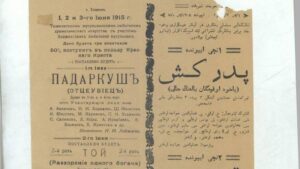
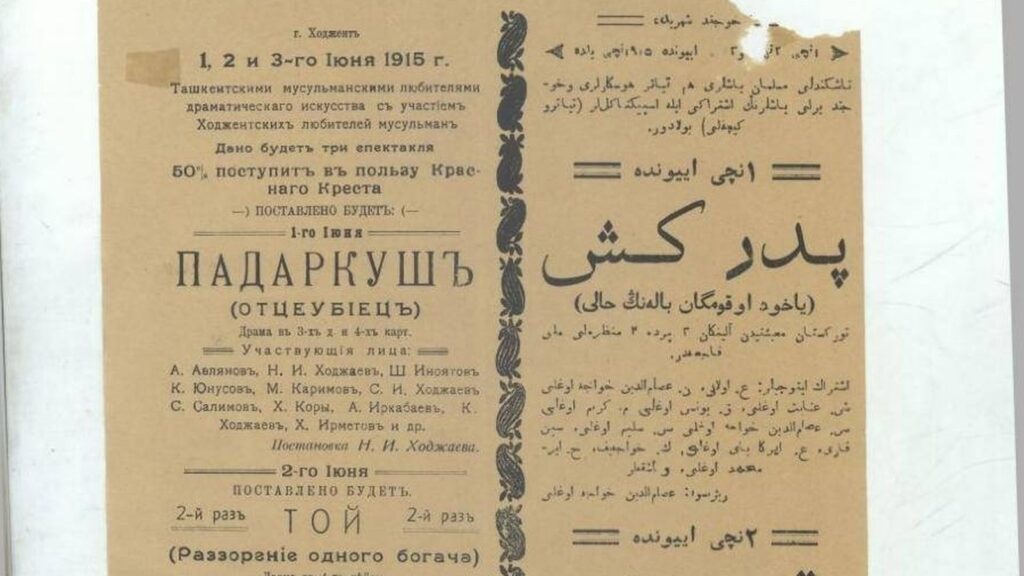
In early June 1915, a poster in Russian and Uzbek invited the public of Khujand, a town on the Syr Darya that then belonged to Samarkand province and today lies in northern Tajikistan, to three evenings of theatre. “Tashkent Muslim amateurs of dramatic art”, joined by local performers, would stage Padarkush (The Parricide) on 1 June, To‘y (The Wedding), which the Russian half of the poster called The Ruin of a Rich Man, on 2 June, and a new play, Badbaxt kelin (The Unhappy Bride), on 3 June. Half the proceeds were to go to the Red Cross. The poster is now preserved in the Abdulla Avloni Memorial Museum in Tashkent. The first name in every cast list is “A. Avlyanov”, the Russian spelling of Abdulla Avloni, and the third play was staged by him. Avloni was a schoolteacher, poet and textbook author, and one of the founders of the Tashkent amateur theatre troupe known as Turon.
A teacher touring with a theatre company was an unusual sight in Turkestan at the time. The region had its own popular performers, but no established tradition of European-style drama. The word most people knew for an actor was maskhara, the jester of street shows and wedding feasts, and no respectable man wished to be called one. Yet in the years just before the First World War, a group of Muslim reformers decided that their society needed a stage. Why a teacher like Avloni took part in this endeavour, and what it cost him and his fellow reformers, reveals much about how they hoped to change their world.
Who were the Jadids?
These reformers were known as Jadids, from usul-i jadid, the “new method” of teaching children to read through sounds rather than rote memorisation. From the 1890s onwards, they opened schools, newspapers and publishing houses, convinced that Muslims in the Russian Empire could overcome what they regarded as backwardness through modern knowledge.
Read more on Novastan: Who Made the Nations of Central Asia?
In Turkestan, which Russia had governed as a colony since 1867, they faced pressure from two sides: a colonial administration suspicious of initiatives it did not control, and conservative religious scholars who saw the new schools as a threat to religion and to their own authority.
Read more on Novastan: From “Obey the Tsar” to the “Stalin School”: What Sixty Years of Textbooks Taught Children in Turkestan
Why a teacher needed a stage
Abdulla Avloni (1878–1934) studied at a traditional school and a madrasa in Tashkent, read the reformist press from his teenage years and later turned his own house into a new-method school. He wrote the readers Birinchi muallim (The First Teacher) and Ikkinchi muallim (The Second Teacher), as well as a book on ethics, Turkiy guliston yoxud axloq (The Turkic Rose Garden, or Ethics, 1913). In 1907, he launched the newspaper Shuhrat. With a print run of only about three hundred copies, it was closed by the authorities after ten issues.
Books and newspapers, however, could reach only those who could read, and literacy was limited in Turkestan. A play could speak to everyone in the hall. When the Turon troupe made its official debut in Tashkent on 27 February 1914, Avloni’s close friend Munavvar Qori Abdurashidxonov explained to the audience what they were about to see. Some people, he said, regarded theatre as mere clowning. In fact, its true meaning was “a house of lessons, or a school for adults”. He compared the stage to a room lined with mirrors, in which everyone could see their own virtues and faults and learn from them. Mahmudkhoja Behbudi of Samarkand, the author of Padarkush, expressed much the same idea in his journal Oyina: theatre was a place of instruction and preaching.
Read more on Novastan: Bukhara Before the Border: Aini and the Politics of Tajik-Uzbek Memory
Padarkush made the point without subtlety. A rich man refuses to send his son to school. Left idle, the boy drifts into drinking and bad company, eventually taking part in a robbery in which his own father is killed. In Tashkent, the father was played by Avloni, a man who had spent years persuading parents to send their children to his school and who now portrayed a father who would not. In a comedy he later wrote for the troupe, Advokatlik osonmi? (Is It Easy to Be a Lawyer?), the target was another familiar habit: a carter listens to flatterers, throws a lavish wedding feast and ends up in debt, close to losing his home.
An evening at the Colosseum
The Tashkent debut took place at the Colosseum, a hall with some two thousand seats. The programme had three parts. First came Padarkush. Then Azerbaijani actors, among them the director Aliasgar Askarov and an actress named Gulzar Khanum, performed a one-act comedy, Khor-khor. The evening ended with music and songs, including two songs set to Avloni’s own verses. In Padarkush, every role was played by a man, including that of the rich man’s wife. The only woman on stage that night appeared in the Azerbaijani comedy.
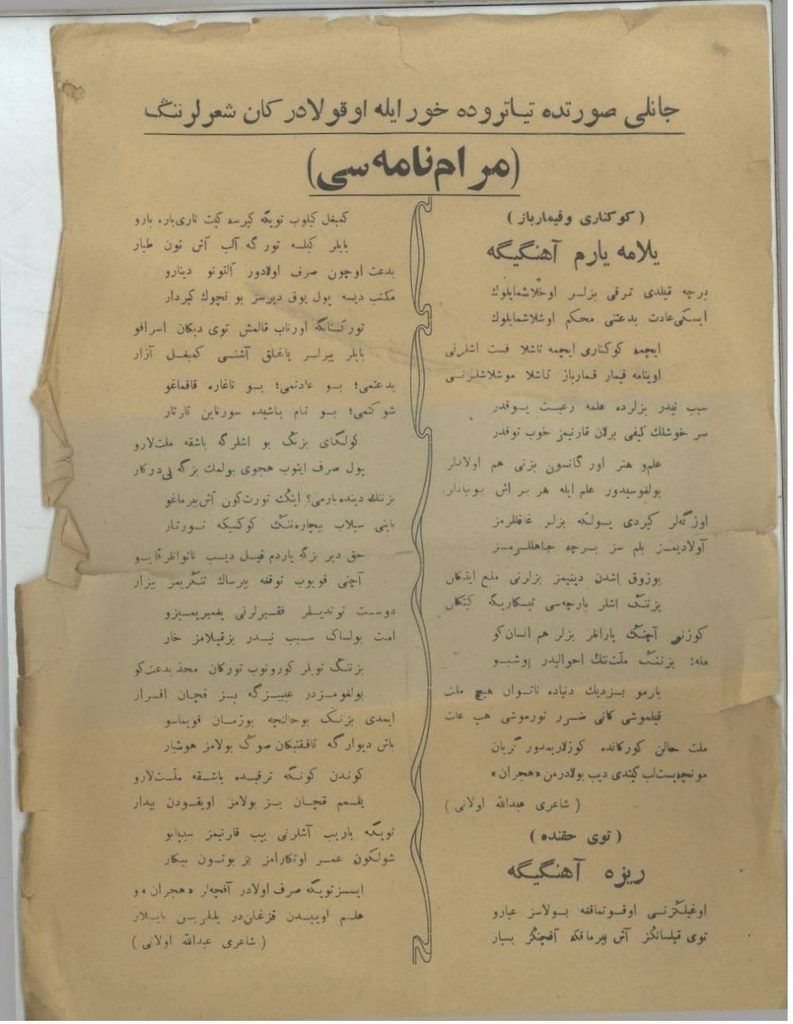
The hall was sold out. A reviewer in the Tashkent newspaper Turkiston viloyatining gazeti wrote that anyone familiar with theatre would hardly believe these actors had only just learned their craft, taking them instead for performers who had trained in Europe for years. For much of the audience, it was the first play they had seen in their own language, and it concerned a family much like those of their neighbours. Songs were also part of the attraction. Another printed sheet preserved in the Abdulla Avloni Memorial Museum gives the words of verses by Avloni that a chorus sang in the theatre as “living pictures”, each set to a tune the audience already knew. One, about an opium addict and a gambler, was sung to the popular melody Yalama yorim, while another concerned wedding feasts.
The actors were not paid. Every performance was also a fundraiser, with proceeds supporting reading rooms and new-method schools and, once the war had begun, wounded soldiers, the Red Cross and the Red Crescent. The Samarkand premiere of Padarkush in January 1914 raised more than 329 roubles for the town’s Muslim reading room. A performance of the same play in Khujand in January 1915 raised 590 roubles for the Red Crescent. Avloni’s passport, also preserved in the museum, was registered in Khujand and Kokand that same month.
The Azerbaijani connection
The Jadids of Turkestan did not build their theatre alone. Tatar and Azerbaijani companies had been touring the region since 1911, and a permanent Tatar troupe operated in Tashkent. Avloni himself had participated in Tatar theatre in the city since at least 1909. These companies performed in their own languages, however, and local reviewers complained that audiences found them difficult to follow. Munavvar Qori addressed this directly in his speech: Tashkent had seen several plays, but not one in the language of Turkestan.
Baku offered a model. In the same speech, Munavvar Qori described the Najot (Salvation) society there, whose theatre had improved public morals, supported the poor and helped establish some thirty village schools. If the Muslims of the Caucasus could have a theatre of their own, he asked, why not the Muslims of Turkestan? The answer came with Azerbaijani assistance: Askarov directed the Tashkent production of Padarkush, and Azerbaijani plays appeared alongside local works in the troupe’s repertoire from its first evening. The Abdulla Avloni Memorial Museum still holds a bound volume of eleven Azerbaijani plays printed in Baku and Ganja, including Khor-khor, the comedy performed that night.
The connection grew closer over time. In 1916, the Azerbaijani actor and director Sidqi Ruhulla brought his company to Tashkent and staged Uzeyir Hajibeyov’s Leyli and Majnun, first performed in Baku in 1908 and often described as the first opera of the Muslim world. A photograph in the museum shows the participants in the 1916 production, and the Baku edition of the libretto is also preserved in its collection.
Resistance from religious scholars and colonial authorities
None of this went unopposed. Behbudi wrote Padarkush in 1911, but the censors delayed its publication until 1913 and its first performance until 1914. Before the Tashkent debut, a number of local religious scholars and merchants asked the city authorities to ban the play. When that failed, they offered the troupe more money than the performance would have earned if it agreed not to go ahead. According to a contemporary observer, they feared that the actors, many of them teachers at new-method schools, would come to be seen as maskharas and lose their place in respectable society.
The argument then moved into print. In November 1914, Sayyid Ahmad Wasli, a madrasa teacher in Samarkand, argued in the Kokand newspaper Sadoi Farg‘ona that theatre was contrary to Islamic law, one of the forbidden amusements that wasted time and money and encouraged vice. Behbudi replied in Oyina the following month. He acknowledged that theatre was an innovation but argued that an innovation bringing benefits was a good one. A play that warned its audience against drunkenness and debauchery was, he wrote, a place of preaching.
The colonial authorities viewed these activities from another perspective. On 26 February 1914, the day before the Tashkent debut, Avloni applied to open a new school. The district school inspector wrote back asking which textbooks and curriculum he intended to use, together with the authors’ names and the places and years of publication. The stage was watched no less closely. Even a Tatar singer wishing to organise charity concerts in Turkestan in 1915 needed permission, and the acting governor-general referred the matter to the official Muslim religious board in Orenburg.
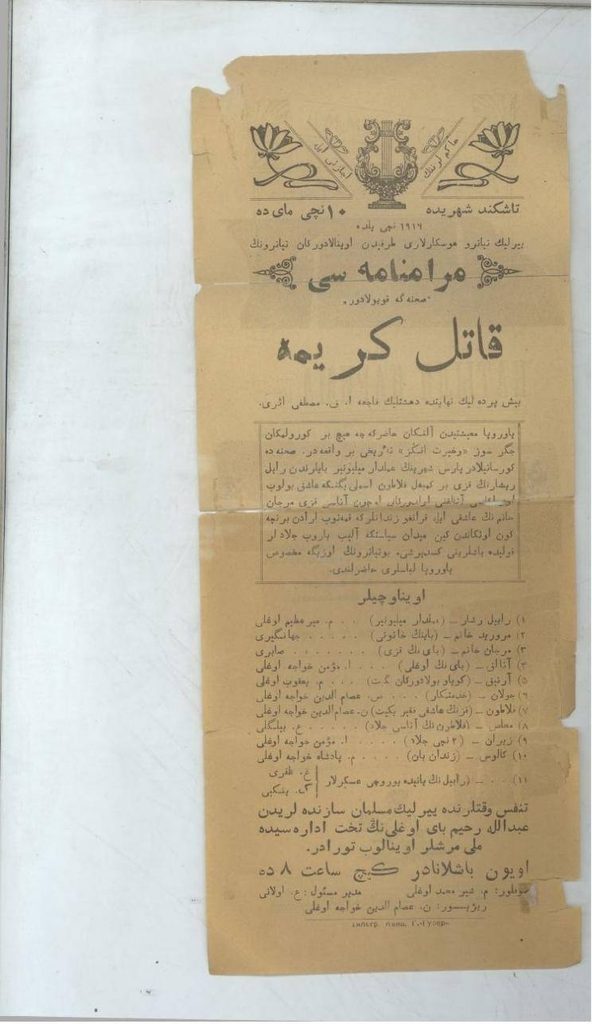
The museum preserves the programme of another such evening. On 10 May 1916, local Muslim amateurs performed Qotili Karima (The Murderer of His Daughter), a five-act melodrama set in Europe by A. F. Mustafa, at Tashkent’s Summer City Theatre. Its Azerbaijani edition, printed in Baku, is also held by the museum. One side of the programme is in Uzbek, the other in Russian, with the Russian text announcing that the play would be performed “in the Sart language”, a colonial designation for the local Turkic speech. The programme was printed by the press of the governor-general’s chancellery and names Avloni as “responsible manager”, the person answerable for the evening.
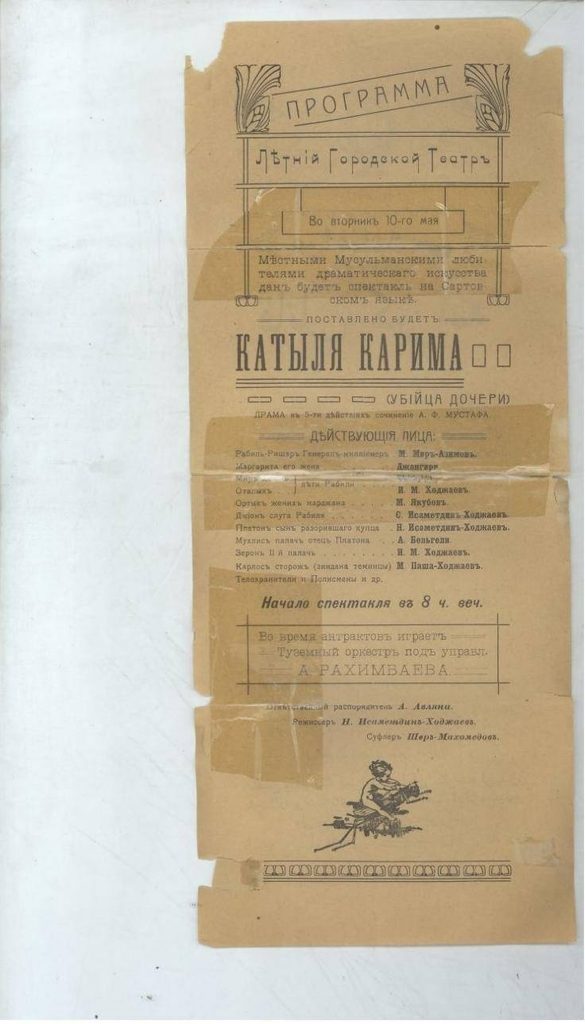
Theatre worked for the Jadids because it reached people whom print could not, in their own language and in a hall full of their neighbours, accompanied by music they already loved. It was controversial for the same reasons. It put respected men on stage like jesters, mixed preaching with entertainment and presented fathers, customs and money in an unflattering light before a paying public.
What remains of Avloni’s theatre
Also in 1916, the Tashkent group was formally constituted as the Turon Society of Amateurs of Dramatic Art. Its statute, comprising 73 articles, promised wholesome entertainment for the public, assistance for Muslims in need, new reading rooms and schools, and scholarships for talented young people.
After 1917, Avloni held positions in public education and administration and edited newspapers. In 1919–1920, he served in Afghanistan as a Soviet diplomat, and from 1930 until his death he headed the Department of Language and Literature at the Central Asian State University in Tashkent. He died in 1934, before the purges of 1937–1938 that claimed the lives of many of his fellow Jadids.
His troupe outlived the movement. Uzbekistan’s National Academic Drama Theatre in Tashkent traces its history to 1914 and the Turon troupe, and its centenary was marked by a presidential resolution in 2014. What survives of Turon on paper is scattered. The Abdulla Avloni Memorial Museum preserves the 1915 Khujand poster, the 1916 photograph, the programme of Qotili Karima and the sheet of Avloni’s songs, and its catalogue is now available online.
Read more on Novastan: A Theatre’s history (Osh)
In 1992, the national institute for teachers’ professional development in Tashkent was named after Avloni, and the museum housed within the institute is devoted to his legacy. In 2028, Uzbekistan will mark the 150th anniversary of his birth. It is easy to read the Khujand poster as a theatre document. It is just as much a school document: an announcement of lessons for adults, with a teacher among the cast.
Sources
Arranged by section. Titles are given in the original language.
Opening and “Who were the Jadids?”
Abdulla Avloni Memorial Museum, Tashkent (hereafter AAMM). Poster of three performances in Khujand, 1–3 June 1915, inv. AAM-0269. Online catalogue: https://www.avloniymuseum.uz/collection
Khalid, Adeeb. The Politics of Muslim Cultural Reform: Jadidism in Central Asia. Berkeley: University of California Press, 1998, pp. 129–132, 152–153.
Why a teacher needed a stage
Khalid 1998, pp. 96, 123, 127 (Avloni’s education, school and the newspaper Shuhrat).
Avloniy, Abdulla. Turkiy guliston yoxud axloq. Tashkent, 1913. Modern edition: Tashkent: O‘qituvchi, 1992.
Abdurashidxonov, Munavvar Qori. Speech at the opening of the Turon troupe, Tashkent, 27 February 1914. Turkiston viloyatining gazeti, 2 March 1914.
Behbudiy, Mahmudxo‘ja. “Teyotr nadur?” Oyina, 1914, no. 29 (10 May), pp. 550–553.
Allworth, Edward. “The Beginnings of the Modern Turkestanian Theater.” Slavic Review 23, no. 4 (1964): 676–687 (on the plot of Padarkush).
Egamberdiyev, Alisher. “Abdulla Avloniy jamiyatdagi ijtimoiy illatlarga qarshi qanday kurashgan?” UzA, 29 June 2026 (Avloni in the role of the father; Advokatlik osonmi?).
An evening at the Colosseum
Rizayev, Shuhrat. Jadid dramasi. Tashkent: Sharq, 1997, p. 64 (the programme of 27 February 1914), as summarised in Mirzayeva, Shahrizoda. “Jadid ma’rifatparvarlari davrida o‘zbek teatrining ilk bosqichi.” Oriens 4 (26), 2024, pp. 522–525.
Taziljanbaev. “Tashkanda milli tiyatir.” Oyina, 22 March 1914, p. 324. Cited in Khalid 1998, p. 152.
Egamberdiyev, Alisher. “‘Ibratxona’ga aylangan tomoshagoh: Behbudiy Turkiston uchun nega aynan teatrni tanladi?” UzA, 25 June 2026 (the review in Turkiston viloyatining gazeti).
Khalid 1998, pp. 130–131 (proceeds of the performances in Samarkand and Khujand).
AAMM. Programme of verses by Abdulla Avloni sung by a chorus in the theatre, inv. AAM-0271; Avloni’s passport book, 1910, with registrations of 1915–1919, inv. AAM-0256.
The Azerbaijani connection
Khalid 1998, pp. 129–131, 214.
Abdurashidxonov, speech of 27 February 1914 (see above).
AAMM. Photograph of the participants of Leyli and Majnun, Tashkent, 1916. Volume of eleven Azerbaijani plays (Baku and Ganja, 1908–1914), including Khor-khor, inv. AAM-0153; volume of Azerbaijani librettos and plays (Baku and Tiflis, 1912–1915), including Leyli and Majnun, inv. AAM-0246.
“Sidgi Ruhulla.” Kinobiz.az. https://www.kinobiz.az/en/filmmaker/sidgi-ruhulla (the 1916 Tashkent productions).
“Leyli and Majnun.” Presidential Library of the Republic of Azerbaijan. https://eres.preslib.az/site/historical/page/en/tsxginv
Resistance
Khalid 1998, pp. 130, 152–155. Khalid’s sources: Salihov, M. B. O‘zbek teatr tarixi uchun materiallar. Tashkent: O‘zdavnashr, 1935, pp. 74–79; Wasli, Sayyid Ahmad. “Shariati islomiya.” Sadoi Farg‘ona, 21 November 1914; Behbudiy, Mahmudxo‘ja. “Tiyatr, musiqi, she’r.” Oyina, 18 December 1914, pp. 111–114.
AAMM. Letter of the inspector of public schools of the 1st district of Syr Darya province to Abdulla Avloni, 1914, inv. AAM-0257; programme of Qotili Karima, Tashkent, Summer City Theatre, 10 May 1916, inv. AAM-0270 (the play’s Azerbaijani edition is in inv. AAM-0246).
What remains
Khalid 1998, p. 131 (the Turon society, 1916).
Egamberdiyev 2026, “Abdulla Avloniy…” (see above) (the statute of 1916).
Qosimov, Begali. Milliy uyg‘onish: jasorat, ma’rifat, fidoyilik. Tashkent: Ma’naviyat, 2002.
Avloniy, Abdulla. “Afg‘on sayohati. Kundaliklar.” Sharq yulduzi, 1990, no. 7.
Khalid, Adeeb. Making Uzbekistan: Nation, Empire, and Revolution in the Early USSR. Ithaca: Cornell University Press, 2015.
“Toshkentda Milliy akademik drama teatri kapital ta’mirlanadi.” UzDaily, 29 June 2026 (the theatre’s history dated from 1914 and the Turon troupe).
O‘zbekiston Respublikasi Prezidentining 2014-yil 22-yanvardagi PQ-2114-son qarori “O‘zbek Milliy akademik drama teatrining 100 yilligini nishonlash to‘g‘risida”. https://lex.uz/docs/-2470273
Mo‘minov, A. S. “O‘zbekistonda pedagoglar malakasini oshirish tizimining tarixiy shakllanishi (1933–2024): arxiv hujjatlari asosida tahlil.” Maktab ta’limi: muammolar, izlanishlar, yechimlar, 2026, no. 10, pp. 131–142.
By Abbosbek Mominov.
Abdulla Avloni Memorial Museum, National Institute of Pedagogical Excellence named after A. Avloni, Tashkent.
Edited by Mathieu Lemoine.