




 From “Obey the Tsar” to the “Stalin School”: What Sixty Years of Textbooks Taught Children in Turkestan

Support Novastan, the European Central Asia magazine
By supporting Novastan, you are supporting the only English, French and German-language media specialising in Central Asia. We’re independent and we need your help to stay that way!From the Russian Empire to Stalin’s Soviet Union, school textbooks in Central Asia served as instruments of political control. Drawing on rare historical sources, Abbosbek Mominov explores how successive regimes sought to shape children’s loyalties – and how Jadid reformers challenged their vision of education.
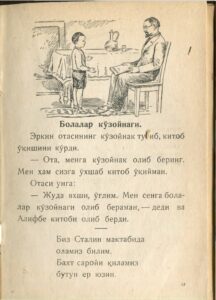
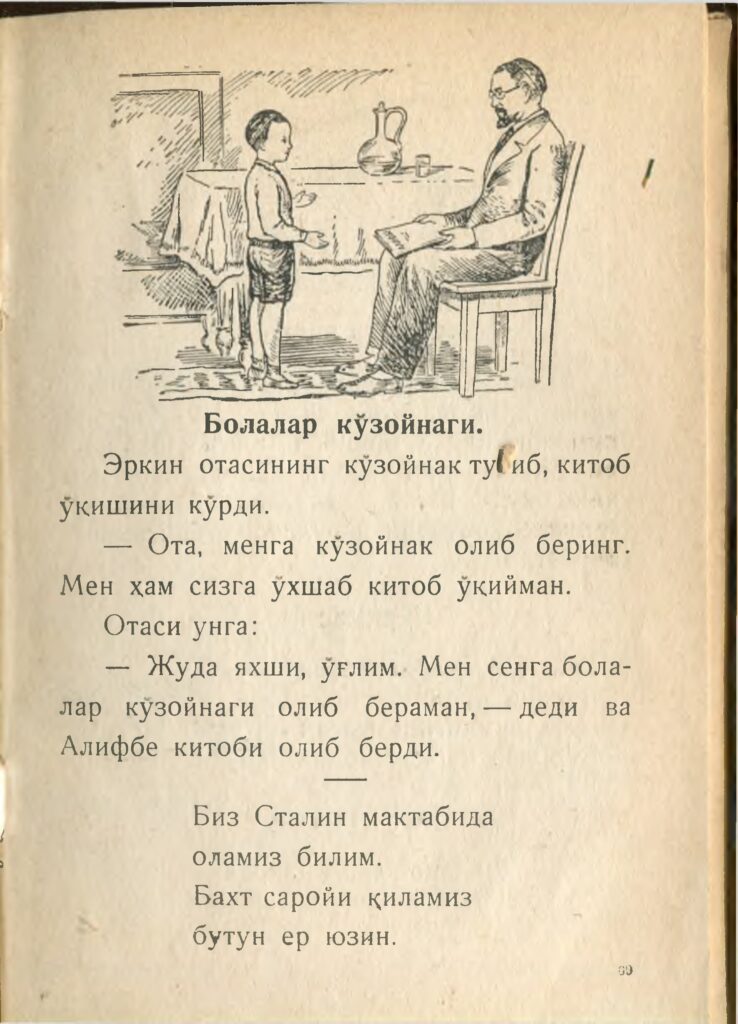
In 1903, children in Tashkent who reached lesson 109 of their school reader read this: “To obey the tsar is the command of God Almighty. Whoever the tsar may be, obeying him is a duty for everyone.” Almost forty years later, in 1941, a new generation memorised a different line from its primer: “We gain knowledge in Stalin’s school.”
Between these two books, two forces fought over the school in Turkestan. One saw it as a way to open the nation’s eyes. The other wanted to turn it into a machine for producing loyal subjects, first of the empire and then of the Party. This struggle is best followed not through historians’ general conclusions but through the textbooks, curricula and journals of the time, most of which now sit in the rare-book collections of libraries.
Read more on Novastan: Who Made the Nations of Central Asia
A note on the name. Until 1917 “Turkestan” meant the Turkestan Governor-Generalship, the colonial administration that Russia set up in 1867 with its capital in Tashkent. The Emirate of Bukhara and the Khanate of Khiva lay outside it as Russian protectorates under their own rulers. In April 1918 the governor-generalship became a Soviet autonomous republic, and in October 1924 the national delimitation divided it among new national republics, among them the Uzbek SSR. The first textbooks quoted here were written for the Muslims of a Russian colony, the last for the children of a Soviet republic.
A sermon inside a textbook
The 1903 sentence comes from Muallimi soniy (“The Second Teacher”), a reader compiled by Ali Asghar Kalinin for the Russian-native schools and printed with the governor-general’s permission. Lesson 76 says plainly why one should finish such a school: the graduate would find work as an interpreter or a clerk, and a man who knew Russian would become an official. Lesson 108 presents the conquest of Turkestan as an event that happened “by the will of the Lord of the worlds”. Lesson 110 is the sermon (khutba) for Nicholas II, which, the book says, was to be read on imperial holidays in “all the Muslim mosques” of the region. The colonial school, in other words, tried to instil loyalty to the empire through the most sacred notions of Islam: religious duty, obedience and the Friday sermon.
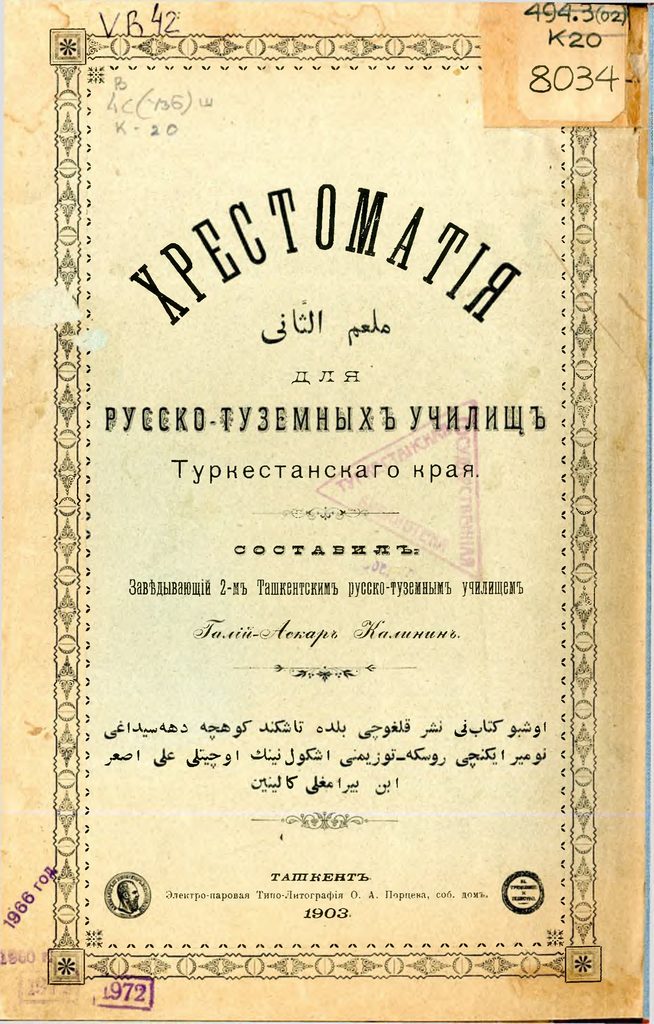
Credit: Courtesy of the A. Avloni National Institute of Pedagogical Excellence, Tashkent.
In 1902, the newspaper Turkestanskie Vedomosti summed up the purpose of this school in one phrase: “to teach children to think in Russian”. People understood this well. Akmal Akromov, a classmate of the writer Abdulla Qodiriy, recalled that many parents refused to send their sons to such schools for fear the boy would “turn Russian”, and scolded those who did.
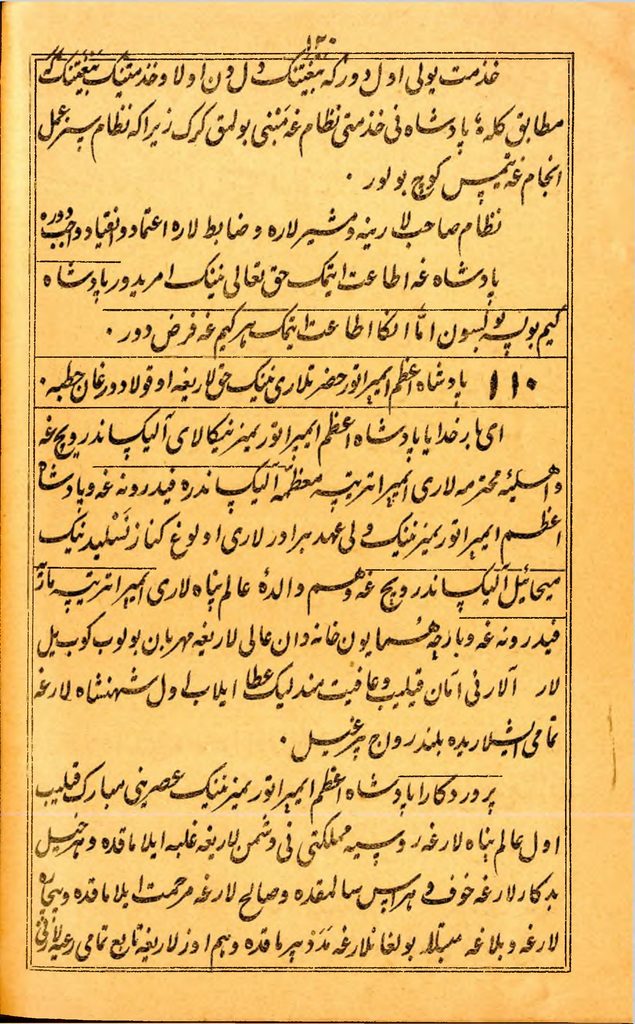
Credit: Muallimi soniy (1903), lesson 109. A. Avloni National Institute of Pedagogical Excellence, Tashkent.
Yet the traditional maktab, the only alternative, was in deep crisis. In his 1923 novella Eski maktab turmushi yoki Tolib (“Life in the Old School, or The Pupil”), Moʻminjon Muhammadjonov shows it from the inside. Every Thursday children brought the teacher a coin; a pupil to be punished was held down by his arms and legs and beaten with a whip or a stick. The aim was not to understand the lesson but to be released sooner, and the hero is still “neither literate nor skilled” at sixteen or seventeen. Bukhara was no better. In 1912 the Persian-language newspaper Bukhoroi sharif wrote that a student could study Arabic grammar for ten to fifteen years and still be unable to write Arabic correctly.
Families therefore faced two roads: a school that taught their children to think in Russian, or one that kept them memorising for ten years and let them go illiterate. The Jadids offered a third.
What the Jadids asked for
The Jadids took their name from usul-i jadid, the “new method” of teaching children to read by sound, which Ismail Gasprinsky introduced among the Muslims of the Russian Empire in the 1880s. In Turkestan, their schools were private, kept going by fees and local benefactors, and tolerated by an administration that had its own project in the Russian-native school. The reformers were neither allies of that administration nor its declared opponents. They wanted what the government school could give, without the purpose it was built for.
The Jadids did not run away from Russian. Mahmudkhoja Behbudiy wrote in his journal Oyina: “For our own benefit, let us know Russian and study in government schools.” But he wanted the language to serve the homeland and the faith. In 1907 he sent the Muslim faction of the Second State Duma a draft with two demands: that the schools and madrasas of Turkestan be freed from government control, and that “the Russian script not be forced on the Muslim nation”.
The administration answered with more control. Under rules drawn up by a special commission in 1909, teachers in the old schools had to be “politically entirely reliable”. In 1910–1911 more than fifty new-method schools were closed. The most telling case is that of Munavvar Qori. In February 1911, Munavvar Qori asked the district school inspector for permission to teach Russian in his school. In June 1911, the request was refused until the Ministry of Public Education issued its instructions on new-method schools. Munavvar Qori did not give up, and by early 1914 he had obtained the permission: in a report of 30 January 1914, the inspector noted that his was the only school in the district where Russian was taught. He later described the tsarist police’s attitude to cultural work in one sentence: it “opened on one side and closed on the other”.
Pressure came from within as well. On 3 January 1914, in the mosque of the Ulugh Beg madrasa in Samarkand, before five or six thousand people, a man who had sent his child to a new-method school was declared “an infidel, his wife divorced”. Behbudiy recorded the episode in Oyina. The new school was caught between two fires.
A compromise that lasted less than a year
After 1917 many Jadids went to work in the new Soviet institutions: schools, publishing houses and the Commissariat of Education. For the first time a government was promising mass schooling in the mother tongue, and for a few years the reformers wrote its textbooks and explained its decrees. The price of that cooperation became clear only later.
The first decrees left room for compromise. Order No. 38 of the Turkestan Commissariat of Education, dated 4 November 1918, made an exception for religious lessons in Muslim schools. An appeal signed by Muhammadamin Afandizoda and Munavvar Qori in the newspaper Ishtirokiyun in April 1919 explained it: religion could be taught by the school’s own teacher, but not by imams. For the Jadids this was an acceptable path.
It did not last. The statute of the Turkestan labour school, approved in September 1919, placed all schools under the Commissariat and banned religious teaching altogether. The 1920 curriculum for unified labour schools admitted that much of the central programme did not suit Turkestan, yet declared its direction “compulsory for all schools of Turkestan”. A graduate was expected to know “at least the budget of his home town”. The list of public buildings a child should study included a cooperative, a post office and a hospital, but neither a mosque nor a madrasa.
Even so, the Jadids kept writing textbooks for a while. Oʻzbekcha oʻqish (“Uzbek Reader”), compiled by F. Sayfiy and Elbek and printed in 30,000 copies in 1921, opens with the poem “Language”: “Who are those who sell the Turkic tongue?” Its page on Navoi calls him “our greatest and first poet”. The Jadid spirit lived on inside a textbook of the Soviet state publisher. In Bukhara, which was a separate people’s republic from 1920 to 1924, the 1922 primer Til achgʻich, issued by the Bukharan education authority, still begins with Bismillah and ends with the Fatiha. In Turkestan, by then, another principle was being stated openly: a 1923 adult literacy programme printed in Kazakh in Tashkent said that all teaching must be tied to politics, “because nothing today is outside politics”.
Read more on Novastan: Between integration and inheritance: How Armenians in Uzbekistan are redefining community
“Not only six hours of lessons”
From 1925, the journal Maorif va oʻqitgʻuvchi (“Education and the Teacher”) made the new task explicit. People’s Commissar of Education R. Inʼomov defined the aim of education as “communist upbringing and the training of forces to build communism”, while admitting that “we have almost no Party teachers”. His deputy Riza oʻgʻli wrote that a teacher’s job was “not only six hours of lessons”: he had to go “among the masses” and work for Soviet construction. By 1929, a teacher who stayed out of an election campaign was called “unfit”.
The money changed hands too. The waqf endowments that had supported schools and madrasas for centuries were moved into the Soviet education budget; “waqf capital is today education capital”, the journal wrote. A 1927 report of the Commissariat gave the old schools two years to be “Sovietised” and promised to “hasten the death” of those that were not.
The turn on religion was especially quick. In 1925, Vadud Mahmud argued in the same journal for “scientific, educational struggle” against religion rather than coercion. Four years later N. Inoyatiy wrote: “In our school we must firmly establish not irreligious but anti-religious upbringing.” The view of the Jadids changed as well. In early 1926, the journal still named Behbudiy, Munavvar Qori, Avloni and Fitrat as leaders of Turkestan’s intellectual and literary renewal. By 1929, it called its own first year and a half, when Vadud Mahmud was literary editor, a “dark period”. The Turon library, founded by the Jadids in Tashkent, was renamed October, and 5,000 books were removed from its shelves.
The hammer and sickle in the primer
In 1930, an all-Russian conference on school books demanded that textbooks stir hatred of the class enemy and that primers raise collectivists and fighters for the cause of the working class. Uzbek primers followed. In Sh. Rahimiy’s Savod (“Literacy”), printed in 50,000 copies in 1930–1931, children learned the new letters through sentences such as “This is Grandpa Lenin. Lenin is my father. I am a Leninist” and “Be a pioneer!” In one story, children tell their religious elders: “Either your God stays in this house, or we do.”
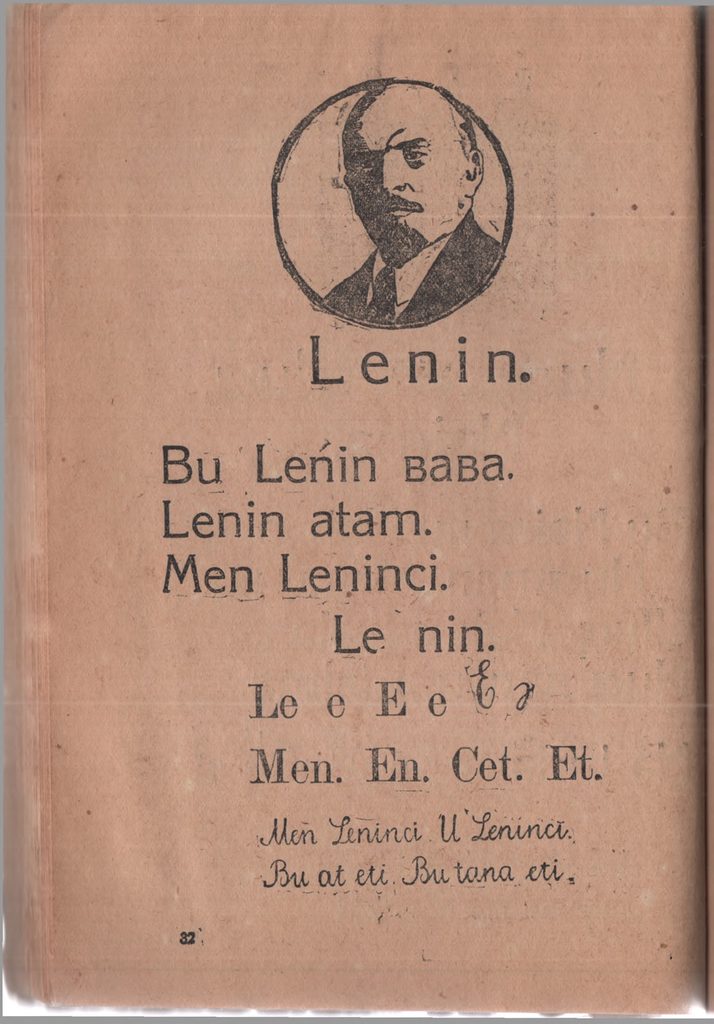
Credit: Sh. Rahimiy, Savod (1930–1931), p. 32. A. Avloni National Institute of Pedagogical Excellence, Tashkent.
In 1933, M. Buzruk Solihov’s book on nationalist tendencies in Uzbek literature called Jadidism “the banner of the Uzbek nationalist movement”. Jadid teachers were repressed; Munavvar Qori was shot in Moscow on 23 April 1931. Behbudiy’s demand that the Russian script not be forced met its fate too. On 13 March 1938, compulsory Russian in national schools was decreed, and in 1940 Uzbek was moved to the Cyrillic script. In Oqil Sharafiddinov’s 1941 primer, a child practising handwriting copied the line “The sickle and the hammer are our emblem.”
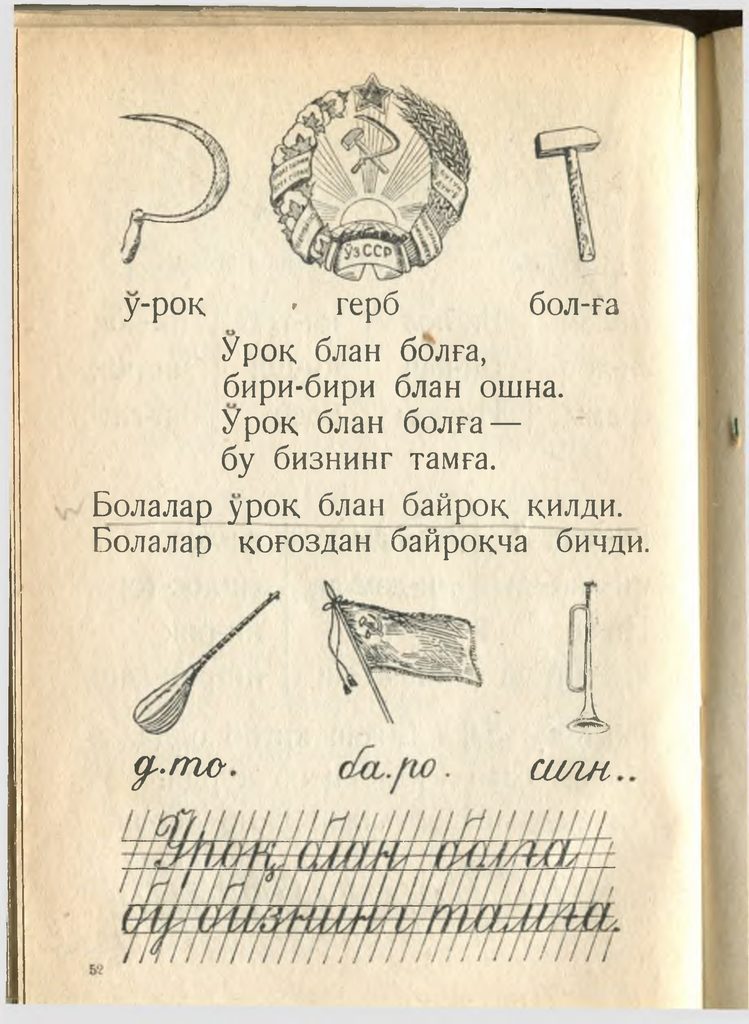
Credit: Oqil Sharafiddinov, Alifbe (1941), p. 52. A. Avloni National Institute of Pedagogical Excellence, Tashkent.
Forgetting was also a policy
After the war, textbooks tied ideology to daily labour. A 1949 second-grade reader holds up as an example the pupils of the afternoon shift who went out to the collective farm and “handed in 500 kilograms of cotton that day”. Control became more thorough. The Uzbek edition of A. N. Volkovsky’s 1950 manual for school inspectors provided for parents who kept a child out of school to be prosecuted under Articles 270 and 274 of the Uzbek SSR Criminal Code. A 1952 manual on school administration published by the RSFSR Academy of Pedagogical Sciences advised inspectors to check pupils’ worldview through essays on “My favourite book” and “My favourite hero”, and through their diaries and library records. It quoted Mikhail Kalinin: a teacher should feel himself “under the strongest control”, stricter than anyone in the world. The same manual leaned on the educator Konstantin Ushinsky, but left out another of his thoughts: “The most vigilant control will not help in this matter. The educator can never be a blind executor of instructions.”
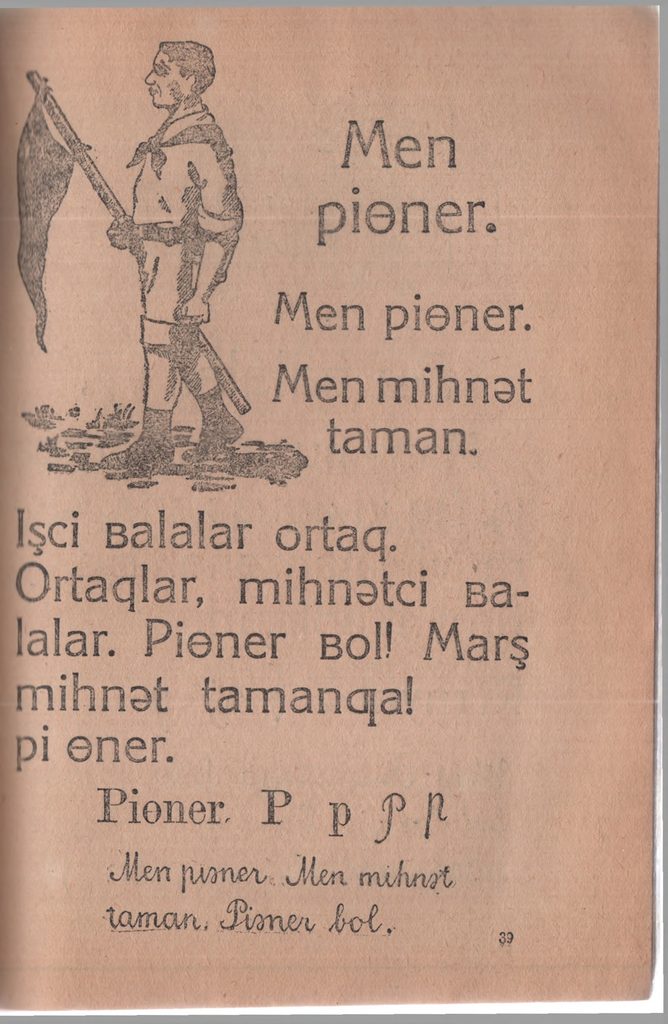
Credit: Sh. Rahimiy, Savod (1930–1931), p. 39. A. Avloni National Institute of Pedagogical Excellence, Tashkent.
The Soviet system did not only control. It also rewrote the past. A 1959 booklet by E. Qodirov called the Jadid schools “bourgeois-nationalist” and accused them of not teaching Russian, although Munavvar Qori had sought permission to teach Russian as early as 1911, and by 1914 his school was the only one in the district where Russian was taught. That same year the Academy of Sciences published a collection of materials on progressive social and philosophical thought in Uzbekistan that included the poets Furqat, Muqimiy and Zavqiy, but not a single Jadid. The editing went both ways. In 1960 Y. Abdullayev sharply criticised the Russian-native school as a tool for “Russifying the local population” and dismissed the lesson praising it in Muallimi soniy as propaganda. Yet in his detailed analysis of the book, he did not mention the lesson that taught obedience to the tsar as a religious duty, or the sermon. Each era took from the past what it needed and passed over the rest in silence.
What sixty years show
In sixty years, the school in Turkestan lived through three policies: that of the empire, that of the early Soviet years, and that of a fully ideological system. One thing never changed: those in power wanted the school to decide what a child would think. The Jadids wanted something else. They wanted the child to think for himself, to study in his mother tongue, and to know his faith, modern science and, where needed, Russian.
After independence in 1991, the works of Behbudiy, Fitrat, Cho‘lpon and Avloni returned to print and to school programmes, and in recent years, the study of the Jadid heritage has become state policy in Uzbekistan. In December 2023, Tashkent hosted an international conference, “Jadids: Ideas of National Identity, Independence, and Statehood”, which opened with an address from the president. Since January 2024, a newspaper named Jadid has been published on the president’s initiative.
Read more on Novastan: “This is the right time to engage with Uzbekistan”: Gulnoza Ismailova on education, talent and the country’s future
This rediscovery brings the old questions back: what language and script a child should learn in, how much room the school leaves for faith, and who decides what a textbook says. The sources suggest caution with every ready-made answer. The Jadids were denounced as nationalists in 1933 and left out of an anthology in 1959 by people who had their books to hand. What was missing was the willingness to quote them in full.
To restore that heritage honestly, we should turn not to the conclusions of later periods but to the documents of the time: yellowed textbooks, curricula and journal pages. They show what each regime wrote, and what it chose to hide.
Sources
By section, in the order the examples appear. Titles are given in the original language.
A sermon inside a textbook
- Kalinin, Ali Asghar. Muallimi soniy. Tashkent, 1903. Lessons 76 and 108–110 (lesson 109 is on p. 119).
- Turkestanskie Vedomosti, 1902, no. 42. Quoted from Kamoliddin and Kocaoğlu 2021 (see below), p. 170, n. 212.
- Akromov, Akmal. “Maktabda.” In Abdulla Qodiriy. Ta’rifi adib, compiled by Xondamir Qodiriy. Tashkent: Abdulla Qodiriy nomidagi xalq merosi nashriyoti, 2004, p. 6.
- Muhammadjonov, Mo‘minjon. Eski maktab turmushi yoki Tolib. 1923.
- “Jalol.” “Islohi madoris.” Bukhoroi sharif (New Bukhara), 1912, no. 98, 7 July (Old Style).
What the Jadids asked for
- Behbudiy, Mahmudkhoja. “Ikki emas, to‘rt til lozim.” Oyina, 1913, no. 1, pp. 12–14. Cited from Behbudiy, Tanlangan asarlar, edited by B. Qosimov. Tashkent: Ma’naviyat, 2009, pp. 151–153.
- Behbudiy, Mahmudkhoja. “Favqulodda takfir.” Oyina, 1914, no. 12. Cited from the same edition, pp. 161–162.
- Kamoliddin, Sh., and T. Kocaoğlu. Proekt kul’turnoi avtonomii Turkestana Makhmudkhodzhi Bekhbudi. Tekst. Perevod. Kommentarii. Saarbrücken: LAP Lambert Academic Publishing, 2021, pp. 51 and 58 (Behbudiy’s draft of 1907).
- Abdullayev, Y. Eski maktabda xat-savod o‘rgatish. 1960 (for the 1909 commission rules and the closures of 1910–1911).
- Munavvar Qori Abdurashidxonov. Tanlangan asarlar. Edited by S. Ahmedov. Tashkent: Ma’naviyat, 2003 (for the 1911 petition and the inspector’s report of 1914).
A compromise that lasted less than a year
- Turkestan Commissariat of Education. Order No. 38, 4 November 1918.
- Afandizoda, Muhammadamin, and Munavvar Qori. “Xitobnoma.” Ishtirokiyun, 28 April 1919. Cited from Munavvar Qori Abdurashidxonov, Tanlangan asarlar (2003), pp. 108–109 (electronic edition).
- Statute of the Turkestan labour school, September 1919.
- Birlashgan mehnat maktablarining programmasi. 1920.
- Sayfiy, F., and Elbek. O‘zbekcha o‘qish. 1921.
- Til achg‘ich. Bukhara: Bukharan education authority, 1922.
- Mektepterde ülkenderdi jazuw-sïzuwgha üyretüw jolï [Programme of lessons in schools for the liquidation of illiteracy]. Tashkent: Turkestan Extraordinary Commission for the Liquidation of Illiteracy, 1923, p. 7. In Kazakh, in Arabic script.
“Not only six hours of lessons”
- Inʼomov, R. Report. Maorif va o‘qitg‘uvchi, 1925, no. 7–8, pp. 3 and 8.
- Riza o‘g‘li. “Navbatdagi vazifalar va muallim.” Maorif va o‘qitg‘uvchi, 1925, no. 1, pp. 80 and 83.
- Marg‘ilonli, X. A. “Vaqf sarmoyasi va el tarbiyasi.” Maorif va o‘qitg‘uvchi, 1925, no. 1, p. 101.
- Mahmud, Vadud [signed V. M.]. “Kallami – kulohmi?” Maorif va o‘qitg‘uvchi, 1925, no. 9–10, p. 14.
- Laziz. “Turkistonning uyg‘onish tarixi.” Maorif va o‘qitg‘uvchi, 1925, no. 11–12 (published January 1926), pp. 102–105.
- Kozirev. “Sho‘ro saylovlari munosabati bilan muallimlar vazifasi.” Maorif va o‘qitg‘uvchi, 1929, no. 1, pp. 14–15.
- Inoyatiy, N. “Maktabda dinga qarshi tarbiya.” Maorif va o‘qitg‘uvchi, 1929, no. 2–3, pp. 26–27.
- N. “‘Turon’ emas – ‘Oktabr’.” Maorif va o‘qitg‘uvchi, 1929, no. 6, pp. 15–17.
- Sulaymon, Sh. “Besh yilni to‘ldirg‘onda…” Maorif va o‘qitg‘uvchi, 1929, no. 12, pp. 4–6.
- People’s Commissariat of Education of the Uzbek SSR. O‘zbekistonda maorif ishlari. Samarkand, 1927, pp. 40–41.
The 1925 issues of Maorif va o‘qitg‘uvchi were published in Tashkent, the 1929 issues in Samarkand.
The hammer and sickle in the primer
- Rahimiy, Sh. Savod. Samarkand–Tashkent: O‘zbekiston Davlat nashriyoti, 1930–1931.
- Solihov, M. Buzruk. O‘zbek adabiyotida millatchilik ko‘rinishlari. 1933.
- Sharafiddinov, Oqil. Alifbe. Tashkent: O‘zSSR Davlat o‘quv-pedagogik nashriyoti, 1941, pp. 52 and 59.
Forgetting was also a policy
- O‘qish kitobi (second grade). 1949.
- Volkovsky, A. N. Maktablarga inspektorlik qilish: rayon xalq maorifi bo‘limlarining yosh inspektorlari blan suhbatlar. Tashkent: O‘zSSR Davlat o‘quv-pedagogika nashriyoti, 1950, pp. 22 and 33.
- Shkolovedenie. Moscow: RSFSR Academy of Pedagogical Sciences, 1952.
- Qodirov, E. O‘zbekiston SSRda xalq maorifining muvaffaqiyatlari. Tashkent: O‘zSSR Davlat nashriyoti, 1959, p. 7.
- O‘zbekistonda progressiv ijtimoiy-falsafiy fikrlar tarixiga doir materiallar. Tashkent: Academy of Sciences of the Uzbek SSR, 1959.
- Abdullayev, Y. Eski maktabda xat-savod o‘rgatish. 1960.
Background
- Khalid, Adeeb. The Politics of Muslim Cultural Reform: Jadidism in Central Asia. Berkeley: University of California Press, 1998.
- Khalid, Adeeb. Making Uzbekistan: Nation, Empire, and Revolution in the Early USSR. Ithaca: Cornell University Press, 2015.
This article was originally published in Uzbek by Oyina.uz on 28 October 2026 and has been adapted by Mathieu Lemoine and Maya Ivanova into English for Novastan with permission.
By Abbosbek Mominov
A. Avloni National Institute of Pedagogical Excellence, Tashkent