 Tajik women reveal themselves through the “I am Tajik and…” trend
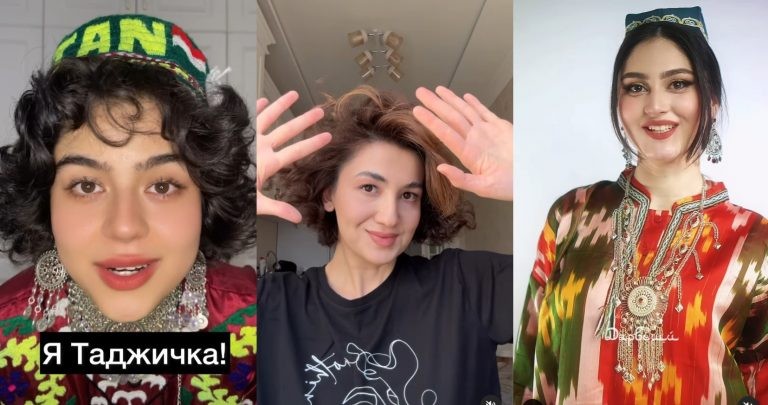
Faced with archaic social expectations, Tajik women are expressing their exhaustion through a new coded language on social media. Built around the phrase “I am Tajik”, many personal testimonies have circulated in recent years.
“I am a Tajik woman and I have an unbreakable strength of spirit that allows me to overcome all of life’s difficulties,” says Madina Nigmatova, who took part in the movement.
With the aim of deconstructing stereotypes deeply rooted in Tajik society, a growing number of women and girls across the country are regularly joining this movement, celebrating a strong image of women through traditional clothing and jewellery.
Beyond imposed roles
Far from limiting themselves to the domestic roles traditionally imposed on women – cooking, cleaning and caring for the household – which some movements, such as “tradwives” in the United States, are now bringing back into fashion, Tajik women are using the digital sphere to give voice to feminist struggles. Madina Nigmatova, a social media marketing specialist and trainer, says that women not only have the right but also the duty to be visible, fulfilled in their careers, creative and fully active in the business world.
“We know our traditions, we respect them, we pass them on to future generations. But we want to live in our time, as educated and independent women. The modern Tajik woman has learned to combine several roles: taking part in competitions, pursuing any career, while also looking after her children and managing the home,” she says.
Also read on Novastan : Comment les migrants nourrissent le Tadjikistan
This movement is taking place in a context where women and married girls in Tajikistan have limited access to electronic devices and the internet, often because of family control. In households where men work abroad, for example, mothers may receive smartphones instead of wives, thereby limiting the latter’s digital autonomy.
Novastan est le seul média en français et en allemand spécialisé sur l'Asie centrale. Entièrement associatif, il fonctionne grâce à votre participation. Nous sommes indépendants et pour le rester, nous avons besoin de vous ! Vous pouvez nous soutenir à partir de 2 euros par mois (défiscalisé à 66 %), ou en devenant membre actif par ici.
A subtle deconstruction of prejudice
In her version of “I am Tajik”, Madina Nigmatova draws attention to the widespread stereotype of the accomplished woman who, in Tajik society, is often perceived as a divorced woman.
Modern women easily combine family life, professional achievement and personal fulfilment: some make pastries, others create and run online businesses, while others work as makeup artists.
Also read on Novastan : Contrôle de l’habillement des femmes au Tadjikistan : entre tradition et répression
“When the videos were shared in different groups, many comments said that, to reflect the true image of the Tajik woman, they should have shown how to cook, sweep the yard or milk cows. The Tajik woman, the kelinka, is not limited to the role of servant. She is a full person who seeks fulfilment and balance between private life and career. I feel immense admiration for them,” says Madina Nigmatova.
A long-standing trend
This trend emerged last year, when several bloggers shared a joint video in which they said they were Tajik women and that this did not prevent them from “building a career”, “living separately from their parents”, “dressing as they wish”, “running a blog”, “not being married at 32”, “doing business”, or “creating a company”.
Also read on Novastan : Comment l’appareil judiciaire discrimine les femmes au Tadjikistan
The video sparked fierce controversy and a wave of hatred, particularly because the young women spoke in Russian while presenting themselves as Tajik. Yet the negative reactions did not manage to put an end to the trend. On the contrary, the more malicious comments multiplied, the more they increased the feeling of exhaustion with social injunctions. What women once kept silent out of shame, they now express more freely.
Multiple demands
“I am Tajik, I am 26 years old and I am postponing marriage because I am afraid of drastic changes in life; the institution of marriage frightens me because I have seen few successful examples around me,” Leila writes on her page.
“I am Tajik: I got married at 37. My only daughter is four and a half. I am 43. I lived and continued my studies in Italy, in the south to be precise. I have lived in Russia for 18 years. Before becoming an eyebrow specialist, I worked for 12 years as a stylist, buyer and merchandising department manager in major companies in Moscow,” Zarina says.
Also read on Novastan : Faut-il renforcer l’arsenal juridique contre les violences sexistes au Tadjikistan ?
“I am a Tajik woman who finished a Russian school in Tajikistan and I did not get married straight away. I am Tajik and I grew up in a traditional family and no, I was not scolded, we never argued before I left. On the contrary, I was truly supported,” writes Omina.
“I am Tajik and I do not allow myself to give unsolicited advice, such as: ‘One child is not enough, you need to have another one. It is not in your plans? Then your husband will end up leaving you,’” says Shakhzoda.
“I am Tajik, and I deliberately chose to marry a Kazakh, simply because that is what I wanted. When I want something, I refuse to forbid myself from having it,” says Bargigul.
Backlash and masculinist reactions
These posts regularly receive thousands of views and hundreds of comments. Women tend to leave positive and inspiring replies.
By contrast, fuelled by underlying misogyny, comments from men are generally far from encouraging. They include: “your eyes are not those of a Tajik woman”, “you dishonour the nation”, and “marrying a foreigner destroys the Tajik gene”. Many other comments in the same vein seek to discredit the activities and positions taken by many women in Tajikistan.
A simple format
The phrase “I am Tajik” can be personalised by adding something for which one has been criticised, felt shame, or which is, on the contrary, a source of pride.
Examples include: “… and I earn much more than men”, “… and I do not know how to make plov, and that is perfectly fine”, “… and I speak five languages”.
Also read on Novastan : Ces femmes tadjikes qui s’approprient les professions « masculines »
The video is often filmed in a pleasant setting where the women feel safe, with a posture intended to appear authentic. Traditional elements of Tajik culture in clothing or decor are often highlighted, because promoting cultural heritage and traditions is not incompatible with feminist emancipation.
The hashtags #iamtajik, #tajikgirlpower and #ihavetheright often accompany these messages and help them spread more widely.
“We are different, but we are all Tajik”
Many Tajik girls have also taken part in the “duxtari tojik” trend, meaning Tajik girl. In these videos, they embody women from different regions of the country, challenging the boundaries of regionalism — a phenomenon that remains very present in Tajik society.
Accompanied by a song by Tajik singer Nobovar Chanorov, which evokes girls from different regions, the emphasis is placed on cultural richness and regional identity rather than geographical division.
Want more Central Asia in your inbox? Subscribe to our newsletter here.
“I did not know there were so many styles of traditional clothing in our country,” Bahora says in one of her videos. Several moved internet users responded by highlighting friendship between all regions of Tajikistan.
The message is regularly shared in several languages. At the request of her followers, makeup artist Farangis offers looks inspired by different regions of Tajikistan, accompanied by brief explanations in Tajik, Russian and English. The movement goes beyond the country’s borders and more broadly inspires women from neighbouring countries. This is notably the case of an Uzbek blogger who also joined the movement, presenting the wedding dresses of Tajik women from different regions.
This trend unites Tajik women across the continent: from Iran to China, each video brings its own personal touch.
The editorial team of Your.tj
Translated from Russian by Lisa D’Addazio and from French by Mathieu Lemoine
Edited by Emma Fages
Proofread by Elise Medina
Thank you for reading this article! If you have time, we would appreciate your feedback, either through this anonymous form or by email at editorial@novastan.org. Thank you very much!