
 From Central Asia to America: The Koryo-Saram Diaspora Finds a New Voice
Support Novastan, the European Central Asia magazine
By supporting Novastan, you are supporting the only English, French and German-language media specialising in Central Asia. We’re independent and we need your help to stay that way!After more than a century of migration, repression and adaptation, the Koryo-Saram are building new communities in the United States. Hana Sexton, founder of Koryo Saram Koreans in America, speaks to Novastan about historical memory, cultural survival and the challenge of making a little-known diaspora visible.
The history of the Koryo-Saram extends across several countries and political systems. Their ancestors began settling in the Russian Far East in the nineteenth century, many fleeing poverty, famine and Japanese colonial rule on the Korean Peninsula. In 1937, Stalin’s government deported the entire Korean population of the Soviet Far East to Kazakhstan and Uzbekistan, accusing them collectively of potential collaboration with Japan.
The deportees endured a brutal journey in overcrowded railway wagons and were forced to rebuild their lives in unfamiliar conditions. Over subsequent decades, Koryo-Saram communities became deeply rooted in Central Asia. They contributed to agriculture, science, medicine, education, culture and public life, while also experiencing linguistic assimilation and the gradual erosion of some Korean traditions.
See more on Novastan: How Central Asia became home for the Koryo-Saram
Following the collapse of the Soviet Union, the community became increasingly dispersed. Many moved to South Korea, Russia, Europe and the United States, creating new forms of transnational family and cultural life. Today, an individual Koryo-Saram family may have relatives in Kazakhstan, Uzbekistan, South Korea, Russia and North America.
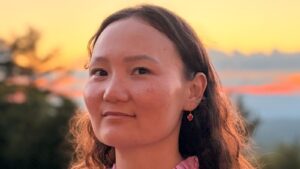
Hana Sexton grew up in Central Asia and later settled in the United States. After repeatedly encountering a lack of awareness about Koryo-Saram history, she established Koryo Saram Koreans in America, a nonprofit initiative intended to increase the visibility of the community and strengthen its connections with the wider Korean-American diaspora.
She is a member of the Council of Korean Americans and The Korea Society, and participates in cultural, community and policy events across the United States. In this interview with Novastan, she explains why the Koryo-Saram experience cannot be reduced to labels such as “Soviet Korean” or “Russian Korean,” and why preserving the community’s history matters far beyond the diaspora itself.
Novastan: Could you begin by introducing yourself and telling us what inspired you to establish Koryo Saram Koreans in America?
Hana Sexton: For more than a decade in the United States, my life has involved repeatedly answering one question: who are the Koryo-Saram?
Meeting people across very different social and professional circles taught me something important. My lifetime would simply be too short to explain the history of the Koryo-Saram individually to every new person I encountered. That exhausting realisation is precisely why I founded a nonprofit initiative dedicated to our community.
I am a Koryo-Saram Korean American. It is an identity that I claim proudly, but it is also one that is constantly obscured by misconceptions. We are frequently described as “Soviet Koreans,” “Russian Koreans,” “Central Asian Koreans” or even “North Koreans.” The reality is far more complex.
Many Koryo-Saram migrated to the Russian Far East long before the Soviet Union was established. They moved there during the late nineteenth and early twentieth centuries, often fleeing famine, poverty and Japanese colonisation. The Soviet era was only one chapter in our much longer history, just as the Russian Empire before it and the post-Soviet Central Asian states afterwards were also chapters.
Each period and each region shaped our culture, but none of them defines us entirely.
We are ethnic Koreans and today many of us predominantly speak Russian. The broader Russian-speaking Korean world also includes communities such as the Sakhalin Koreans, although their historical experience is distinct in important ways.
For me, Koryo-Saram is a collective identity for a global diaspora united by a shared history of migration, Stalinist forced displacement, trauma, resilience and cultural adaptation. We also developed a distinctive cuisine, including dishes such as morkovcha, the spiced carrot salad that has become famous across the former Soviet Union.
Through this organisation, we are no longer telling our story only one person at a time. We are trying to share our historical legacy with the wider world.
For readers unfamiliar with this history, who are the Koryo-Saram, and how would you describe their journey from the Russian Far East to Central Asia and, more recently, to the United States?
The Koryo-Saram are ethnic Koreans whose ancestors settled in the Russian Far East from the second half of the nineteenth century onwards. Labour was needed to develop sparsely populated land around Vladivostok and other border regions, and many Koreans settled there as farmers, labourers and traders. Others arrived while fleeing Japanese colonial rule on the Korean Peninsula.
Koryo-mar, the traditional language associated with the community, is now officially considered endangered. The language carries traces of the varieties of Korean spoken by the original migrants, but decades of displacement and assimilation transformed the linguistic life of the community.
In 1937, under Joseph Stalin, the Soviet government forcibly deported the entire ethnic Korean population of the Russian Far East to Central Asia, primarily Kazakhstan and Uzbekistan. The authorities justified the deportation by invoking fears of Japanese espionage and alleged “anti-Soviet activities.”
Read more on Novastan: From Bukhara to Queens: The Global Journey of the Bukharan Jews
It was the first large-scale Soviet deportation of an entire ethnic community, although it would not be the last.
The journey was brutal. Families were loaded into freight and cattle wagons. Many people died from disease, hunger and exposure during the journey or shortly after their arrival. Survivors found themselves in a completely different climate and environment. They had to farm in the steppe, grow food for their own survival and meet state agricultural demands, while trying to preserve elements of Korean family and cultural life.
For decades, many deportees remained classified as “unreliable people.” Their movements were restricted and they were required to report to local authorities.
A lesser-known part of our history concerns the Korean intellectuals and officials who survived deportation and were later sent to North Korea to help establish the new state. Some were subsequently purged, imprisoned or killed by the North Korean authorities. For them, deportation was followed by another form of displacement and political repression.
Over time, the Koryo-Saram became Soviet citizens. Many entered professional life and became scientists, doctors, teachers, engineers, artists and administrators. At the same time, Soviet assimilation policies, the closure of Korean-language schools and the dominance of Russian contributed to the decline of Korean-language transmission.
Read more on Novastan: Diasporas et diversité : brève histoire des peuples au Kazakhstan
After the collapse of the Soviet Union in 1991, many Koryo-Saram began seeking opportunities abroad. South Korea became a major destination, but the United States also attracted a growing number of migrants.
I was personally surprised to discover how many Koryo-Saram live in different American states. Today it is common to meet a Koryo-Saram American citizen with relatives in both South Korea and Central Asia.
Unlike some other communities deported under Stalin, including many ethnic Germans or Poles, the Koryo-Saram were never collectively repatriated. As a result, the diaspora is now scattered across Central Asia, Russia, South Korea, Europe and the United States.
In America, Koryo-Saram often settle in cities with established Korean communities, including New York and Los Angeles. They become part of a broader Korean diaspora while maintaining cultural and family ties to Central Asia and the post-Soviet world.
There are estimated to be around 500,000 Koryo-Saram worldwide, with growing populations in South Korea and the United States. The community’s journey is one of displacement, resilience and cultural adaptation: from early migration to the Russian Far East, through forced deportation to Central Asia, and later to the rebuilding of lives in South Korea, America and elsewhere.
Much has been written about Koryo-Saram communities in Kazakhstan and Uzbekistan, but far less about those living in the United States. What distinguishes the American experience, and how has the community evolved there?
The Koryo-Saram population in the United States is extremely diverse. Some people came directly from post-Soviet countries. Others were born in South Korea or another country and later moved to America for education, employment or family reunification.
Even Koryo-Saram living in the United States are not always aware of the full diversity of the community here.
Unlike the Soviet deportations, migration to the United States is generally voluntary. This allows Koryo-Saram to integrate into American society under completely different circumstances.
In my own case, I entered the American diplomatic and policy world relatively easily as the spouse of a former US diplomat. Other people make different choices. Some surround themselves primarily with Americans. Others remain within Russian-speaking social circles. Some identify strongly as Korean American and build their networks among ethnic Koreans.
Read more on Novastan: Qu’est-ce qu’être un Coréen au Kazakhstan aujourd’hui ?
One characteristic that many Koryo-Saram communities share is a tendency towards insularity. I believe this is partly a legacy of our complicated history and the experience of living for generations as a distrusted or misunderstood minority.
At the same time, many families successfully preserve Koryo-Saram traditions. These include hansik, Korean food culture, hwangap, the traditional celebration of a person’s sixtieth birthday, family rituals and distinctive forms of Koryo-Saram cuisine.
In the United States, Koryo-Saram may identify simultaneously with the broader Korean diaspora and with Russian-speaking immigrant communities. This creates opportunities for networking and cultural exchange, but it also means navigating several identities, languages and national backgrounds.
The American Koryo-Saram experience is shaped by voluntary migration, economic opportunity and comparatively successful integration into US society. It shares historical roots with Central Asia but is also influenced by post-Cold War migration and the blending of Korean heritage with American life.
I hope that, as Korean Americans, we will become a more confident, outward-facing and globally connected diaspora.
What are the main objectives of Koryo Saram Koreans in America? What kinds of activities do you organise, and what needs within the community are you hoping to address?
At present, my main priority is raising awareness and increasing the visibility of the Koryo-Saram community. This work is vital, and it requires thinking beyond one’s own experience in order to advocate for people who often remain unseen.
I believe that South Korea, the United States and wider society all benefit from greater cross-cultural understanding and from recognising the diversity that exists within the Korean diaspora.
Read more on Novastan: The Lexicon of Kazakh Decolonisation
The needs within the Koryo-Saram community are broad and can be difficult to address.
Many people face cultural barriers when asking for help. Some find it extremely difficult to admit that they are low-income or vulnerable. They may come from backgrounds in which revealing weakness historically invited exploitation rather than support.
One of my goals is to bridge that gap and help create an environment in which people feel safer asking for assistance.
I take great pride in fostering cross-cultural understanding through grassroots advocacy.
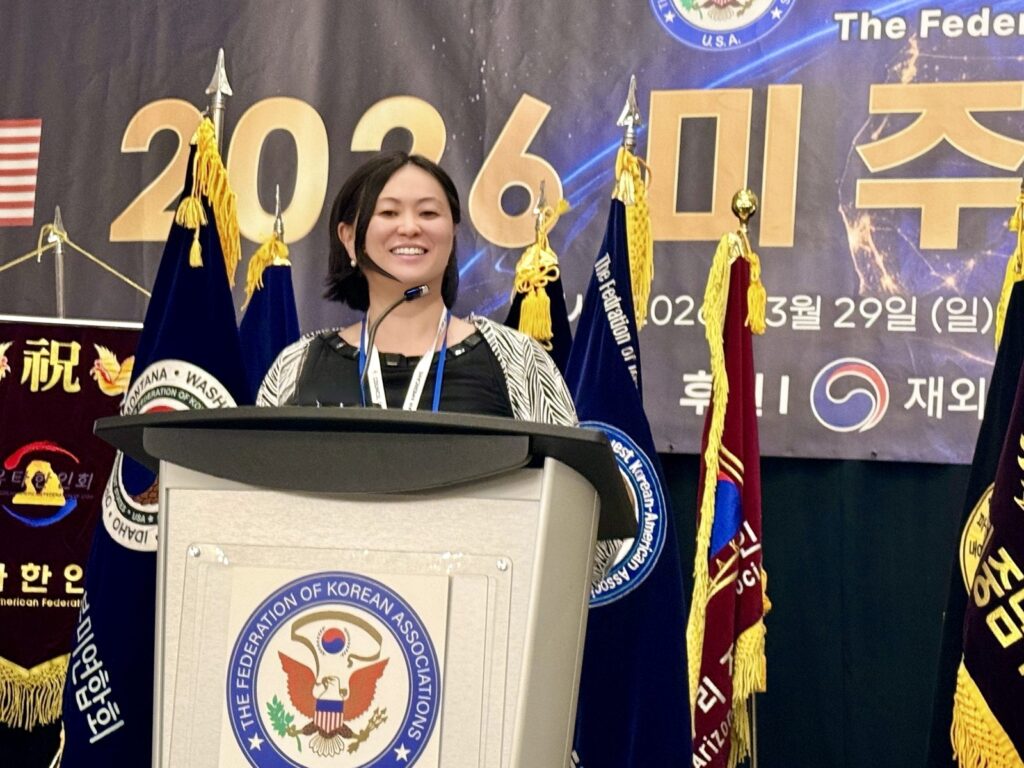
On Samiljeol, Korea’s March First Independence Movement Day, in 2025, I became the first Koryo-Saram in America to participate in a joint commemoration with Korean Americans in the state of Florida. I built on that milestone by taking part in a larger Korean-American commemoration in Georgia in 2026.
In autumn 2025, I represented South Korea at FusionFest in Orlando, one of Florida’s largest multicultural festivals. I organized a cultural display featuring reproductions of national treasures from the National Museum of Korea, traditional hanbok, heritage skincare and other elements of Korean culture.
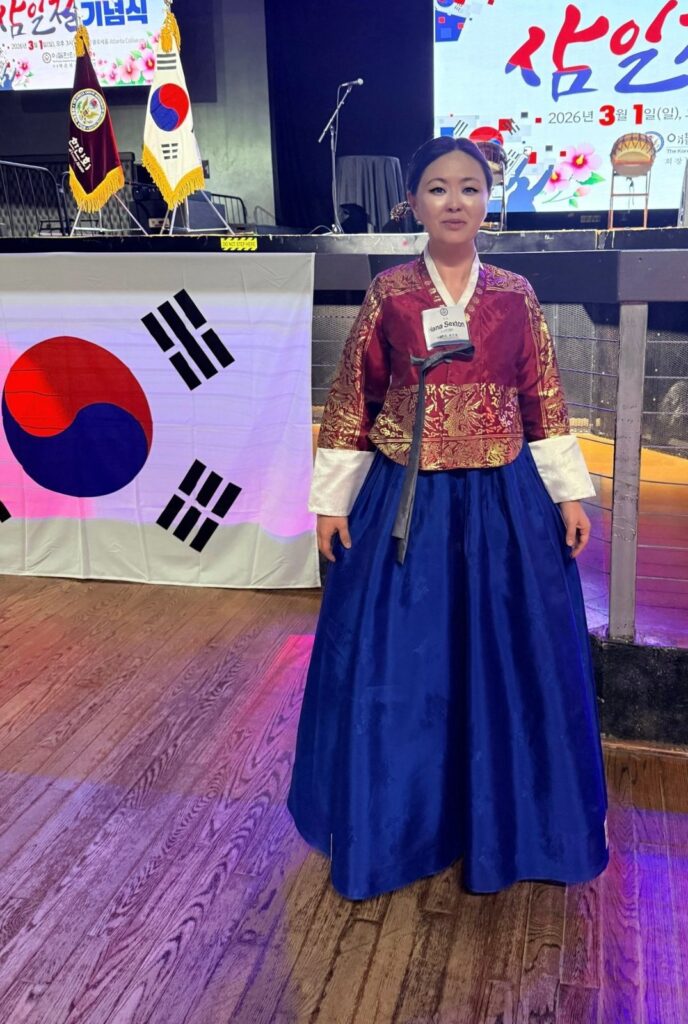
I also modelled a traditional hanbok during the FusionFest fashion show, accompanied by music from KPop Demon Hunters. In addition, I have carried the South Korean flag at several major cultural events in Florida.
Alongside grassroots events, I invest in leadership and institutional engagement by participating in major Korean-American and US policy forums. I attend these events at my own expense because I believe that the Koryo-Saram diaspora needs a visible voice in such spaces.
I have attended the Van Fleet Policy Forum, the flagship policy event of The Korea Society.
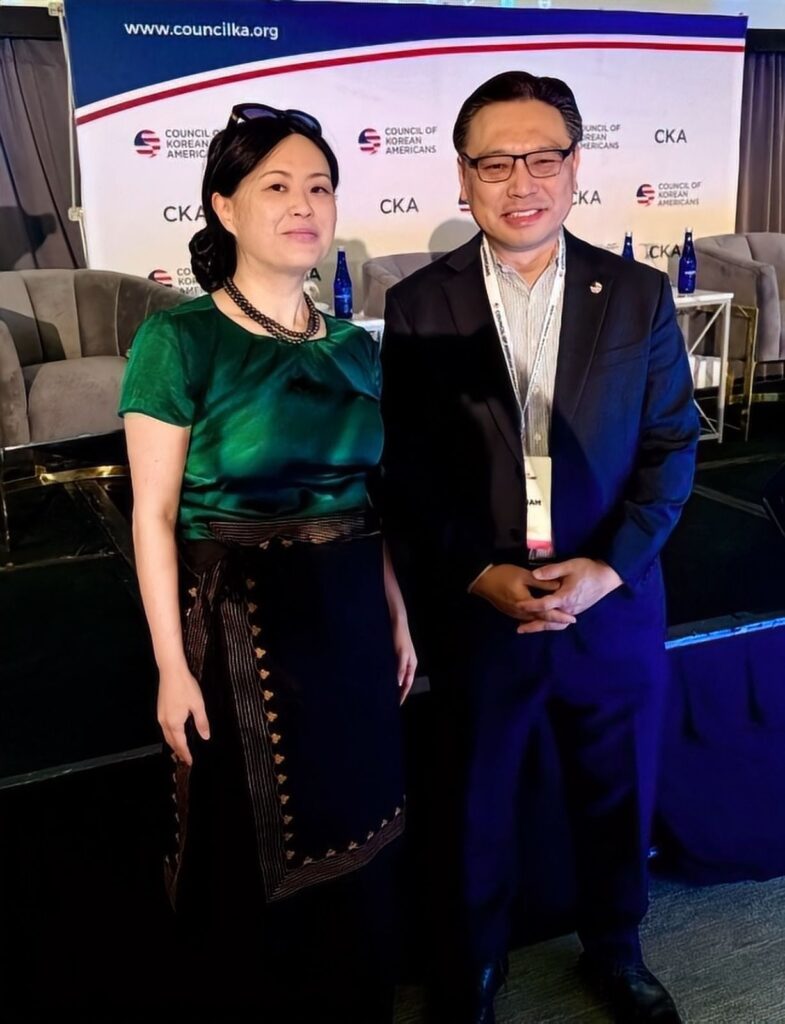
I have also participated in the Council of Korean Americans’ annual Envision Gala and Summit, the Federation of Korean Associations US’s national leadership convention for presidents of Korean associations, and the World Korean Business Convention in Duluth, Georgia.
Ultimately, I believe that South Korea, the United States and the Koryo-Saram community all benefit from mutual collaboration, deeper cultural understanding and a shared appreciation of our Korean heritage.
Many Koryo-Saram families remain connected across Kazakhstan, Uzbekistan, South Korea, Russia and beyond. How transnational is the community today, and what kinds of links exist between these different diasporas?
The Koryo-Saram diaspora is deeply transnational. Strong family, cultural and economic ties connect communities across Kazakhstan, Uzbekistan, Kyrgyzstan, Tajikistan, Turkmenistan, Russia, South Korea and other countries.
As I mentioned earlier, the Koryo-Saram were never collectively repatriated. For that reason, they can now be found across the world.
Koryo-Saram in America often have relatives working or living in South Korea, Central Asia, Russia or Europe. This creates expanded social networks and a broader sense of identity and belonging, but it also produces challenges.
These include identity tension, legal and political complexity, social isolation and the practical difficulty of maintaining family life across borders.
Our history spans more than a century of migration, repression and cultural survival. As a result, Koryo-Saram identity is often a living negotiation between contrasting political, social and cultural frameworks.
One example concerns children born and raised in South Korea to parents who are not South Korean citizens. In many cases, those children do not automatically acquire South Korean citizenship. They may later be required to return to Russia or Central Asia, where they face additional questions about identity, belonging and integration.
I am not afraid to enter uncomfortable rooms or spaces, because that is often where change must be made.
It is not uncommon for people to ask whether the Koryo-Saram are “communists”. This is insulting, but such questions usually reflect genuine ignorance rather than deliberate hostility.
The diaspora lived for decades under the Soviet label of an “unreliable people” after the 1937 deportation. After surviving that history and eventually reaching the United States, the last thing many people want is to prove repeatedly that they should not be distrusted because of where they come from.
This is one reason why many Koryo-Saram do not identify publicly as Koryo-Saram. It can be exhausting to remain permanently on the defensive.
Being part of a transnational diaspora offers cultural richness, economic opportunity and global connections. But it also brings identity challenges, risks of cultural loss and substantial emotional and logistical demands.
Success often depends on how well individuals and families manage these multiple worlds, using technology and community networks to sustain connections without becoming overwhelmed by distance or isolation.
You are also active in organisations such as the Council of Korean Americans and The Korea Society. How has this broader engagement shaped your work, and do you think awareness of the Koryo-Saram experience is growing within Korean-American and US policy circles?
I see myself as trailblazing by becoming the first Koryo-Saram American to join both the Council of Korean Americans and The Korea Society.
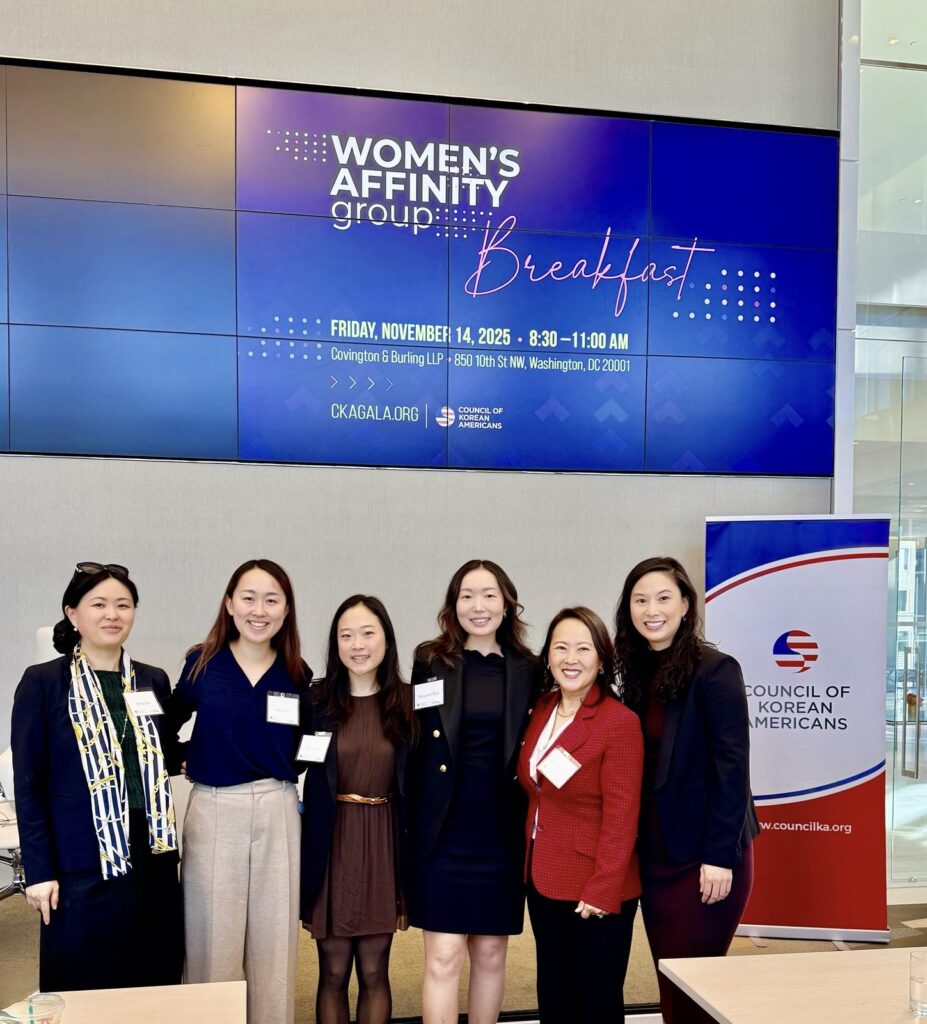
of Directors. Photo courtesy of Hana Sexton.
These are among the most prominent Korean-American organisations in the United States.
Because I have an American MBA and practical experience of foreign-service life, I am able to engage with policy, academic and business environments. I understand the language used in those circles and can find a sense of belonging there.
This is a significant step forward. Awareness of the Koryo-Saram experience is gradually growing, but much more work remains to be done.
Korean-American organisations are increasingly aware that the Korean diaspora is not limited to migration directly from the Korean Peninsula. It also includes communities shaped by life in China, Japan, Central Asia, Russia and other parts of the world.
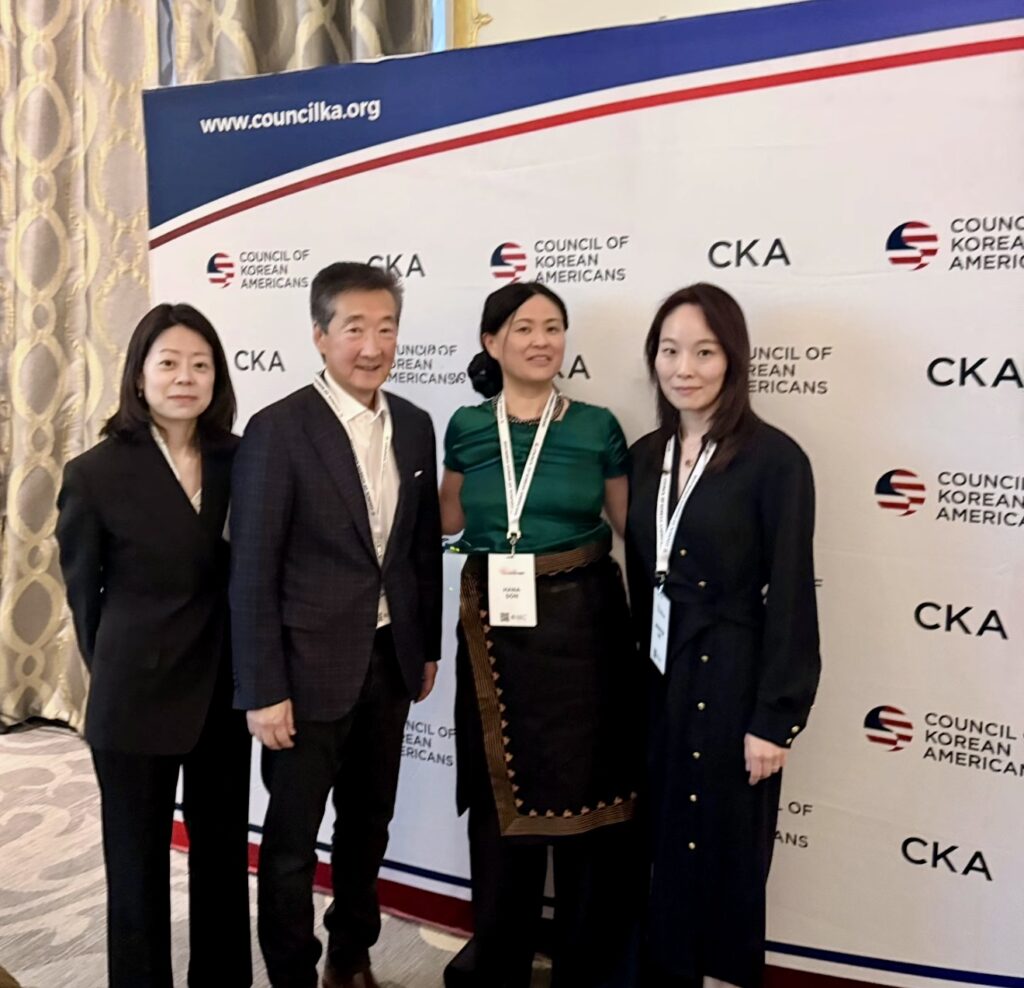
The Koryo-Saram experience adds an important dimension to that wider history. It shows how Korean identity survived and changed under Russian imperial rule, Soviet repression, Central Asian integration and post-Soviet migration.
Uzbekistan has qualified for its first FIFA World Cup, and Central Asia is receiving increasing international attention. Do you think this growing visibility is also creating greater interest in the region’s Korean communities, or do the Koryo-Saram remain largely overlooked?
Uzbekistan’s World Cup qualification has undoubtedly increased Central Asia’s international profile. However, its effect on the visibility of the Koryo-Saram is likely to remain indirect and relatively limited.
The community is still underrepresented in Western media. Without deliberate cultural, journalistic or diplomatic outreach, Koryo-Saram history can easily remain overlooked, even as international interest in Central Asia increases.
Nevertheless, any positive attention given to Central Asia helps us in the broader sense. When more people become curious about Uzbekistan, Kazakhstan and the wider region, there is a greater opportunity to introduce them to the communities that have contributed to its social and cultural development.
Read more on Novastan: Uzbekistan at the World Cup: The White Wolves Enter the Global Stage
Several internationally known figures have Koryo-Saram heritage or partial Koryo-Saram ancestry.
They include Lomon, also known as Park Solomon, the Uzbekistan-born South Korean actor; Nellie Kim, the Olympic gymnastics champion; and Gennadiy Golovkin, the world boxing champion.
Figures such as these undoubtedly contribute to the visibility of the diaspora. Yet the wider history of the Koryo-Saram remains much less well known than their individual achievements.
How are younger generations engaging with their multiple identities – Korean, Central Asian, Russian-speaking and American? Are there particular challenges in preserving language, culture and historical memory?
America seems to me to be an ideal place in which to preserve culture.
Because many of our organisation’s activities revolve around culture and heritage, I have met Korean Americans who immigrated to the United States more than 40 years ago. This includes both Koreans from the Korean Peninsula and Koryo-Saram Koreans.
Some have preserved as “heritage” cultural practices and social norms that are no longer common in contemporary South Korea or in post-Soviet countries. Diaspora communities sometimes preserve a version of culture that reflects the period in which people emigrated.
I did not grow up in the Soviet Union, and I always felt that I had a strong sense of American individualism. I was never afraid to be different, even though I grew up without Americans around me.
Ironically, it was in America that I encountered what I considered a Soviet mentality most clearly. That experience helped me recognize how different I was from what I understood as a stereotypically Soviet mentality.
In a similar way, one may encounter patriarchal South Korean social norms in some Korean-American communities even when those norms no longer exist in exactly the same form in contemporary South Korea.
There is no single model for younger Koryo-Saram.
Some are not merely preserving their multiple identities. They are reinventing them in ways that reflect both their heritage and the globalised world in which they live.
Others in the United States currently show little interest in their background or in what their ancestors experienced. It can be very comfortable to become a fully integrated American.
Many Koryo-Saram already possess a global outlook and have relatively little difficulty integrating into American society.
At the same time, I believe the community carries shared generational trauma. When you work with Koryo-Saram for long enough, you may notice certain behavioural patterns even among people who do not speak Russian or who do not publicly identify as Koryo-Saram.
Language loss remains one of the greatest challenges. Many younger people no longer speak Koryo-mar or Korean. Some do not speak Russian either. In such cases, identity is transmitted through food, family stories, names, photographs, celebrations and memories rather than language.
Historical memory can also become fragmented. A young person may know that a grandparent was deported but may not know the details. Another may know the family’s migration route but feel little emotional connection to it.
Preservation therefore requires more than nostalgia. It requires education, documentation, community spaces and opportunities for younger generations to interpret the history in their own way.
Looking ahead, what projects are you currently working on, and where do you see the greatest opportunities for cooperation between Koryo-Saram communities in the United States, Central Asia and South Korea?
We are preparing to participate in a Korea Liberation Day event, and I hope we will make history by participating for the first time in the upcoming Council of Korean Americans Summit in Los Angeles.
Koryo-Saram communities in the United States, Central Asia and South Korea share a common heritage. They can build on this to develop cultural, economic and educational cooperation.
Cultural preservation and exchange
Koryo-Saram communities in Kazakhstan and South Korea have worked for years to revive Korean traditions, language and cuisine.
In the United States, where the Koryo-Saram population is growing, there is also increasing interest in Korean heritage.
Cooperation could include joint cultural festivals and language-immersion programmes connecting communities in America, Central Asia and South Korea.
Youth-led initiatives in Kazakhstan, including Korean Sunday schools, could inspire similar programmes in the United States and South Korea. Such initiatives would help younger generations build a stronger sense of identity and shared history.
Economic and business cooperation
Projects such as K-Park in Alatau City, Kazakhstan, demonstrate how Koryo-Saram entrepreneurs can strengthen economic links between Kazakhstan and South Korea.
Koryo-Saram in the United States could act as an additional bridge, connecting Central Asian and South Korean businesses with American markets.
Promising sectors include Korean culture, Korean food, technology and creative industries.
Cooperation could take the form of co-branded products, joint ventures, professional networks and investment platforms linking the three regions.
Education and research
Koryo-Saram descendants in the United States, Central Asia and South Korea possess increasingly strong academic and professional networks.
Cooperation could include joint research on Korean history, diaspora studies, migration and cultural adaptation, as well as student and scholar exchanges.
Universities in South Korea, Central Asia and US cities with significant Korean populations, including New York and Los Angeles, could establish partnerships focused on heritage, language and diaspora studies.
There is still a great deal of Koryo-Saram history that remains insufficiently documented, especially at the family and community levels.
Tourism and heritage tourism
K-Park in Kazakhstan is intended to serve as both a cultural landmark and an economic hub.
Similar initiatives could be developed in the United States and South Korea. Heritage tourism routes could connect significant Koryo-Saram locations and communities across several countries.
Visitors could learn about Korean culture as it developed in the Russian Far East, Central Asia, South Korea and the United States.
Such projects could contribute to cultural diplomacy and deepen mutual understanding.
Policy and diaspora engagement
Given the strong diplomatic ties between South Korea and the Central Asian states, Koryo-Saram communities could advocate for policy frameworks that support diaspora engagement.
This could include cultural grants, support for research and education, diaspora investment incentives, easier routes to legal status or naturalisation and greater recognition of Koryo-Saram heritage in national historical narratives.
The greatest opportunities lie in cultural revitalisation, cross-border business networks, educational partnerships, heritage tourism and policy advocacy.
By pooling resources and networks across the United States, Central Asia and South Korea, Koryo-Saram communities can strengthen their shared identity while contributing to sustainable cultural and economic development.
Finally, if there is one message you would like Novastan’s readers to take away about the Koryo-Saram experience, what would it be?
The Koryo-Saram story is not simply a footnote in Korean history.
It is a living testament to resilience, cultural endurance and the quiet power of identity in the face of displacement and erasure.
For more than a century, the Koryo-Saram have navigated migration, forced deportation, language loss and assimilation. Yet they preserved elements of Korean culture through food, theatre, newspapers, music, family celebrations and community gatherings.
Our journey demonstrates that identity is not static. It evolves, adapts and endures.
History is not preserved only in official documents. It also survives through everyday acts of remembrance: cooking morkovcha, preparing family dishes, maintaining traditions, telling children about their grandparents or performing traditional dances at family celebrations.
The Koryo-Saram story is one of endurance with dignity, adaptation with pride and the belief that heritage can remain alive even when the ancestral homeland is far away.
It is also a call to recognise and honour such histories, not as isolated curiosities, but as vital threads in the global story of human resilience.
Interview conducted and edited by Mathieu Lemoine.
Photographs courtesy of Hana Sexton.
Mathieu Lemoine, Editor-in-Chief for Novastan-English