




 Zainab Entezar: “Vulnerability is not the opposite of resistance”
Support Novastan, the European Central Asia magazine
By supporting Novastan, you are supporting the only English, French and German-language media specialising in Central Asia. We’re independent and we need your help to stay that way!In Shot the Voice of Freedom, Afghan filmmaker Zainab Entezar documents women organising protests against Taliban rule, capturing not only their courage in the streets of Kabul but also the fears, disagreements and difficult decisions behind their resistance. Speaking to Novastan Editor-in-Chief Mathieu Lemoine, she reflects on the personal costs of activism, the ethical challenges of clandestine filmmaking, and why Afghan women must be recognised as more than victims of repression.
When the Taliban returned to power in Afghanistan in August 2021, women were progressively excluded from education, employment and public life. Yet despite the growing restrictions and dangers, groups of Afghan women continued to organise demonstrations, demanding their fundamental rights and refusing to disappear from public view.
Read more on Novastan: “I survived things. But I also built things”: Nilofar Ayoubi on Afghan women, exile and resistance
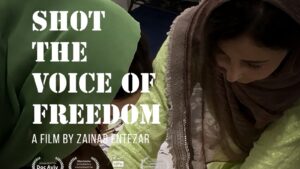
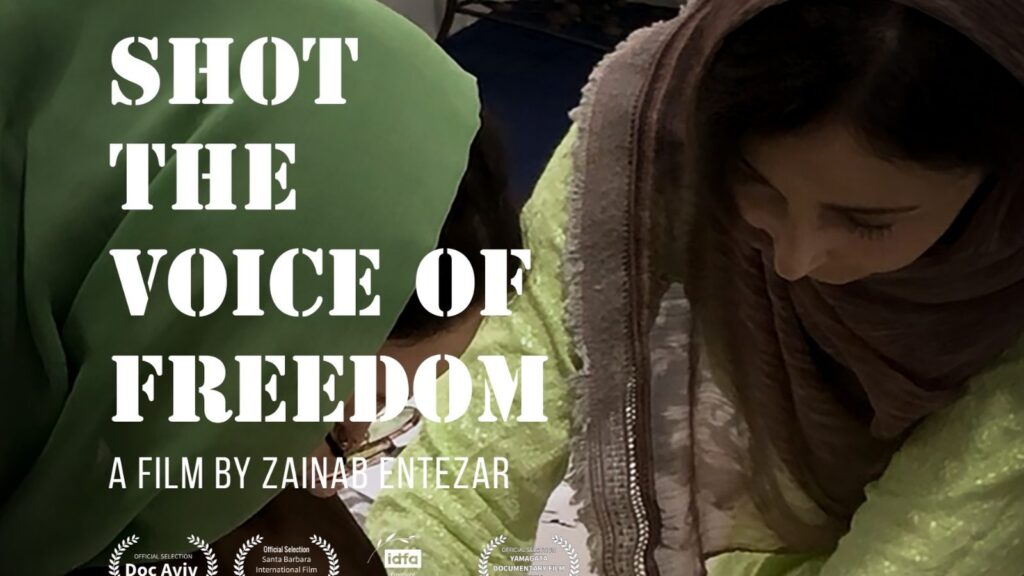
For Afghan filmmaker Zainab Entezar, their resistance became the subject of Shot the Voice of Freedom (2024), a documentary that follows two sisters, including activist Reshmin, and other women organising protests in Kabul. Filmed partly in secret, the documentary moves between the streets, where demonstrations take place under the watch of armed Taliban members, and private homes, where the women plan their actions, confront opposition and grapple with the consequences of their decisions.
Rather than presenting its protagonists solely as victims or symbols of extraordinary bravery, the film offers a more intimate portrayal of resistance, revealing the uncertainty, vulnerability and determination behind public acts of defiance.
Premiering at the International Documentary Film Festival Amsterdam (IDFA) in 2024, Shot the Voice of Freedom is also being presented at the 2026 Asian Film Festival Barcelona. Meanwhile, Entezar’s latest documentary, 771 Days (2026), turns towards her own experiences living under Taliban rule before leaving Afghanistan.
In an interview with Novastan, Entezar discusses the relationship between cinema and resistance, the responsibility of documenting people at risk, and the challenges of telling Afghan women’s stories from exile.
What initially motivated you to document the resistance of Afghan women, and how did your own experience as an Afghan woman and filmmaker shape the story you wanted to tell?
For me, documenting the resistance of Afghan women was not simply a cinematic choice. It was deeply connected to my own life, experiences, and the reality in which I was living.
When the Taliban returned to power in 2021, Afghan women gradually faced increasingly severe restrictions on their education, work, social participation, and personal freedoms. What struck me most, however, was that despite these restrictions, women refused to remain silent. They took to the streets, protested, found one another, and tried to make their voices heard internationally, even when they knew they might pay a heavy price for doing so.
Read more on Novastan: From Madrid to Kabul: An Afghan Diplomat on Spain, the Taliban and the Republic’s Collapse
As an Afghan woman and filmmaker, I could not remain indifferent to this reality. I felt that if these moments were not documented, an important part of the history of Afghan women’s resistance might be overlooked, or others might tell their stories on their behalf.
With Shot the Voice of Freedom, I wanted the camera to do more than simply witness repression. I wanted it to show how women think, make decisions, experience fear, question themselves, and continue resisting despite everything. It was important to me to portray them not only as victims of an oppressive system, but as human beings with their own agency, ideas, and capacity to make choices.
The film is an attempt to document a moment in history when Afghan women continue to fight for their right to be present and to speak, despite efforts to silence them.
Through Reshmin and the other women you followed, what did you come to understand about the personal costs of resistance? How did you portray their vulnerability without reducing them to victims?
One of the most important things I came to understand while making this film is that resistance does not begin only when a woman stands in the street and raises her voice. Sometimes it begins much earlier, when she decides at home that she will go out, confront her fears, or stand up to opposition from people closest to her.
For the women in the film, the cost of resistance was not limited to the risk of arrest or violence in the streets. Their decisions could affect family relationships, their sense of security, their future, and even their relationships with the people they loved. Sometimes, alongside the repression they faced outside, they also had to confront fear and opposition within their own homes.
Through Reshmin and the other women, I came to understand more deeply that courage does not mean being unafraid. They were afraid, they worried, and they discussed the possible consequences of their decisions. But fear did not necessarily prevent them from acting.
When telling their stories, I did not want to turn these women into idealised, almost untouchable heroines. They are real people who are sometimes certain of their decisions, sometimes hesitant, and sometimes in disagreement about the path ahead. I believe that showing these complexities is more meaningful than presenting an unrealistically perfect image of courage.
Vulnerability is not the opposite of resistance. Sometimes, the meaning of resistance becomes clearest when a woman expresses her fear and still decides to continue fighting.
Much of the documentary unfolds inside homes, where women discuss their plans, confront disagreements and prepare for demonstrations. How did you approach the relationship between these private spaces and the streets of Kabul?
For me, the home and the street are not separate spaces. They are two parts of the same political and social reality.
In the streets, resistance becomes more visible. Women gather, chant slogans, and publicly oppose the Taliban’s policies. But before they reach the streets, important decisions are made at home. Women discuss when and how to protest, share their concerns, and sometimes have to make difficult decisions about the dangers awaiting them.
In the film, the home is not simply a place of refuge from danger. It also becomes a space for discussion, planning, disagreement, and political decision-making. In a society where women’s presence in public life is severely restricted, these conversations and relationships take on particular significance.
It was important to me to document these moments because I did not want the audience to see only the final result: women protesting in the streets. I wanted viewers to understand that behind every demonstration lies a series of decisions, anxieties, human relationships, and collective efforts.
These scenes also show that women’s resistance does not always take the form of a large, formally organised movement. Sometimes it begins with communication between a few women, mutual trust, and a decision made in a small, private space.
For this reason, I see both the home and the street as spaces of resistance: one where decisions take shape, and the other where those decisions become a visible public presence.
The documentary includes footage filmed secretly during demonstrations. What ethical dilemmas did you face, and how did you balance making women’s struggle visible with protecting their safety?
This was one of the most difficult aspects of making the film, because the camera could be both a tool for documenting the truth and, under certain circumstances, a source of danger for the people in front of it.
Filming demonstrations in the presence of armed Taliban members involved serious physical risks. But the question was not only about my own safety as a filmmaker. The footage could potentially be used to identify women, investigate their relationships, or put pressure on them and their families.
In these circumstances, one question was always important to me: could making an image visible to the world create a cost for the person in it that they should never have to bear?
Making a film about women’s resistance did not mean that I had the right to publish everything I had recorded without considering the consequences. Recording an image and deciding to publish it are two different responsibilities. A filmmaker must think not only about what they want to show, but also about the risks that its publication might create.
For this reason, the safety and privacy of the people featured in the film have been fundamental concerns for me. Under such circumstances, decisions about how footage is used, how much information is shared with audiences, and which details might lead to someone’s identification require particular care.
At the same time, I did not want fear of danger to result in all evidence of women’s resistance disappearing. If no images remain, those who want to deny this resistance may find it easier to erase it from public memory.
For me, the filmmaker’s responsibility lies in finding a balance between these two obligations: documenting the truth and protecting the people who have trusted us with their stories. No film should be made at the expense of recklessly endangering the people whose lives it seeks to represent.
One particularly disturbing element of the film is footage showing women making statements after their arrests. What did you want viewers to understand through the contrast between these images and the women’s own voices throughout the documentary?
For me, these images are among the most significant parts of the film because they show that repression does not end with restricting women’s actions. It can also involve attempts to control the narrative surrounding those actions.
When a woman takes to the streets to protest, she is trying to speak about her circumstances, her rights, and the future of her society. But when that same woman appears after being arrested, in circumstances where her words may be subject to pressure and control, the issue is no longer simply whether she can be present in the streets. It becomes a question of who is allowed to determine the meaning of her protest.
Placing these images alongside the women’s voices and conversations elsewhere in the film was important to me. By that point, the audience has already encountered their thoughts, concerns, aspirations, and disagreements. When viewers subsequently see the footage recorded after their arrests, they can reflect on the difference between a woman’s independent voice and a narrative that may have been imposed on her under pressure.
I did not want simply to tell the audience how to interpret these images. Instead, I wanted the contrast to emerge through the structure of the film, allowing viewers to think about it and draw their own conclusions.
The footage also reminds us that power is exercised not only through arrest and restriction, but sometimes through attempts to control the meaning of events themselves. In such circumstances, preserving women’s independent voices and documenting what they said before being silenced become particularly important.
Your film portrays women as political actors rather than simply as victims of repression. Has international media coverage adequately reflected this agency? And what forms of solidarity would make a meaningful difference today?
I believe international media have played an important role in bringing Afghan women’s voices to the world. However, there remains a considerable gap between making women’s suffering visible and recognising them as independent political actors.
Many accounts of Afghanistan focus on the restrictions, violence, and deprivation that women experience. These realities must be documented and reported. But when the narrative is limited to suffering, an essential part of the truth is overlooked: Afghan women continue to think, make decisions, organise, resist, and find ways to fight for their future.
Afghan women are not only people whose rights have been taken away. They are also people actively fighting to reclaim those rights. I believe the distinction between these two perspectives is crucial.
Since 2021, Afghan women have repeatedly demonstrated that, despite repression and restrictions, they are not prepared to simply abandon their social and political presence. However, international solidarity has not always matched the courage these women demonstrate or the price they pay. Media attention alone is not enough, just as expressions of political concern cannot bring meaningful change without effective action.
Meaningful solidarity must begin with listening to women themselves. This means supporting their independent initiatives, creating opportunities for their voices to reach international audiences, supporting artists and human rights defenders at risk, and preserving opportunities for Afghan women to work professionally and participate in cultural life.
Read more on Novastan: Beyond the ‘Graveyard of Empires’: Rethinking the Afghan State
It is also essential that Afghan women do not receive attention only when a major crisis or news event occurs. Their resistance is not a passing headline. It is a long-term struggle that requires sustained attention, support, and accountability.
I do not expect a film, by itself, to change the political situation in Afghanistan. But I hope it can help audiences see women not only through the lens of repression, but also through their determination, ideas, and struggle.
How has living in exile changed your relationship with Afghanistan and the stories you want to tell? What are the challenges of documenting a society to which you can no longer freely return?
Exile has changed my relationship with Afghanistan, but Afghanistan remains an inseparable part of my life, identity, and work. Physical distance does not mean that my connection with its people, realities, and stories has disappeared.
As a filmmaker, before going into exile, I could be physically present in the society I was documenting and experience its realities more directly. When you are forced to leave your country, however, your relationship with that society becomes more complicated. You can no longer move freely as you once did, enter every space, or document people’s everyday lives without concerns about the security consequences.
One of the greatest challenges is finding a balance between physical distance and human closeness. On the one hand, you no longer live in the same geographical space. On the other, the stories you want to tell still concern real people who remain there and may be exposed to danger.
This situation makes the filmmaker’s responsibility even greater. You must pay attention to the information you receive, the limitations on access, the security of your sources, and the possibility that images or stories could be misused. You must also ensure that physical distance does not lead you to oversimplify the complexities of people’s lives.
At the same time, exile has allowed me to look at certain experiences from a different perspective. When you are far from your country, you sometimes come to understand more deeply the meaning of home, freedom, belonging, and loss. These experiences have naturally influenced my perspective on cinema and the stories I choose to tell.
I continue to see myself as a filmmaker who makes films about Afghanistan and its people. My place of residence has changed, but the responsibility I feel towards the stories of this society remains.
Your latest documentary, 771 Days, turns towards your own experiences under Taliban rule. What prompted you to tell your own story, and how do you see the relationship between the two films?
For me, making 771 Days did not mean abandoning the stories of other women and turning towards an entirely separate subject. It was a continuation of the path I had begun by documenting Afghan women’s experiences, but this time the camera turned more directly towards my own life.
In Shot the Voice of Freedom, I sought to document the lives and resistance of women who continued fighting to make their voices heard despite restrictions and danger. I was present alongside them as a filmmaker, trying to portray their experiences and decisions.
But with 771 Days, I faced an experience that I could no longer observe simply from the outside. The film explores 771 days of my own life under Taliban rule, a period that profoundly affected me as a woman, mother, filmmaker, and writer. In this film, my personal experience and my struggle to preserve my identity and my ability to continue living and working become central to the story.
Deciding to tell my own story was not easy. When filmmakers tell other people’s stories, they must take responsibility for how those lives are represented. But when you become the subject of your own film, you face additional questions: What should you reveal? How can you transform a personal experience into a cinematic narrative? And how can you tell your story honestly without claiming to represent every Afghan woman?
I believe the connection between these two films lies precisely here. Both are about the struggle to preserve one’s voice, identity, and capacity to make choices under a system of political power that seeks to restrict them. One follows women’s collective resistance at close range, while the other tells the personal story of a woman confronting the same political reality.
I do not want international audiences to finish watching my films feeling only sadness about the situation of Afghan women. I want them to know these women, listen to what they have to say, and understand the complexity of their lives. Afghan women are not merely symbols of suffering. They are filmmakers, writers, mothers, students, activists, and individuals with their own aspirations, decisions, and different visions of the future.
If audiences come away from these two films understanding that women’s resistance does not happen only in the streets or in moments of public protest, but also in the struggle to continue living, preserve one’s identity, tell the truth, and refuse to remain silent, then I will feel that I have communicated something essential about what I wanted to express.
By Mathieu Lemoine, Editor-in-Chief for Novastan English.