 Bunyodkor Tashkent: the prestige project that tried to put Uzbek football on the world map
Special series – The Clubs Behind Uzbekistan’s World Cup Dream
As Uzbekistan plays in its first-ever FIFA World Cup after a historic qualification campaign, Novastan looks at the clubs that shaped the country’s football identity. From Soviet-era Pakhtakor Tashkent to regional powerhouses such as Nasaf Qarshi, Navbahor Namangan and Neftchi Fergana, this series explores how club football helped build the foundations of the White Wolves’ rise.
In 2008, Uzbek football briefly became one of the strangest stories in the global game. A young Tashkent club, only three years old, claimed it was close to signing Samuel Eto’o from Barcelona, actually signed Rivaldo, hired Zico, and then brought in Luiz Felipe Scolari, Brazil’s 2002 World Cup-winning coach. Its name was Bunyodkor, meaning “creator” or “builder”, and for a few years it seemed to offer a new idea: that Uzbek football could force its way into international visibility through money, infrastructure and famous names.
Bunyodkor is unlike the other clubs in this series. Pakhtakor Tashkent carries Soviet memory and national tragedy. Nasaf Qarshi represents regional achievement and Asian success. Navbahor Namangan embodies popular passion in the Fergana Valley. Neftchi Fergana recalls the early years of independent Uzbek football. Bunyodkor belongs to a different category. It was not an old community club or a regional football institution. It was a project: fast, ambitious, spectacular and deeply tied to the political economy of late Karimov-era Uzbekistan.
The club was founded on 6 July 2005 as Neftgazmontaj-Quruvchi, usually shortened to Kuruvchi, meaning “builder”. The name reflected its origins in construction and energy-linked structures. In 2008, after rapid sporting success, the club was renamed Bunyodkor. The new name, often translated as “creator” or “builder”, suited its self-image. This was a club built quickly, with the aim of doing quickly what most football institutions take decades to achieve.
Its rise was immediate. After starting in the lower divisions, Bunyodkor moved rapidly through Uzbek football. It finished second in the 2007 Uzbek League, then won the championship in 2008, 2009, 2010, 2011 and 2013. It also won the Uzbek Cup four times, in 2008, 2010, 2012 and 2013, and the Uzbek Super Cup in 2014. In less than a decade, it became one of the most decorated clubs of independent Uzbek football.
Also read on Novastan: Uzbekistan at the World Cup: The White Wolves Enter the Global Stage
But domestic success alone was not what made Bunyodkor famous. The turning point came in 2008, when the club tried to place itself in the global football conversation. The first episode was Samuel Eto’o. Kuruvchi publicly claimed that it had signed the Barcelona striker on a short-term contract. Eto’o travelled to Tashkent and gave a skills session, but the transfer never happened. Barcelona denied that a completed deal existed, and Eto’o remained in Europe. The episode mattered less because Eto’o played for the club – he did not – than because it showed Bunyodkor’s new method: using global football names to make the world look at Tashkent.
Support Novastan, the European Central Asia magazine
By supporting Novastan, you are supporting the only English, French and German-language media specialising in Central Asia. We’re independent and we need your help to stay that way!Rivaldo was different. He actually came. In August 2008, the Brazilian World Cup winner and former Ballon d’Or winner left AEK Athens for Bunyodkor. Reports described the contract as one of the most lucrative ever offered by a Central Asian club. For an Uzbek club, this was extraordinary. Rivaldo’s arrival gave Bunyodkor instant global recognition. For the first time, a club from Uzbekistan was not being discussed only in Asian football circles, but in the international sports press.
His presence was more than symbolic. Rivaldo played for Bunyodkor between 2008 and 2010, scored regularly and became the club’s international face. He brought glamour, but also credibility. The idea of an Uzbek club employing a player who had won the World Cup with Brazil and starred for Barcelona would have sounded impossible only a few years earlier. Bunyodkor made it real.
Also read on Novastan: Pakhtakor Tashkent: The Club That Carries Uzbek Football’s Memory
The club then added another Brazilian legend, this time on the bench. Zico arrived as head coach in September 2008. His stay was brief, but successful. Under him, Bunyodkor won the Uzbek league and cup double and reached the semi-finals of the AFC Champions League. That continental run was important because it showed that the project was not only spectacle. Bunyodkor could also compete seriously in Asia.
In 2009, the club went further by appointing Luiz Felipe Scolari. Scolari had led Brazil to the 2002 World Cup and had recently left Chelsea. In Tashkent, he was reunited with Rivaldo, one of the stars of his World Cup-winning Brazil side. His contract was reported to make him one of the world’s best-paid football managers at the time. Bunyodkor’s domestic dominance continued, but the experiment did not last. Scolari left in 2010, less than a year into his contract, and Rivaldo also departed that year.
The money behind this period remains central to the story. Officially, Bunyodkor’s early sponsors were linked to construction and oil-gas structures, and later to state-linked companies such as Uztransgaz. During the Rivaldo and Scolari years, international reporting connected the club’s big-spending model to the opaque political economy of Karimov-era Uzbekistan, including companies and elite networks close to the presidential family. The precise ownership and financing arrangements were never fully transparent, and that opacity is part of the club’s history. Bunyodkor was not only a football club with rich sponsors; it was a product of a specific political moment, when energy money, elite business networks, international branding and football spectacle briefly came together.
When the money became less reliable, the illusion of unlimited ambition faded quickly. Rivaldo later pursued unpaid wages. Scolari left. Zeromax ran into serious trouble. Bunyodkor remained an important Uzbek club, but the era when it could plausibly attract Brazil’s biggest football names was over.
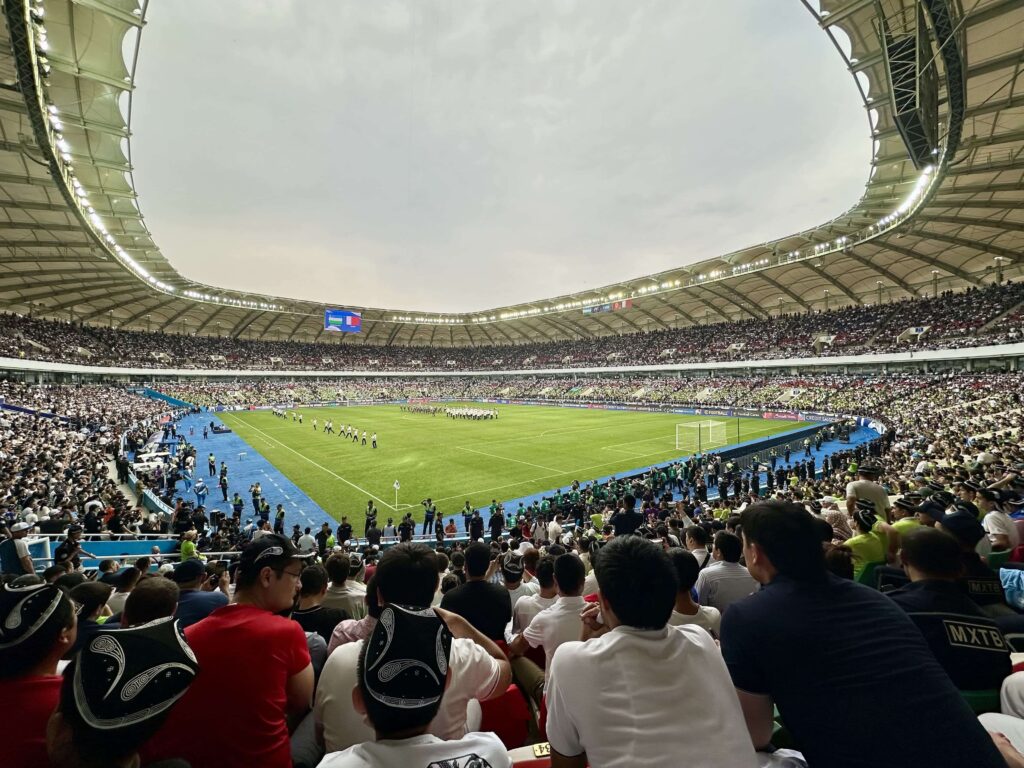
The club’s stadium tells a parallel story. Bunyodkor initially played at smaller Tashkent venues, including the MHSK and JAR stadiums. In 2012, the new Bunyodkor Stadium opened in Tashkent with a capacity of around 34,000 spectators. Later renamed Milliy Stadium, although the Bunyodkor name has remained closely associated with the venue, it became one of Uzbekistan’s main football arenas and an important home for the national team. The stadium gave the club a physical monument to its ambitions: modern, large and clearly designed to project national football confidence.
Bunyodkor’s nicknames also reveal how it wanted to be seen. The club is commonly known as Qaldirg‘ochlar, “the Swallows”, a nickname that gives it a more elegant and modern identity than the industrial or regional names of many older Uzbek clubs. It has also been called the “Asian Barcelona”, a label linked to the club’s attempted relationship with Barcelona, its Brazilian stars and its dream of becoming a stylish continental power. These labels matter because Bunyodkor was always more than a team on the pitch. It was also a brand, a projection of ambition and a claim that Uzbek football could belong in a wider global conversation.
Also read on Novastan: Nasaf Qarshi: the club that put Uzbek football on Asia’s map
Yet Bunyodkor’s fan identity is more complicated than that of clubs such as Navbahor or Neftchi. Navbahor has the emotional weight of Namangan. Neftchi has Fergana’s industrial memory and early independence dominance. Pakhtakor has generations of Soviet and post-Soviet supporters. Bunyodkor is younger and more constructed. Its fans are mostly Tashkent-based and linked to a newer football culture: urban, stadium-centred, and associated with the club’s years of success rather than with decades of inherited loyalty.
This does not mean the club lacks supporters. Bunyodkor’s rise, stars, stadium and trophies gave it visibility, especially among younger fans in Tashkent. But its supporter culture has never carried the same mythology as Pakhtakor’s tragedy, Navbahor’s packed stands in Namangan or Neftchi’s Sarkisyan-era memory. Bunyodkor’s fan base is a product of modern Uzbek football: newer, more media-driven, and shaped by success, branding and academy football.
The club’s place in popular culture is also different. Pakhtakor has been celebrated in songs and public memory. Navbahor’s culture lives strongly through supporters, fan pages and stadium chants. For Bunyodkor, there does not appear to be a clearly documented famous pop song comparable to Pakhtakor’s songs by well-known Uzbek performers. Its pop-cultural footprint comes instead from spectacle: the astonishing arrival of Rivaldo, the Eto’o episode, Scolari in Tashkent, the “Asian Barcelona” label, and the image of a club that briefly made Uzbekistan visible in global football gossip.
That may be Bunyodkor’s most distinctive cultural role. It did not enter Uzbek popular culture mainly through music or folklore. It entered it through headlines. For a few years, the club made people ask: how could Rivaldo be in Tashkent? Could Eto’o really come? Why was Scolari coaching in Uzbekistan? Bunyodkor became a football story that sounded almost unreal, and that unreality was part of its appeal.
Also read on Novastan: Discussions sur le développement du football féminin au Kazakhstan
There were also real footballers behind the spectacle. Mirjalol Qosimov, one of Uzbekistan’s great football figures, coached the club before and after the Brazilian era and helped give it a domestic football identity. Server Djeparov, one of the best Uzbek players of his generation and a two-time Asian Footballer of the Year, played for Bunyodkor. Rivaldo brought global fame, but players like Qosimov and Djeparov connected the club to Uzbek football’s own hierarchy of talent and authority.
Bunyodkor also became part of the careers of players who now define Uzbekistan’s World Cup generation. Eldor Shomurodov played for Bunyodkor from 2015 to 2017 before moving to Rostov in Russia, the transfer that opened the path to Serie A and later to his role as Uzbekistan’s captain. Abdukodir Khusanov, now one of the most internationally visible Uzbek players after his move to Manchester City, also passed through Bunyodkor’s academy before leaving for Belarus and then moving through Lens to English football. In this sense, Bunyodkor’s future may be more important than its past glamour: not as a club that buys stars, but as a club that helps produce them.
This is where the hope for the future lies. Bunyodkor is unlikely to repeat the Rivaldo-Scolari moment. That period belonged to a specific political and financial environment that no longer exists in the same form. But the club still has assets that matter: a recognised name, a major stadium environment, an academy tradition, experience in Asian competitions and a place in the capital’s football ecosystem. If it builds from youth development rather than spectacle, Bunyodkor can remain important to Uzbek football in a more sustainable way.
The club’s recent position suggests a more modest but potentially healthier phase. It is no longer the overwhelming force of 2008-2013, and it no longer looks like a club trying to buy global attention. But that may not be a weakness. Bunyodkor’s next chapter could be less glamorous and more useful: developing young players, competing domestically, returning to Asian relevance and contributing to the national team’s talent pipeline.
That would also change the meaning of its name. “Bunyodkor” means builder. In the late 2000s, the club tried to build international prestige from the top down, with money, names and spectacle. In the future, it may have to build differently: from academy fields, coaching structures, scouting and patience.
This is why Bunyodkor belongs in a series about the clubs behind Uzbekistan’s World Cup dream. Not because it is the deepest-rooted club in the country, and not because its big-money years offer a model to copy. It matters because it shows one of the boldest and most contradictory experiments in Uzbek football history. It brought global attention to Tashkent. It produced real trophies. It reached the AFC Champions League semi-finals. It revealed the risks of opaque money and prestige politics. And, through players such as Shomurodov and Khusanov, it still connects to the generation carrying Uzbekistan onto the World Cup stage.
Pakhtakor is memory. Nasaf is regional achievement. Navbahor is passion. Neftchi is early independence power. Bunyodkor is ambition – brilliant, excessive, fragile, and still unfinished.
Mathieu Lemoine, Editor-in-Chief for Novastan-English