


 “My Childhood Was Spent on the Shore of a Sea That No Longer Exists”
Support Novastan, the European Central Asia magazine
By supporting Novastan, you are supporting the only English, French and German-language media specialising in Central Asia. We’re independent and we need your help to stay that way!Archaeologist and museum specialist Oktyabr Dospanov on the lost world of Muynak, the memory of the Aral Sea and the cultural heritage of Karakalpakstan.
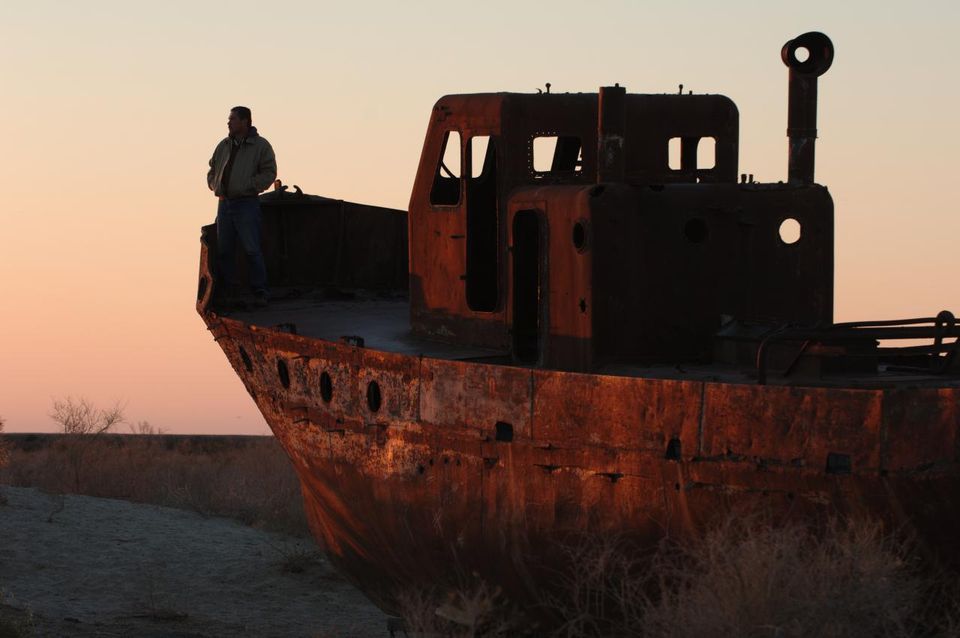
For much of the outside world, Muynak is represented by a single image: rusting ships stranded in a desert. For Oktyabr Dospanov, however, the town was once an island, a busy port and the setting of a childhood filled with ship bells, gulls, music and the smell of freshly caught fish. In this interview, the Karakalpak archaeologist and museum specialist recalls the human world that disappeared with the Aral Sea, explains why the region’s cultural history reaches far beyond the ecological catastrophe, and reflects on what should be preserved for future generations.
This interview was conducted in Russian and translated into English.
See more on Novastan: Souvenirs éphémères
The story of the Aral Sea is usually told through statistics: falling water levels, rising salinity, abandoned ports and millions of tonnes of salt and dust lifted from the exposed seabed. Those figures describe the scale of the disaster, but they cannot fully convey what it meant to lose a sea that organised the economy, culture and daily rhythms of an entire region. Dospanov belongs to the last generation that remembers the Aral as an ordinary presence rather than a vanished world. Born in Muynak, he later became an archaeologist and museum specialist. His professional path began in 1979, when Igor Savitsky invited him to join an expedition at Janpyk Kala, an ancient Khorezmian settlement near the Sultan Uvays mountains. He subsequently worked at the museum in Nukus that now bears Savitsky’s name, devoting decades to the archaeology, ethnography, art and environmental history of Karakalpakstan.
Novastan: You grew up in Muynak when it was still a living port. What kind of town was it?
Oktyabr Dospanov: My childhood was spent in Muynak, which at that time was a real island in the Aral Sea. For me, it is not simply my birthplace. It was an entire world, filled with sounds, smells and the feeling of continuous life. It is difficult today to imagine that Muynak was once one of the region’s largest fishing centres.
The town’s life was inseparable from the sea. There were five large fishing collectives, twelve fish reception points and two cargo ports. One was in Muynak itself, on the shore, and the other was around twenty kilometres away at Usay, on the opposite side of the island. The fishing industry set the rhythm of the whole town.
Muynak seemed never to sleep. Even late at night, people were always walking through the streets: some going to work, others returning after their shift. Work continued around the clock. I can still hear the ship bells, the grinding of the port cranes, and the hum of fishing vessels and engines. These sounds were a natural part of everyday life.
The city was also remarkably diverse. Engineers, sailors, fishermen, teachers, doctors, scientists and artists came from across the Soviet Union. Karakalpaks, Uzbeks, Kazakhs, Russians, Tatars, Koreans, Ukrainians and many others lived side by side. In the mahallas, neighbours helped one another build houses, celebrated holidays together and supported families in difficult times. That sense of community was one of Muynak’s greatest riches.
What do you remember most vividly about the sea itself?
For my generation, the Aral was not a symbol of tragedy. It was the symbol of a happy childhood, filled with the sound of waves and the cries of gulls. Hundreds of vessels stood at Muynak’s quays: cargo ships, fishing schooners, tankers, barges and tugboats. The port operated day and night. It seemed impossible that the sea could ever disappear.
The coast was rich in life. There were reed beds, lakes and wetlands, and an extraordinary number of birds: pheasants, wild ducks, flamingos, pelicans and, above all, gulls. The silver gulls that local people affectionately called ‘laughing gulls’ accompanied us from morning until evening. Fishermen watched them because they could reveal the position of shoals of fish.
I also remember the clean, fresh air. The sea did not have the harsh salty smell that people often imagine. A constant wind made even the hottest summer days easier to bear. In winter, the sea froze and the cold was severe. We swam, fished and played football on the shore. Children came to the nearby pioneer camp from many parts of the Soviet Union, and the coast had holiday homes, sanatoriums and tourist facilities.
See more on Novastan: A sécher
What remains most powerfully in my memory is not a landscape but a smell. When I was five or six, my father and his friend Ibadulla took me out in a small wooden boat. Far from the shore, we met a large fishing seiner commanded by a man named Tazhibay-aga. He showed me the bridge, the cabins and the engine room. The hold was filled with fish. I pointed to the largest one, a huge catfish, and insisted that it was a shark. Everyone laughed.
We stayed on the vessel for almost two days. I saw how the fishermen worked and lived. The engine room smelled of diesel fuel, motor oil, metal, sea moisture, fresh fish, wooden decks and salt-soaked ropes. It was sharp, but warm and alive. To me, that was the smell of the real Aral Sea. Sometimes I close my eyes and I am back there, hearing the engine and the waves against the hull.
Muynak also had a social and cultural life that is rarely mentioned. Where did young people meet?
Muynak did not live by work alone. It had two cinemas. The best known was Sputnik, just a few steps from the shore and beside the market. After an evening screening in summer, people would walk along the waterfront, listen to the waves and stay outside talking for a long time. Later, in the second half of the 1980s, the Berdakh cinema opened in another part of the city. It was a modern cultural centre for films, concerts and public events.
The cultural centre of the fish-canning plant was another important place. It had a library and hosted theatre, amateur performances, concerts and celebrations. Young people especially loved the weekend dances. Many people met their future partners there.
There were also several cafes. The most famous was Tolqyn, which means ‘wave’ in Karakalpak. It was not simply somewhere to eat or drink tea. Families celebrated birthdays and weddings there, friends met, music played, and people exchanged news and made plans.
Music was everywhere. On warm evenings, young people gathered spontaneously in courtyards, on squares or near the sea. Someone would bring a guitar, accordion or bayan, and people would sing together. There were no mobile phones or social networks. People listened to one another and spent long evenings in company. At weddings and major family celebrations, bakhshi – traditional storytellers and musicians – performed epics and legends to the accompaniment of instruments such as the dutar. Ancient oral tradition and modern youth culture existed naturally alongside each other.
When did people understand that the retreat of the sea was irreversible?
The process was gradual. The first alarming signs became visible in the late 1960s and early 1970s. At first, people hoped it was temporary and that the sea would return. A special canal was dug from the port towards the receding water so that vessels could continue to sail. But the water withdrew faster than people could adapt.
Fishermen noticed the change first. Their catches became smaller. Fewer schooners went out. Ships that had entered the port freely began to run aground, surrounded by sand and salt blown from the exposed seabed.
Read more on Novastan: Football de rue
I remember how the sound of the city changed. Muynak had always lived through the noise of its port: bells, cranes, engines, fishermen’s voices, metal cables and waves at the quays. Then came silence. It arrived almost imperceptibly, but that silence was the most frightening thing. When the ships stop sounding, when the sea can no longer be heard and the port ceases to live, you understand that more than water is disappearing. An entire world is going.
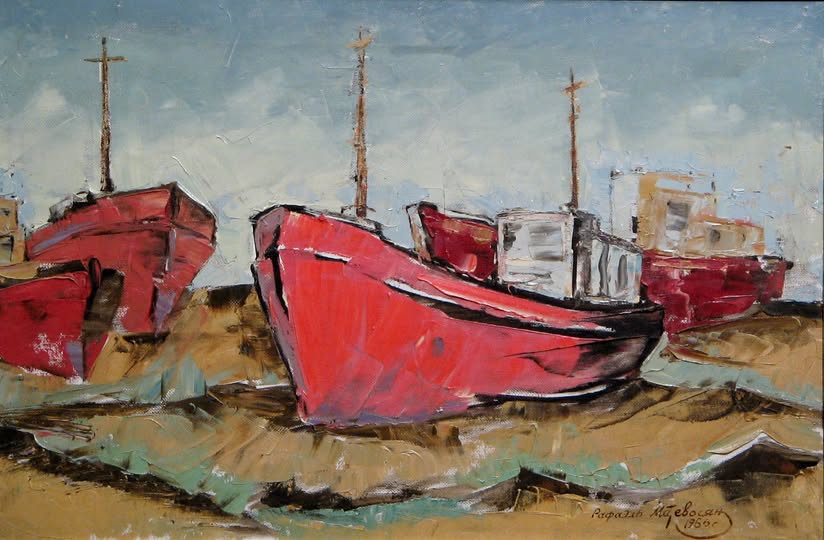
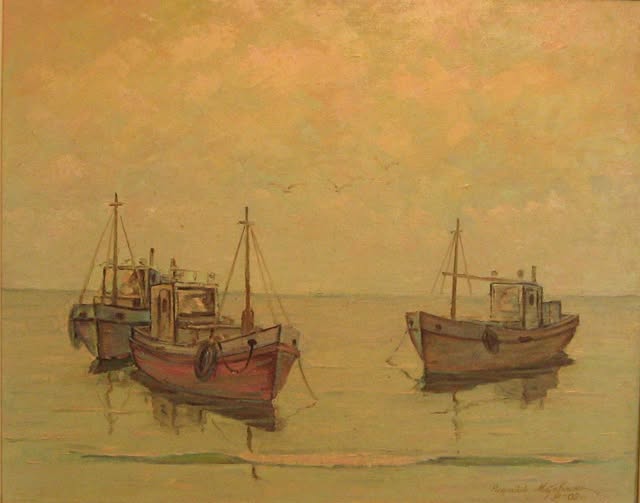
The marine painter Rafael Matevosyan, who devoted more than half a century to the Aral Sea, described an early morning when he woke to voices and crying. Residents had gathered on the shore. Overnight, the water had retreated by dozens of metres. Boats that had been moored at the pier were lying on dry sand. Some people prayed, some cried and others simply stared at the departing water. Matevosyan later captured that moment in a painting called The Sea Has Gone.
The human consequences came quickly. Enterprises closed, fishing declined and families lost their livelihoods. Many people left Muynak for other cities or republics. The city lost not only employment and population, but also confidence in its future.
“Then came silence. It arrived almost imperceptibly, but that silence was the most frightening thing.”
What disappeared with the sea beyond the fishing industry?
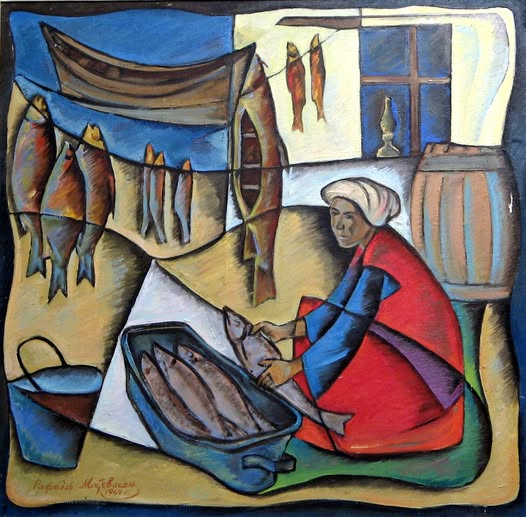
Fishing was not just a source of income. It was one of the oldest forms of economic life in the Aral region and had shaped people’s identity for centuries. Archaeological excavations reveal fish represented on ceramics, bronze objects, wall paintings and household items. Fish also appeared in carpets, embroidery, jewellery, woodcarving and textiles. It symbolised water, life and prosperity in an arid region.
For many families, fishing and factory work passed from parents to children. To work at the fish-canning plant was considered respectable. People were proud that their labour mattered to the whole country. When the sea disappeared, traditions that had formed over generations also weakened: techniques and practical knowledge, recipes and fish cuisine, songs, stories and the everyday vocabulary of life by the water.
The psychological loss was equally important. Many residents came to feel that they had been left at the edge of a lifeless desert, far from the world’s attention, with the best part of their lives behind them. When former residents meet today, they often cry. Those tears express joy at seeing one another, but also nostalgia for a world that cannot be restored.
That is why the memories of the last witnesses matter so much. There are still people who remember the port cranes, the crowded waterfront, the smell of fresh fish and the horizon of open water, but their number decreases every year. Their oral histories, family photographs, songs and personal objects are part of the region’s heritage. The Aral Sea is not merely an environmental problem. It is the fate of millions of people.
Tourists now come to photograph the ship cemetery. What do you wish they understood about Muynak?
I am glad that people are interested in our region, but I would like them to see more than an unusual tourist attraction. Behind every ship is a human life. Behind every photograph are thousands of families who lost the world they knew. Every metre of exposed seabed contains the memories of people who sailed from this port, caught fish, built homes, raised children and believed the sea would last forever.
Visitors should try to imagine another picture: an expanse of water reaching the horizon, fishing vessels returning to port, gulls overhead, children laughing on the shore and a town full of movement. Only then can they understand what was lost.
At the same time, Karakalpakstan should not be reduced to catastrophe. This region has been a crossroads of nomadic and settled civilisations for thousands of years. The art of the Aral region carries images of animals, birds, plants, water and steppe. Its carpets, textiles, jewellery, embroidery, carved wood and yurt interiors preserve symbols that connect people to the natural world. Muynak was one part of a much wider cultural landscape.
Your own career began with archaeology. How did Igor Savitsky influence you?
My path into science began in 1979, when I met Igor Vitalyevich Savitsky. He invited me to join an archaeological expedition at Janpyk Kala, one of the great monuments of ancient Khorezm on the right bank of the Amu Darya. That expedition became my school of archaeology. It showed me how rich and insufficiently studied the history of Karakalpakstan was.
Savitsky later invited me to work at the museum in Nukus. He was not only a remarkable artist, collector and museum builder. He taught a whole generation to see culture as an interconnected whole. Through him, I understood that archaeology is not simply excavation. It is a way of understanding people, their worldview and their relationship with nature, history and art.
Karakalpakstan is an open-air museum. It has hundreds of archaeological sites, from antiquity to the late medieval period. Ancient Khorezm stood at the meeting point of major Eurasian trade and cultural routes. Nomadic and settled worlds interacted here, alongside influences from Iran, the Mediterranean, the steppe, Turkic states, the Arab world and Central Asia. Irrigation systems created from at least the first millennium BCE made possible cities, fortresses, palaces and settlements in desert landscapes.
The region’s spiritual history is equally layered. Zoroastrian, Buddhist, early Christian and Islamic traditions all left traces in monuments, rituals, ornament and symbolism. Archaeology records those processes in layers of soil and objects, while oral tradition preserves them in images and stories. Both are necessary.
Savitsky’s importance also lies in the way he built the museum. When he founded it in 1966, he created departments of archaeology and ethnography alongside the art collection. He had first come to Karakalpakstan through the Khorezm Archaeological and Ethnographic Expedition, and during fieldwork he produced hundreds of paintings and drawings of archaeological sites, village life, plants, animals and the region’s changing light. He was interested in the smallest details of traditional culture – a ceramic ornament, carved wood, a textile pattern or a piece of metalwork – because he saw each of them as a language through which a people expressed its worldview.
His study of Karakalpak traditional woodcarving remains especially important to me. He showed how the decorative culture of the region emerged from the meeting of settled agricultural traditions and the nomadic culture of the steppe. At the same time, he understood that many Russian artists of the 1920s and 1930s had been erased from public life by repression and ideological pressure. He largely gave up his own artistic career to find, protect and collect their work. That devotion created one of the world’s most important collections of Russian avant-garde and early Soviet art.
He was equally committed to the emerging Karakalpak school of painting. Kydyrbay Saipov, then the region’s only professionally trained artist, became his close friend and ally. Together they encouraged younger artists, organised exhibitions and helped create an artistic environment in which remarkable talents could develop. Among the painters associated with this generation were Zhollybay Izentaev, Zholdasbek Kutymuratov, Abdulla Erimbetov, Bazarbay Serekeev, Aman Atabaev, Murat Khudaybergenov, Daribay Tazhimuratov and Amangeldy Utegenov.
My strongest memory of Savitsky is still from the expeditions. He was modest and extraordinarily hardworking. He could spend hours examining a ceramic vessel, an ornament or a fragment of cloth, explaining its symbols and the techniques used to make it. Every find and every meeting with a traditional craftsperson delighted him. He did not merely study culture; he lived through it.
Which landscapes or historical places best reveal the depth of Karakalpakstan?
The Ustyurt Plateau is unlike anywhere else. Its chinks, cliffs and canyons are magnificent, but the landscape also contains ancient and medieval burial mounds, necropolises, caravanserais, wells and signal towers. They recall the routes that connected East and West across an extremely demanding environment. The saiga is a symbol of Ustyurt, and images of these animals appear in rock art thousands of years old.
The former seabed is also becoming a new and extraordinary landscape. It attracts ecologists, geologists, archaeologists and palaeontologists. Along former shorelines, people find fossil shells, marine remains and, according to local accounts, even the teeth of ancient sharks – reminders that the geological history of this territory reaches back to seas far older than the Aral.
Karakalpakstan is therefore much more than a disaster zone. It is a place where one can read the history of the Earth and the history of human civilisation in the same landscape. Natural and cultural heritage are inseparable here.
Can the region recover environmentally, and what has changed through the planting of saxaul?
When the sea dried, its exposed bottom became a saline desert. Dust and salt storms carried sand, salt and chemical residues over enormous distances. Planting saxaul, kandym and other desert shrubs was one of the most effective ways to stabilise the soil. After decades of work, vegetation now covers significant areas of the former seabed, reducing the intensity of dust and salt storms and creating conditions for new ecosystems. Some animals and birds are returning.
This does not mean the crisis is solved. Safe drinking water, efficient water management, public health, education, transport and sustainable employment remain fundamental. Climate change adds pressure by altering rainfall, accelerating glacier loss in the Pamirs and Tien Shan, and changing the flow of the Amu Darya and Syr Darya. The full restoration of the former sea is an extremely difficult question and cannot depend on one country alone. It requires regional cooperation and rational water use.
The most important lesson is that economic development must not again be built on the assumption that nature is inexhaustible. Any new investment should create dignified local employment, use water responsibly and meet high environmental standards. The people who live here must benefit directly.
Whose work should people read or see if they want to understand Karakalpakstan beyond the Aral Sea disaster?
First, I would name Berdakh, the great Karakalpak poet. His work became one of the spiritual foundations of the national culture. It speaks about the history of the people, moral values, love of the native land and the search for justice and freedom. No less important is Ajiniyaz, one of Central Asia’s major poets and thinkers, whose writing celebrated solidarity between peoples, humanism and respect for human dignity.
In the visual arts, one must of course return to Igor Savitsky and to the artists whose work he helped preserve. Rafael Matevosyan is also indispensable to the memory of the Aral Sea. For more than half a century he painted its water, boats, fishermen and everyday life. Gulls appear repeatedly in his work. After the sea had largely disappeared, he would visit the exposed seabed and say: ‘I believe my gulls will return.’ Those words were later inscribed on his grave.
There is also a deeply personal figure I do not want to omit: my uncle, the Karakalpak writer and translator Shaniyaz Mambetmuratov. He died when he was only 43, but he left an important mark on the literature and culture of Karakalpakstan. The Aral Sea was at the centre of his writing – its open waters, the Amu Darya, fishermen, the landscape and the lives, labour and hopes of ordinary people.
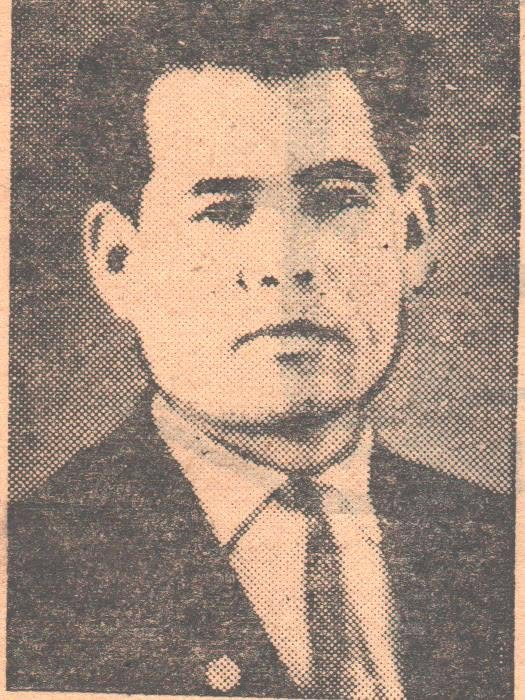
He was extraordinarily well read. It seemed that there was hardly a book in Muynak’s municipal library that he had not opened. He translated foreign authors into Karakalpak, hoping both to introduce local readers to world literature and to show outsiders the richness of his own culture. In the 1960s and 1970s, he used to say that one day Europeans would come to Muynak and the Aral Sea to discover the beauty, history and culture of this region. At the time, that sounded almost impossible.
Part of his work was translated into German and a collection was published in Germany, although he did not live to see it. In a sense, his prediction has now come true: people arrive from across the world, not only to witness an ecological catastrophe but also to learn about Karakalpakstan’s literature, culture, history and inhabitants. As long as his books are read, his voice continues to speak.
Dospanov shared two of his uncle’s poems, translated here, especially for Novastan, from Karakalpak via Russian.
The Seagull
1959
— Seagull, soaring high across the sky,
You seem a messenger of my love.
Why do you circle anxiously above me,
Calling me once more towards the seashore?
— Seagull, flying through the blue of heaven,
Why do you fill my heart with restless thoughts?
Had I not caressed the waves of the sea,
Would spring ever have returned to these shores?
The Blue Sea
1958
Do not judge me harshly when I praise the sea;
Simply look towards the blue edge of the earth.
Like a festive salute marking a great victory,
The blue sea laughs before my eyes.
This blue sea is my native Aral;
With all my soul, I breathe its fresh wind.
And should you wish to know what makes it so majestic,
Know this: within it live both my destiny and my age.
Who else should journalists speak to while the memory of the old Muynak is still alive?
They should begin with the remaining members of the older generation: former fishermen, ship captains, workers from the fish-canning plant and residents of the coastal settlements. They remember the cranes, boats, factory, crowded waterfront, fresh fish and uninterrupted horizon. Such memories cannot be reconstructed from official archives once the witnesses are gone.
It is equally important to record artists, musicians, traditional craftspeople and guardians of oral culture. Young ecologists, archaeologists, museum professionals, historians and civic activists should also be heard, because they connect the past with the region’s future. And journalists should not overlook teachers, farmers, doctors, students and women raising families. The real history of Karakalpakstan is made from many ordinary lives, not only from famous names.
We are among the last living witnesses of the full Aral Sea. That creates a duty to preserve oral testimony, family photographs, private archives, household objects, songs and stories. These materials are as important to the region’s heritage as archaeological monuments and museum collections.
What gives you hope when you think about the future of Muynak and Karakalpakstan?
Above all, people give me hope. Despite everything this region has experienced, its inhabitants have not lost their love for their land or their willingness to work for its future. Human resilience has always been the main strength of the Aral region.
I see a younger generation studying foreign languages, ecology, archaeology, art, museum work, science and information technology. Many of them do not want to turn away from their history. They want to preserve it and show the world that Karakalpakstan is a region of extraordinary cultural heritage and future possibilities.
The world’s growing interest also matters. Archaeologists, artists, scientists, photographers, travellers and students come not only because of the Aral Sea, but also for ancient Khorezm, Ustyurt, the Savitsky Museum and Karakalpak culture.
If I had unlimited resources, I would set three priorities. The first would be human welfare: drinking water, health care, education, infrastructure and good jobs, particularly so that young people can imagine a future here. The second would be ecological restoration and responsible use of natural resources, including water-saving technologies and continued planting on the former seabed. The third would be culture, science and international cooperation. I would like Karakalpakstan to become a major centre for archaeology, museum partnerships, artistic residencies, environmental education and cultural tourism.
The future cannot rest only on natural resources or only on economic growth. It must bring people, nature and culture into balance.
Is there one story you would most like European readers to carry with them?
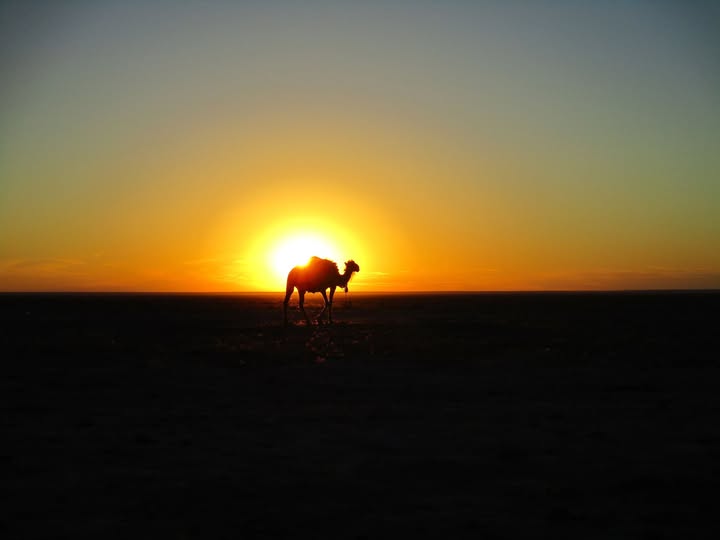
I would tell them the story of the Camel Trail. Elders said that long before modern roads, caravan routes crossed Ustyurt and the shores of the Aral Sea. Camels connected Khorezm with the Volga region, Kazakhstan and lands farther east and west. They sensed the route better than people and could find wells and caravanserais even at night, in sandstorms or fog.
One trail, used by generations of caravans, led towards the Aral Sea. It was not merely a road. It carried trade, encounters, knowledge and culture. Merchants, craftsmen, poets and pilgrims travelled along it. Goods moved with songs, legends, ideas and traditions.
As the sea retreated, harbours vanished and routes were covered by sand. Yet people say the Camel Trail did not disappear. It survived in memory. You may no longer see it on a map, but you can feel it when travelling through the region. It is an invisible thread between past and present.
For me, the legend means that the most important roads do not cross only deserts and steppes. They pass through human memory. Today, the trail can acquire a new meaning. Where caravans once carried goods, it can now carry research, cultural projects, art and friendship between peoples. It can become a symbol of dialogue between Central Asia and Europe.
Perhaps the trail no longer exists on the ground. But while memory remains alive, the road never ends.
Mathieu Lemoine, Editor-in-Chief for Novastan-English