



 “I only needed a passport” : In Ukraine, Central Asian prisoners of wars caught between loyalty and regret
Citizens from Central Asia now represent the largest group of foreign nationals fighting in the Russian army. Novastan spoke with several of them after their capture by Ukrainian forces. Their accounts reveal how Central Asian migrants have become an especially vulnerable recruitment pool for Moscow.
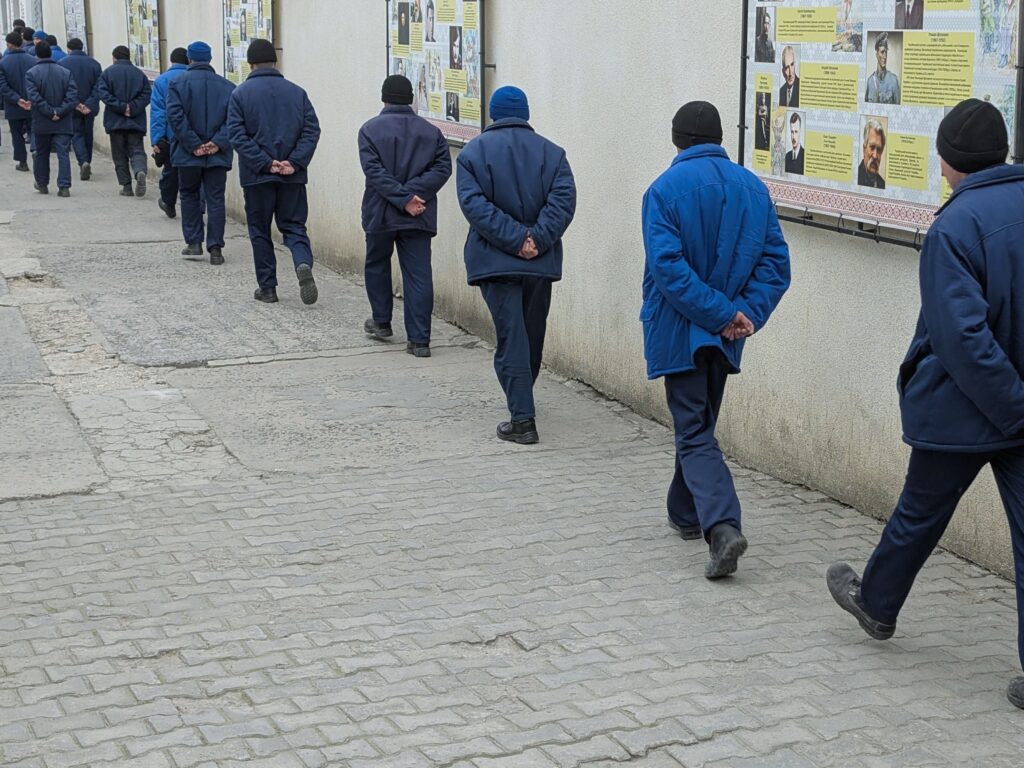
In the yard of a military prison in Lviv region, West Ukraine, dozens of prisonners silently head towards the dining hall. The walls surrounding them are filled with portraits of Ukrainian prominent nationalist figures such as Daniel of Galicia or Stepan Bandera. In the largest prisoner camp in the whole country, everything is in Ukrainian, from the inscriptions to orders given to prisoners.
“There is no trouble here, they are pretty calm and do not brawl much” says a prison guard. In front of him, prisonners start entering the lunchroom, their faces blank. Some of them have already been detained for four years. Many prisonners clearly appear to have Asian features. Among them, some Russian citizens from Siberian republics of Buryatia and Yakutia, where mobilisation rates are particularly high.
Many others come from the five former Soviet republics in Central Asia. “From what I saw, a majority of foreigners in the Russian army come from this region”, explains Khushbakht Peruzaliev. In spring 2024, the 47-year old Tajikistani citizen signed a contract to serve the Russian Army : “I was told that I would not have to go to the front or anything of this kind. They said I would only be working in a warehouse, so I accepted”, he remembers. But soon, these promises revealed to be lies. Few weeks later, the man was captured by Ukrainian forces after being injured in a frontal assault in Donetsk oblast.
Far beyond the 1,400 Africans or 200 Indian citizens that the Russian army recruited since the beginning of the war, more than 12,000 soldiers from Central Asia have already participated in the “special military operation”, according to public data published in April 2026 by the Ukrainian war prisoners coordination. More than half of foreign soldiers serving Russia are originally from Central Asia.
Passport promises amid raids and deportations
In Mykolaiv penitentiary, all Central Asian soldiers that Novastan met were already in Russia before 2022. “Recruitment efforts towards foreigners were targeting on both migrant workers and people who were in jail”, according to an officer of the Ukrainian coordination of war prisonners.
Ilyas, a 40-year old Kyrgyz citizen, worked as a drink retailer in Moscow since 2007. He signed his contract in April 2025. “During the hiring process, they didn’t directly promise me citizenship, but I knew I would have the possibility to obtain it after” he says.
Novastan est le seul média en français et en allemand spécialisé sur l'Asie centrale. Entièrement associatif, il fonctionne grâce à votre participation. Nous sommes indépendants et pour le rester, nous avons besoin de vous ! Vous pouvez nous soutenir à partir de 2 euros par mois (défiscalisé à 66 %), ou en devenant membre actif par ici.
Indeed, in January 2024, a decree was signed by Vladimir Putin, allowing certain foreigners to obtain Russian citizenship under the condition that they served the army, especially during the “special military operation”. The number of foreigners who benefited from this process remains unknown.
In Ukraine, most prisoners from Central Asia mention that they were sent to the front only after a short training, which caused heavy casualties. “We were moving to a village, when on the road, drones already started appearing and targeting us”, Ilyas remembers. He barely escaped, only to be taken prisoner shortly after.
Khushbakht Peruzaliev, a prisoner whose wife and children still live in Ryazan, 200 kilometers south east of Moscow, was harmed during an intense artillery bombing, while he was moving towards Ukrainian lines. “Half of the group was killed immediately, all 200 [Russian military code for death, Editor’s note]”.
He describes a general climate of fear that began to appear “right after the Crocus City Hall attack”. This terrorist attack committed by Tajikistani citizens was claimed by the Islamic State of Khorasan, and killed 149 people. Following this tragedy, living conditions of Central Asian migrants in Russia got tougher. “Raids against Tajiks” became frequent, during which migrants were “barred from Russian territory”, according to Khushbakht Peruzaliev.
The Tajik migrant abandoned plans to renew his expired passport, for fear of being arrested on his way to the embassy in Moscow. “Eventually, special police forces started checking the construction site where I was working”, he explains. During police controls, he was promised to obtain citizenship if he accepted to join the army.
Caress Schenck, a political science professor at Nazarbayev University in Astana, acknowledges that “Tajiks were indeed more targeted than other ethnic groups from Central Asia, after the Crocus City Hall attack”. According to the Ukrainian coordination of war prisoners, Tajiks represent the second most represented nationality in the Russian army, with more than 3,400 recruits, while 4,800 Uzbeks and 2,400 Kazakhs also joined the army.
Caress Schenck reminds that, however, in Russia “migration control policies, raids and pressure to join the army are still highly influenced by the news cycle”.
Other ethnic groups have also been targeted since the beginning of the war, depending on the context : “Sometimes, anyone with Asian features can be perceived as suspicious”, according to the researcher.
Since November 2025, some foreigners in Russia are required to present a commitment contract in the army to obtain Russian citizenship or a residency permit. People from Central Asia are particularly impacted by these policies, as they make up more than 40% migrants living in Russia in 2020.
Despite that, all prisoners met by Novastan explain that they signed the contract by their own will to obtain a Russian passport, Caress Schenck mentions a strong administrative pressure on migrants that “reduces their ability to act and make their own decisions, rather than offering them a real choice”
The ideological vulnerability of migrants
In addition to the precarious administrative status of Central Asian migrants, the Russian army bases its mobilization stategy on shared ideological patterns. “As for me, I wanted to live in Russia. I considered that I had the right to obtain citizenship, so to earn it, I had to serve the homeland” says Jasur Islamov with a detached voice. After a year and a half in the army, in March 2025, the 38-year old man was promised he would obtain citizenship if he continued serving. A few weeks later, Jasur Islamov was captured, after being wounded by a drone strike.
Ilyas, Islamov and Khushbakht never tried to surrender on purpose, unlike accounts from other foreign prisoners of war fighting for Russia, such as African recruits. This behaviour at war could be explained by the fact that parts of migrant populations in Russia are already “Russian speakers, born in the 1970s or 1980s, under the Soviet Union”, according to the Ukrainian coordination of war prisoners.
Prisoners met by Novastan also state that they wish to go back to Russia, hoping to be included in a prisoner exchange. “We have nothing against an exchange of prisoners from Central Asia”, says the Ukrainian coordination of war prisoners. However, among the 7,000 Russian soldiers already exchanged, those originally from Central Asia remain a small minority.
When Novastan asked them about their experience with racism in Russia, before or after serving, all assert that they “never” faced it. They are confident in their ability to rejoin Russian society after their detention, once they obtain a passport. “Could you imagine that I risked my life to obtain citizenship, and they would send me back to my country, when I have nothing left there ? It would be a huge betrayal” says Jasur Islamov, bitterly.
However, it would not be the first time that these war prisoners face disappointments related to their migrant experience in Russia. Despite being married to a Russian woman for years, Ilyas failed to obtain a passport : “I submitted all documents to apply for citizenship, a long time ago, but it was refused”. Jasur Islamov admits that he “did not even receive any money from the contract”, with only two months paid out of the eighteen months he spent in the army.
Novastan est le seul média en français et en allemand spécialisé sur l'Asie centrale. Entièrement associatif, il fonctionne grâce à votre participation. Nous sommes indépendants et pour le rester, nous avons besoin de vous ! Vous pouvez nous soutenir à partir de 2 euros par mois (défiscalisé à 66 %), ou en devenant membre actif par ici.
“I believe it would take years to dismantle internalized discriminations” Caress Schenk explains. The researcher reminds that in the Soviet imagery, racism was seen as inherent to capitalism and the Western bloc.
Citing the Geneva convention, the Ukrainian coordination of war prisoners explains that Central Asian citizens are treated the same as other prisoners. In the courtyard, on the weight training benches, Central Asian prisoners exercise alongside their Russian cellmates.
“We never thought we would end up here”, says Jasur Islamov. When he is reminded that he signed consciously and was aware of risks, the Uzbek detainee bristles : “You are talking as if I specifically signed to kill people… I only needed a place to live, a passport, to work and feed my family”. After a silence, he adds, regretfully : “I’m not saying we made the right decision. Everyone makes mistakes. Everyone”.
Driss Rejichi,
Contributor for Novastan France
Translated by Elea Muresan
Thank you for reading this article! If you have time, we would appreciate your feedback, either through this anonymous form or by email at editorial@novastan.org. Thank you very much!


Wamiq, 2026-06-30
great article, really interesting !
Reply