



 On a disappearing Kyrgyz glacier, seven women learn to read the ice
Support Novastan, the European Central Asia magazine
By supporting Novastan, you are supporting the only English, French and German-language media specialising in Central Asia. We’re independent and we need your help to stay that way!A four-day expedition to Kyrgyzstan’s Adygene glacier brought seven women into the field with glaciologist Gulbara Omorova. For filmmaker Tynymgul Eshieva, the journey is part of a larger effort to document both the rapid transformation of Kyrgyzstan’s glaciers and the women working to understand them.
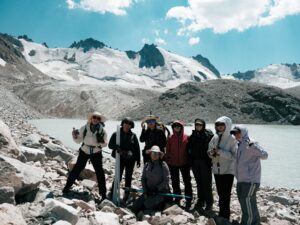
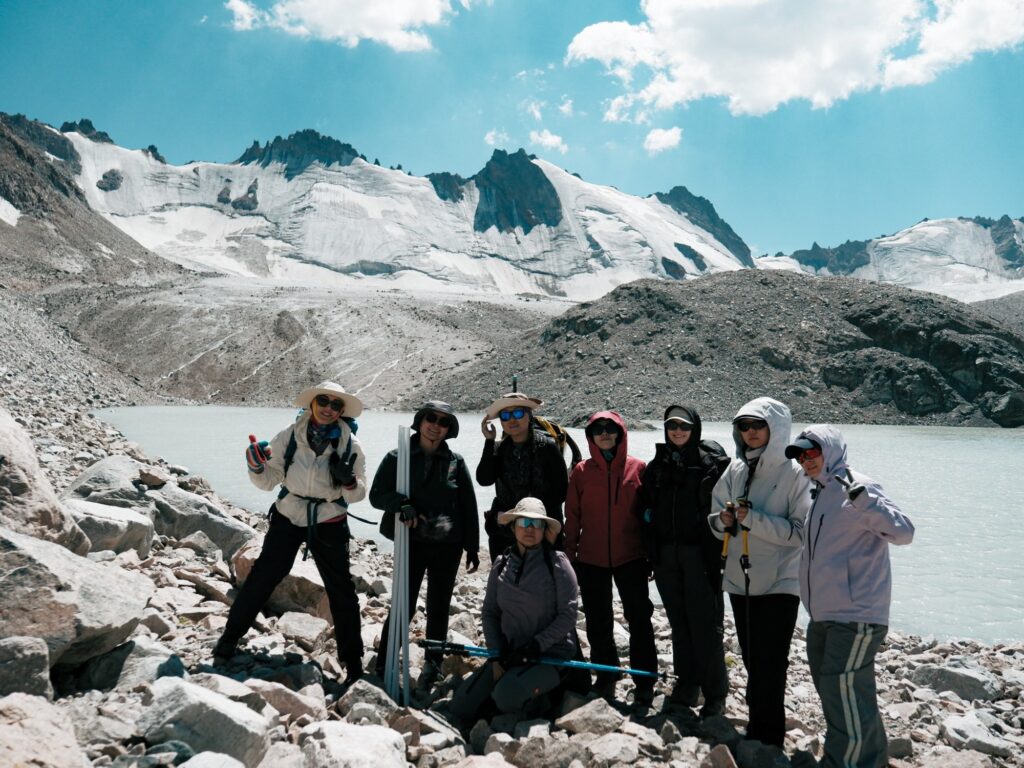
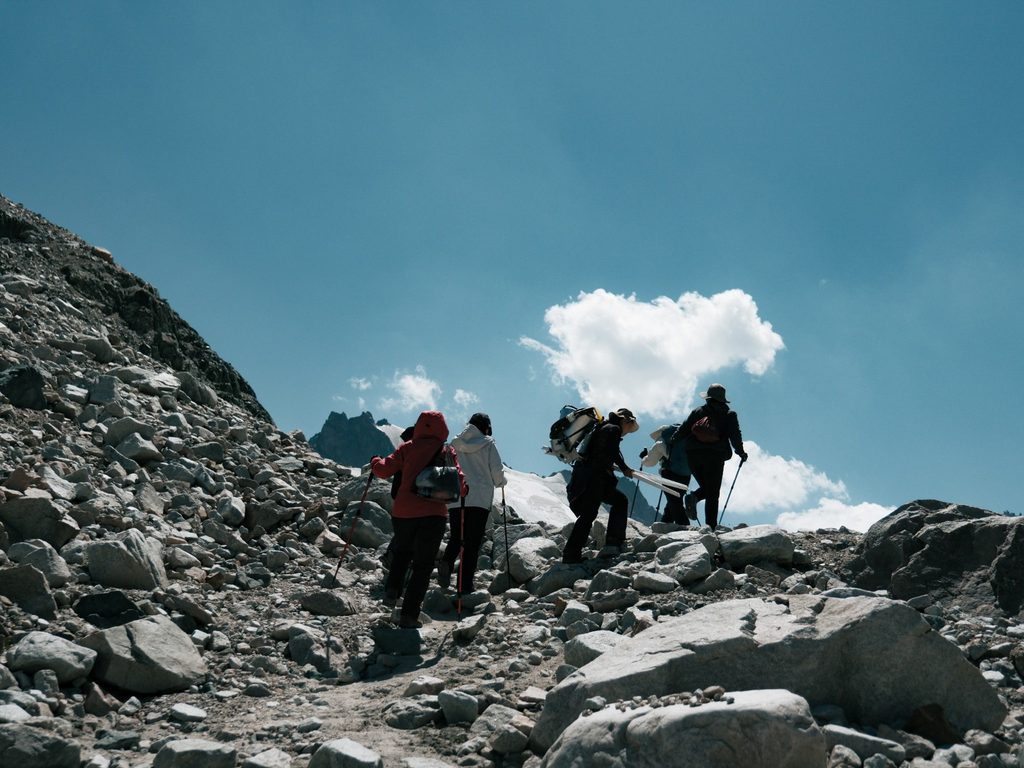
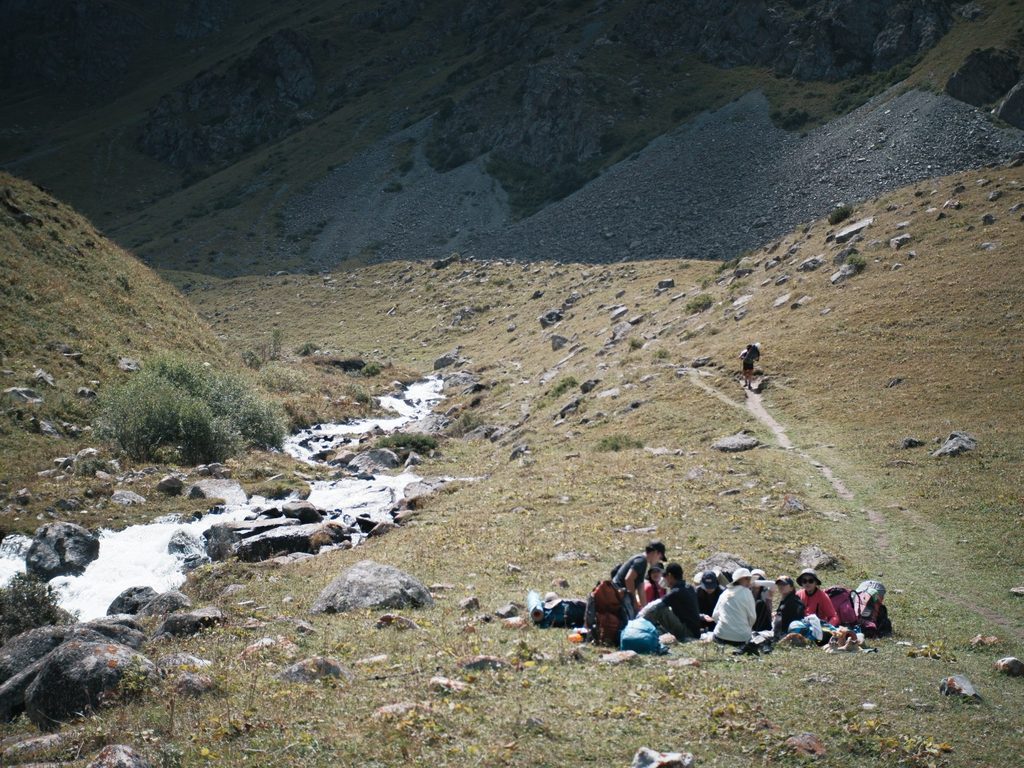
In August, seven women set out into Kyrgyzstan’s Ala-Archa gorge for a four-day expedition. Some were experienced hikers; others had never undertaken a high-altitude trek of this kind. Their destination was the Adygene scientific station, around 11 kilometres into the mountains.
They were not going simply to see a glacier.
From 16 to 19 August, the participants worked alongside Kyrgyz glaciologist Gulbara Omorova, installing ablation stakes to measure melting, recording glacier movement with GPS and carrying out bathymetric measurements on lakes below the ice.
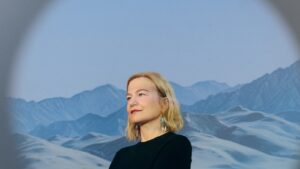
Behind the expedition was documentary filmmaker and producer Tynymgul Eshieva. She is developing The Voice of the Glaciers (Мөңгүлөрдүн үнү), a feature-length documentary centred on Omorova and her work in Kyrgyzstan’s mountains.
The film is still in development and is currently expected to be completed in 2028. But Eshieva has already been filming a landscape that is changing fast enough for those returning to it to see the difference with their own eyes.
“We filmed the teaser in June last year, and then we went back for the expedition in August this year,” Eshieva told Novastan Editor-in-Chief Mathieu Lemoine. “The glacier looked completely different. You don’t need instruments to see it. You can see with your own eyes how rapidly it’s disappearing.”
A glacier changing within a lifetime
The measurements reinforce what the eye can see.
During the expedition, around 1.4 metres of surface lowering was recorded near the glacier terminus over approximately one month. Over an entire ablation season, melting in the lower sections can amount to several metres.
Omorova’s longer-term research paints an even starker picture. The Adygene glacier system comprises three glaciers – Bolshoy Adygene, Panfilov and 30-let VLKSM. Bolshoy Adygene has decreased in area from approximately 3.5 square kilometres in 1962 to 2.8 square kilometres in 2025, a loss of around 20 percent. More strikingly, the annual rate of area loss has accelerated from 0.006 to 0.033 square kilometres per year.
The smaller glaciers are retreating too. Between 1977 and 2024, Panfilov lost around 20 percent of its area and 30-let VLKSM around 29 percent.
For Eshieva, however, seeing the process at close range changed the meaning of such figures.
“It’s completely different to see it with your own eyes,” she said. “You can read the news, follow websites, see the numbers online. But when you go there, when you stand on the glacier and feel it, it’s something else.”
What struck her just as strongly was the work required to produce those numbers.
“She carries heavy equipment up the mountain. She takes the measurements again and again, with total commitment,” Eshieva said of Omorova. “It’s slow, repetitive work, sometimes even boring, but it’s absolutely necessary. Without people like her doing it year after year, we simply wouldn’t know what is happening.”
The woman behind the measurements
Eshieva has known Omorova since the mid-2000s. Long before either woman imagined making a documentary together, they talked, hiked and even climbed a peak near Bishkek.
Eshieva only began documentary filmmaking in 2023. While editing her first feature documentary, also about a woman activist, she began searching for another project. She hopes to complete that film next year.
The catalyst came through social media.
The Adygene research station had been robbed and scientific equipment stolen. Omorova appealed publicly for help. People who had never visited a glacier responded, crowdfunding enough money to replace what had been lost.
“That was the moment I thought: this could be a film,” Eshieva recalled. “Here is a woman who fights for her science, for the environment, for justice, and she doesn’t wait for anyone to do it for her. And ordinary people answered her call.”
She began filming.
Omorova’s route into glaciology itself began far from the ice. Trained in sociology, she travelled to villages to interview residents about social issues. During a visit to Batken, farmers told her about shortages of water.
Already an experienced mountaineer with training in alpinism, she began asking why.
That question eventually took her towards glaciology and the Adygene station. It also illustrates one of the central realities of glacier retreat: what happens high in Kyrgyzstan’s mountains does not remain there.
Read more on Novastan: The recession of the Tian Shan glaciers and other recent studies
From the glacier to the valley
As glaciers retreat, they transform not only water availability but the landscape around them.
Omorova’s monitoring has identified 16 new moraine-glacial lakes in the Adygene complex since observations began in 1977. Some glacial lakes can become unstable, making continuous observation essential.
During the August expedition, the participants went out by boat to conduct bathymetric measurements using an echo sounder. By measuring water depth at different points, researchers can map the lake and track how it changes.
Monitoring can also involve automatic loggers recording water levels and temperatures, water-column profiling and examination of the moraine dams holding back the lakes.
Read more on Novastan: Life by the river: the Naryn in Kyrgyzstan
The relationship between melting ice and downstream risk is complex. A lake that appears stable today may change as the glacier, surrounding terrain and permafrost evolve. The purpose of monitoring is therefore not to predict an outburst from a single measurement, but to observe the glacier-lake system continuously and identify changes that may eventually become warning signs.
Eshieva did not originally set out to make a film about the relationship between glaciers and water.
“When I started, my idea wasn’t to connect what happens up on the glacier with what happens down below,” she said. “But the more I filmed, the more I saw that they are deeply connected.”
Whether that relationship ultimately becomes central to the documentary remains open.
“People often ask me at pitching forums: is this a film about water? For now, it isn’t,” she said. “Documentary is a long process. You follow a person’s life, sometimes for two or three years, sometimes ten. I don’t know yet where it will go.”
Seven women on the ice
The August expedition itself emerged partly from necessity.
Eshieva had initially envisaged a camp for aspiring ecologists, selected through an open call and led by Omorova. But by August, funding for the film had not materialised and the summer field season was slipping away.
“I felt I had to do something,” she said.
She changed the plan, crowdfunded an expedition and invited women interested in learning about glaciers to join. There was no competitive selection process. Participants simply had to be willing and able to commit to four days in the mountains.
Seven ultimately went.
Their backgrounds and levels of mountain experience differed. Two already knew Omorova from previous events. One was a journalist and experienced hiker with an interest in environmental issues. Others discovered the expedition through social media.
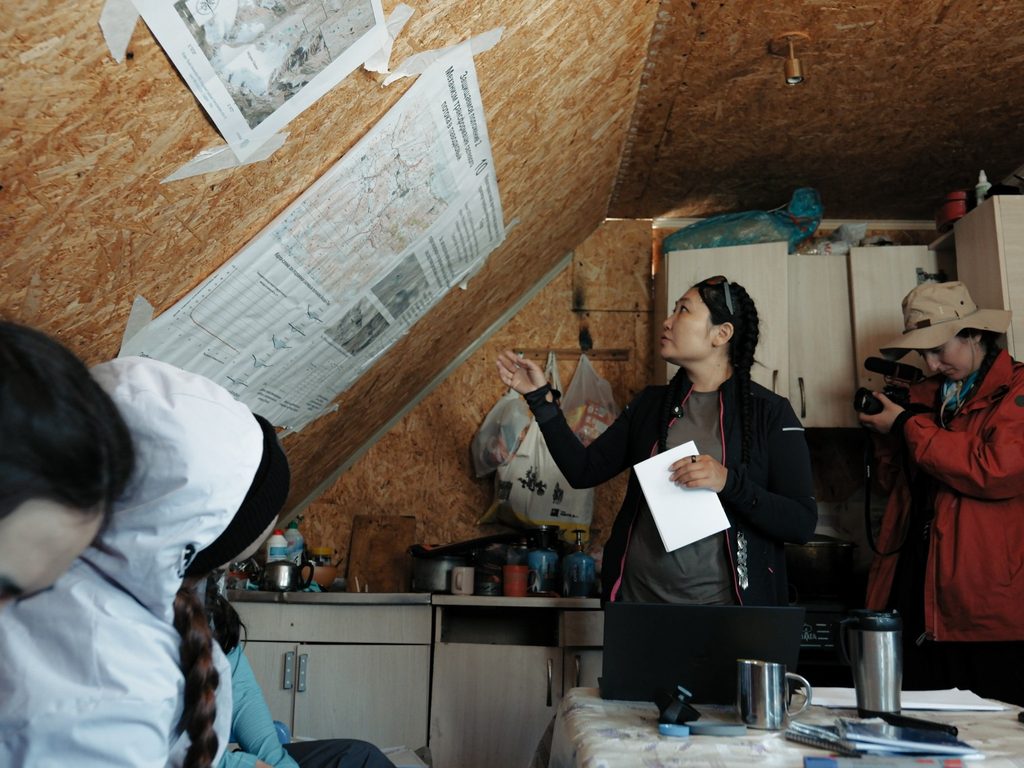
After the 11-kilometre ascent to the station, they did more than watch scientists at work. They learned to use equipment, take measurements and collect data themselves.
“It was important for us not simply to bring the participants to the mountains,” Eshieva said. “We wanted to give them an opportunity to experience scientific work from the inside – to understand how specialists monitor glaciers, document changes and collect data.”
For participant Rahbar Khomidova, who travelled from Tajikistan to join the expedition, the experience carried a wider message.
“The voice of the glaciers should be heard not only by scientists, but by each and every one of us,” she said. “Their story is the story of our shared future.”
A film about who gets to lead
Yet Eshieva is reluctant to define The Voice of the Glaciers simply as a climate documentary.
For now, she and Omorova have agreed that its centre should remain the scientist herself – and what her experience says about women working in fields where they continue to face significant obstacles.
“I want the film to inspire a new generation of scientists, and to be a starting point for talking about our environment, our mountains, about care, about ourselves, and about the glaciers we always thought of as a gift from God,” Eshieva said.
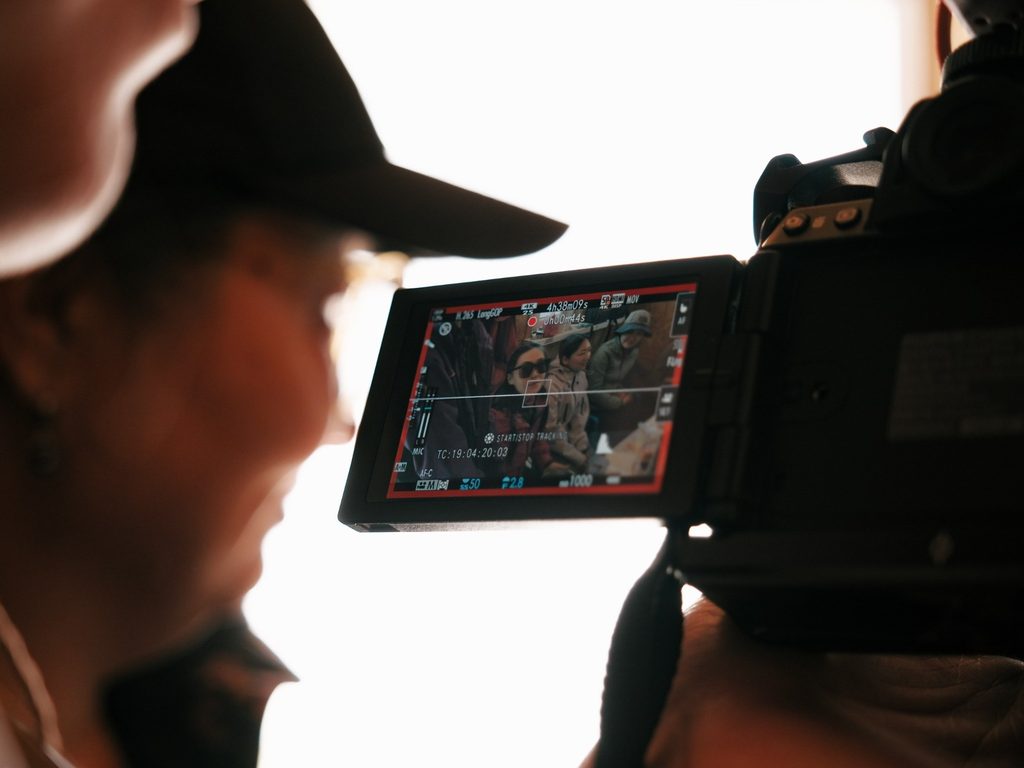
The project has already begun attracting support. The August expedition received equipment from the Union of Hiking Tourism of the Kyrgyz Republic, insurance coverage from NSC and partial financial support from the Creative Industries Park, alongside crowdfunding and contributions from Eshieva’s friends. The Embassy of France in Kyrgyzstan has also supported the film.
More recently, Eshieva presented the project at the Doc by the Sea Producers Lab. The Voice of the Glaciers received 50,000 Kyrgyz soms from the Bir Duino initiative as well as a prize from Kyrgyzfilm.
Funding is nevertheless still needed to turn the material into the approximately 72-minute feature Eshieva envisages.
That uncertainty is part of documentary filmmaking. The glacier, meanwhile, is not waiting for the film to be finished.
Omorova’s observations indicate that the ablation season itself is becoming longer. In 2026, melting continued beyond the end of September. Near the terminus, she measured approximately 4.5 to five metres of surface lowering over the season; even in the accumulation zone, where snow and firn would ordinarily persist, lowering reached approximately 2.5 to three metres.
For Eshieva, those transformations have made the patient work of the woman she has known for two decades newly visible.
“I want to show the work that women do in Central Asia,” she said. “There are so many obstacles here, and still there are women who lead. Gulbara is one of them.”
“These are people whose ideas we can listen to,” she added. “And we should listen to.”
By Mathieu Lemoine, Editor-in-Chief for Novastan English.