




 Kazakhstan’s saiga comeback: When conservation success clashes with farming

Support Novastan, the European Central Asia magazine
By supporting Novastan, you are supporting the only English, French and German-language media specialising in Central Asia. We’re independent and we need your help to stay that way!Kazakhstan’s saiga antelope population has recovered from just 21,000 animals in 2003 to an estimated 4.69 million in 2026. But the conservation success has brought new tensions with farmers, prompting the government to resume controversial culls. As scientists debate population estimates and the sustainability of the measures, Kazakhstan faces a difficult question: how many saigas are too many?
The saiga is one of the most distinctive animals of the Eurasian steppe, instantly recognisable by its unusual, bulbous nose. According to the International Union for Conservation of Nature (IUCN), Kazakhstan is home to approximately 98% of the world’s saiga antelopes.
Yet the species came dangerously close to disappearing. During the 1990s, poaching for meat and horns, the latter traded for use in traditional Chinese medicine, contributed to a dramatic population collapse. By 2003, Kazakhstan’s three saiga populations – Ural in the west, Betpak-Dala in central Kazakhstan and the smaller Ustyurt population in the southwest – numbered approximately 21,000 animals.
Two decades later, the picture has changed remarkably. The April 2026 aerial survey estimated Kazakhstan’s saiga population at 4,689,000, an extraordinary recovery for a species once on the brink of extinction.
But the comeback has created a new dilemma. As herds expand across the steppe, farmers report damage to crops and competition for pasture and water. The government has responded by authorising the removal of thousands of animals, while conservation organisations warn that the species remains vulnerable to sudden population crashes.
A closer examination of Kazakhstan’s official population estimates, scientific research and government decisions reveals both the scale of the recovery and the uncertainties surrounding its management.
This article is based on an analysis of official documents, scientific publications and news reports. No original interviews were conducted. Population growth rates are calculated as compound annual rates between successive surveys.
From 21,000 to 4.69 million: The recovery in numbers
Kazakhstan’s saiga population has undergone extraordinary changes over the past two decades.
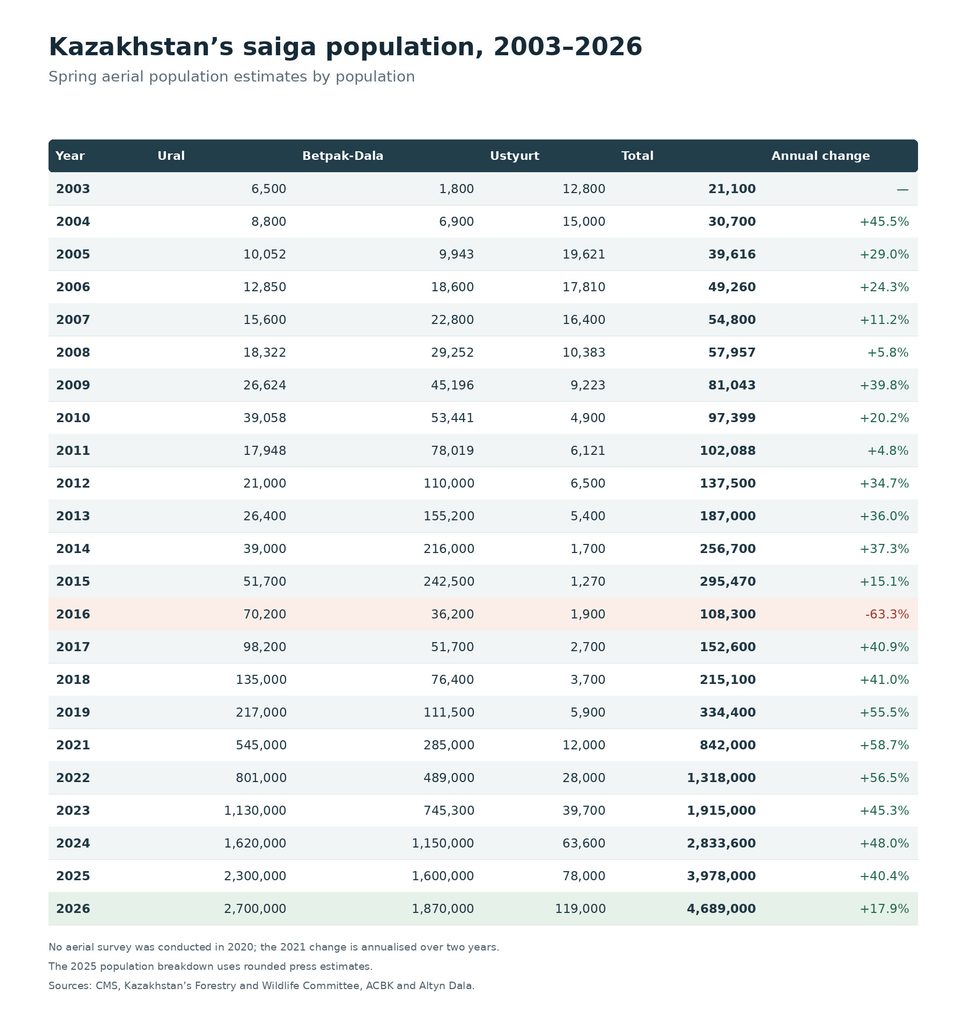
According to figures reported to the Convention on Migratory Species (CMS), the country’s three populations grew from approximately 21,100 animals in 2003 to 295,470 by the spring of 2015 – an average annual increase of 24.6%.
Then came a catastrophe. In May 2015, more than 200,000 saigas died within three weeks, in one of the most devastating wildlife mortality events recorded in recent history. The Betpak-Dala population was particularly badly affected.
By the following spring, Kazakhstan’s total estimated population had fallen to 108,300 animals, a decline of 63.3% between the two surveys.
Remarkably, the recovery resumed. Between 2016 and 2026, the estimated population increased at a compound annual rate of 45.8%, surpassing the previously reported historical maximum of 1.2 million animals, recorded in 1974, by 2022.
The most recent surveys, however, suggest that this extraordinary pace of growth may be slowing.
Kazakhstan recorded an increase of 40.4% between its 2024 and 2025 spring estimates, but only 17.9% between 2025 and 2026.
Kazakhstan’s saiga populations, 2003–2026
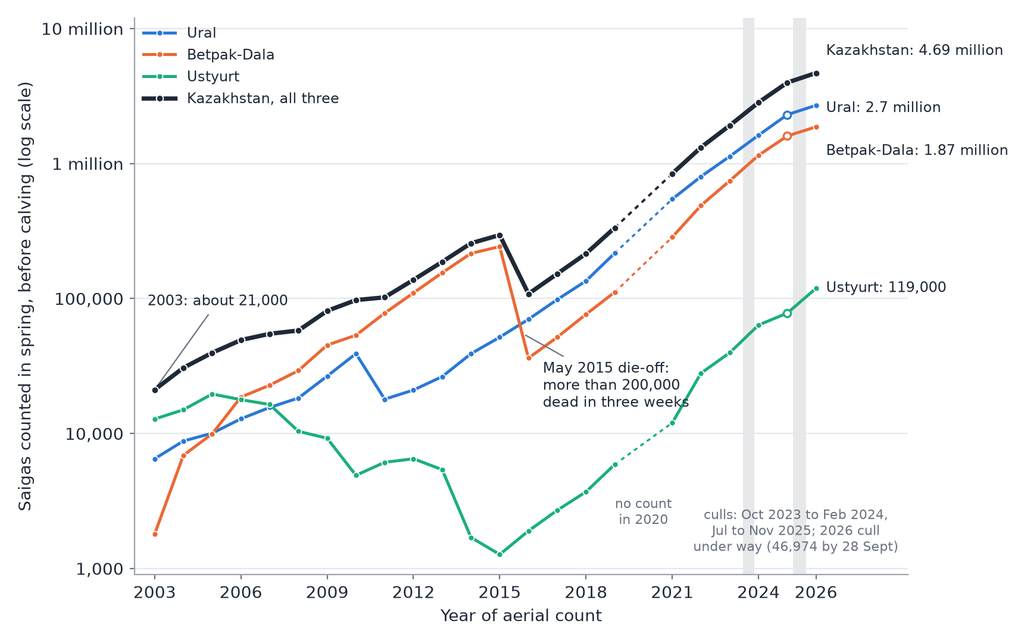
These figures tell a remarkable conservation story. But they also raise a fundamental question: how accurately can millions of animals moving across an enormous landscape be counted?
How are Kazakhstan’s saigas counted?
Kazakhstan’s annual population survey is commissioned by the Forestry and Wildlife Committee and organised by the state enterprise Okhotzooprom. The Association for the Conservation of Biodiversity of Kazakhstan (ACBK), a national conservation organisation, plans the flights and calculates the estimates.
In 2026, two An-2 aircraft spent a combined 215 hours surveying saiga habitats between 7 and 25 April. The survey took place before the annual calving season, meaning that the estimate excludes animals born later in the spring.
The method used is known as a strip transect survey. Aircraft fly along parallel lines across designated areas while observers count animals within a defined strip on either side of the flight path. Researchers then extrapolate the observed density to estimate the population across the surveyed area.
During the 2024 survey, conducted using helicopters, flight lines were spaced either five or ten kilometres apart, depending on saiga density, at an altitude of approximately 120 metres. Large herds were photographed to improve counting accuracy. The survey covered 151,226 square kilometres.
The methodology has evolved. In 2011, for example, the width of the observation strip was reduced from two kilometres to 1.2 kilometres after researchers raised concerns that the wider strip could lead observers to miss distant herds.
The central difficulty is that aerial surveys produce estimates, not exact counts.
ACBK acknowledges that its calculations have a margin of error, but the organisation does not routinely publish uncertainty ranges alongside its recent headline figures. In 2022, it described the estimate of 1,318,000 saigas as the midpoint between a minimum and maximum possible population, without publishing those bounds.
This matters because the probability of detecting saigas changes depending on their distribution.
Small, scattered groups are harder to identify than large concentrations of animals. A 2009 study involving researchers from Imperial College London and Kazakhstan’s Institute of Zoology found that aerial surveys could substantially underestimate dispersed populations. For one Ustyurt survey, the original count represented approximately 64% of the study’s modelled median population estimate.
As herds recover and become larger, they may also become easier to detect. Consequently, some of the apparent acceleration in population growth could reflect improved detection rather than biological growth alone.
This does not invalidate Kazakhstan’s extraordinary recovery. It does, however, complicate comparisons between surveys conducted over different years and under different conditions.
Why has population growth slowed?
The April 2026 survey estimated 4.689 million saigas, approximately 311,000 fewer than the five million animals anticipated by a deputy ecology minister earlier in the year.
The slowdown affected both major populations. The Ural population increased by approximately 17.4%, while Betpak-Dala grew by 16.9%.
ACBK has pointed to two contributing factors: the culling of 196,173 animals in 2025 and difficult winter conditions in 2025–2026.
By 12 May 2026, Kazakhstan’s ecology ministry had recorded approximately 26,000 saiga deaths, including 11,000 in West Kazakhstan Region. A deputy minister described mortality of up to 15–20% annually as falling within natural expectations.
Yet these figures do not fully explain the change in reported growth.
An illustrative calculation shows the limits of the available evidence. If the 196,173 animals culled in 2025 and all 26,000 recorded deaths were added back to the 2026 estimate, the apparent increase would rise from 17.9% to approximately 23.5%.
That difference represents roughly one-quarter of the 22.5-percentage-point slowdown between the last two annual growth rates.
This calculation is not a demographic model or a definitive attribution of causes. It likely overstates the effect of the recorded losses, since some animals would have died naturally, and some reported deaths occurred after the April survey. Birth rates, unrecorded mortality, migration and changes in survey detection could also affect the results.
Several explanations therefore remain possible.
One is increasing pressure on habitats. ACBK and the Royal Society for the Protection of Birds (RSPB) identified more than 60 hotspots in West Kazakhstan where high densities of saigas and livestock coincide with limited water availability. But there is no publicly available study establishing whether Kazakhstan’s herds have reached the carrying capacity of their habitats.
Another possible factor is migration. In July 2025, authorities in Russia’s Saratov region reported that approximately one million saigas had crossed into the region from Kazakhstan. Whether such movements affected the April 2026 estimates remains unclear.
Survey methodology may also play a role. ACBK has previously suggested that annual population growth of 35-40% can occur under favourable conditions, while several recent aerial estimates indicated even higher increases. As herds become larger and easier to detect, some earlier apparent growth could have been amplified by counting effects.
The use of different aircraft may introduce further variation: helicopters were used in 2024, while the 2026 survey employed fixed-wing planes.
Meanwhile, reports in September 2026 described disease and mass miscarriages among saigas in West Kazakhstan. These events occurred after the April survey and therefore cannot explain that particular estimate, although they may affect subsequent population figures.
For now, the precise causes of the slowdown remain uncertain.
Why Kazakhstan has resumed culling
The population recovery has intensified tensions between wildlife conservation and agriculture.
Kazakh authorities argue that growing saiga herds compete with livestock for pasture and water, damage crops and create economic difficulties for rural communities.
In September 2023, the government authorised culling in the Ural and Betpak-Dala populations, citing a feasibility study prepared by West Kazakhstan Agrotechnical University. According to documents submitted to CMS, specialists in Kazakhstan and abroad questioned the quality of the study.
Between autumn 2023 and winter 2024, authorities removed 43,503 saigas, approximately 13% of the more than 337,000 animals recommended for removal.
In April 2024, President Kassym-Jomart Tokayev announced that he would prohibit further culling.
The policy nevertheless changed again the following year.
Following meetings with farmers in June 2025, Kazakhstan’s ecology minister said a scientific assessment had established that removing up to 20% of the saiga population could be considered safe. Experts at the meeting argued that the animals were damaging agricultural land, pasture and biodiversity.
The ministry subsequently cited a biological assessment by the Institute of Zoology to justify population regulation.
A total of 196,173 animals were culled in 2025, substantially below the maximum implied by a 20% removal threshold.
For 2026, the Institute of Zoology established an upper limit of 580,000 animals, equivalent to approximately 12.4% of the spring population estimate. The Forestry and Wildlife Committee has stressed that this figure is a maximum, not a target.
By 28 September, authorities reported that 46,974 saigas had been removed. Reports in early October indicated that 45,250 animals had been taken in West Kazakhstan Region alone, where operations involved driving animals into corrals.
The eventual total for the 2026 cull had not been established in the documents available for this analysis.
Kazakhstan has also informed CITES that rising saiga numbers are increasing pressure on grazing land, competition with livestock, conflicts with farmers and conservation costs.
For the authorities, culling is therefore presented not as a reversal of conservation policy, but as a means of managing a population whose recovery has created new pressures.
How much damage do saigas actually cause?
The economic argument for culling rests heavily on reported losses among farmers. Yet reliable figures remain difficult to establish.
In 2023, Kazakhstan’s agriculture ministry cited losses of 7.9 billion tenge, approximately €15.8 million. A deputy minister later distanced the ministry from this figure, acknowledging that no established methodology had been used to calculate it.
A study by ACBK and the RSPB interviewed more than 100 farmers in West Kazakhstan. Respondents estimated their average losses at approximately 14 million tenge per farm, or around €28,100.
However, these were farmers’ own estimates rather than independently verified financial assessments.
Importantly, respondents often identified drought as a major source of agricultural losses, with saiga activity exacerbating already difficult conditions.
This distinction matters. The presence of large herds may create genuine problems for farmers, but attributing all reported losses to wildlife risks overlooking other environmental and economic factors.
Compensation has been proposed for crop damage, although not consistently for pasture losses. In April 2026, farmers in Kostanay Region were still calling for compensation mechanisms and agricultural insurance.
The issue, then, is not simply whether saigas damage farms. It is how that damage can be measured, how responsibility should be assessed and how affected farmers should be supported.
Conservationists warn against another population crash
Conservation organisations have raised three principal concerns about Kazakhstan’s culling policies.
The first is the fragility of the species’ recovery.
In December 2023, the IUCN reclassified the saiga from Critically Endangered to Near Threatened, recognising the remarkable improvement in its conservation status.
Yet the organisation cautioned that the recovery remained dependent on effective anti-poaching measures and controls on the horn trade.
The species is also vulnerable to sudden mass mortality events. Kazakhstan’s Forestry and Wildlife Committee has recorded 11 major die-offs since 1980.
The catastrophe of May 2015 illustrates the danger. More than 200,000 animals died within three weeks, and CMS estimated that the Betpak-Dala population lost approximately 88% of its animals, although that estimate was based on an incomplete subsequent survey.
A population numbering several million today is therefore not necessarily protected against a rapid future collapse.
The second concern is how culling operations are conducted.
The Altyn Dala Conservation Initiative, a partnership involving ACBK, international conservation organisations and Kazakhstan’s own Forestry and Wildlife Committee, opposed the 2023 decision, particularly because operations took place before and during the breeding season.
The initiative also reported difficulties transporting carcasses to processing plants, resulting in spoiled meat, while some farmers argued that compensation would provide a more appropriate response.
The third concern involves the scientific basis for sustainable harvesting.
A 2021 technical report prepared by the Saiga Conservation Alliance for CMS proposed a precautionary approach: harvesting should take place only in favourable years, when populations are increasing and no major disease outbreak has occurred. It recommended removing around 10% of the pre-harvest population, calculated after the calving season, and using the lower bound of population estimates where uncertainty exists.
These are precautionary recommendations from a technical report, rather than binding international limits.
The comparison with Kazakhstan’s policies is not entirely straightforward. The government’s 20% threshold is based on spring estimates that exclude newborn calves, whereas the report refers to post-calving populations. ACBK has noted that numbers can almost double following calving, potentially narrowing the difference between the two approaches.
Nevertheless, disease reports and mass miscarriages in 2026 raise questions about whether the year would meet the report’s recommended conditions for harvesting.
The absence of published uncertainty ranges for recent population estimates also makes it difficult to assess whether the most precautionary calculations are being applied.
The controversial business of saiga horns
Culling has also raised questions about the commercial use of saiga products, particularly horns.
Kazakhstan holds a stockpile of 232,157 horns collected through culling operations.
In 2025, the Convention on International Trade in Endangered Species of Wild Fauna and Flora (CITES) authorised a limited international trade arrangement allowing Kazakhstan to export up to 30 tonnes of saiga horns before the next conference, subject to verification of control measures in both exporting and importing countries.
The Wildlife Conservation Society opposed the decision, warning of risks associated with reopening international trade.
In September 2026, the state company Zhasyl Damu organised an auction for one tonne of horns. The reported bid amounted to 1.271 billion tenge, approximately €2.5 million.
However, an auction bid did not translate into a completed sale.
By 20 October, the company had not signed the contract, explaining that veterinary requirements for exports to China were still being negotiated. The winning bidder, Kiik Prom, subsequently claimed to have lost a deposit of 184 million tenge.
At its November meeting, the CITES Standing Committee noted that trade had not yet begun and that the necessary verification arrangements depended on external financing.
The episode illustrates the difficulties of translating a potentially valuable wildlife commodity into a regulated international market.
It also raises a broader question: can commercial exploitation be made compatible with the long-term protection of a species whose recovery remains vulnerable?
A conservation success story with unanswered questions
Kazakhstan’s saiga recovery is an extraordinary achievement. In just over two decades, the country’s estimated population has increased from approximately 21,000 animals to nearly 4.7 million.
Yet the same recovery has created new challenges for farmers, conservationists and policymakers.
The available evidence leaves several important questions unresolved.
Recent aerial population estimates lack publicly available uncertainty ranges. The causes of the slowdown in reported growth remain incompletely explained. The effects of disease and mass miscarriages in 2026 are still being investigated. The final number of animals culled during the year has not yet been established, while reliable records of compensation actually paid to affected farmers are difficult to find.
These gaps matter because policies affecting hundreds of thousands of animals, rural livelihoods and the future of a globally significant species depend on the quality of the evidence used to justify them.
The challenge is no longer simply to save the saiga from extinction. It is to ensure that Kazakhstan’s conservation success can coexist with the needs of the communities sharing the steppe – without undermining the recovery that made this dilemma possible.
Sources and methodology
This article draws on 36 sources, including documents from the Convention on Migratory Species (CMS), the International Union for Conservation of Nature (IUCN), the Association for the Conservation of Biodiversity of Kazakhstan (ACBK), scientific publications and Kazakhstani news reports. Sources were accessed between 16 and 23 November 2026. Russian-language sources have been summarised in English.
Sources
All opened between 16 and 23 November 2026. Russian-language sources are summarised in English in the text.
1. IUCN, press release on the Red List update, 11 December 2023. https://iucn.org/press-release/202312/freshwater-fish-highlight-escalating-climate-impacts-species-iucn-red-list
2. UNEP/CMS, ACBK, FZS, FFI and RSPB, joint press release on the saiga, 15 June 2016. https://saiga.cms.int/sites/default/files/PressRelease_UNEP_CMS_ACBK_FZS_FFI_RSPB_saiga-antelope-20160615.pdf
3. CMS, The Sustainable Use of Saiga Antelopes: Perspectives and Prospects, UNEP/CMS/Saiga/MOS4/Doc.7/Rev.1, prepared by the Saiga Conservation Alliance, 2021 (counts 2003 to 2019, harvest rules). https://saiga.cms.int/sites/default/files/document/unep-cms_saiga_mos4_doc.7_rev.1_sustainable-use-saiga-antelopes_e.pdf
4. ACBK, results of the 2026 aerial count, 17 June 2026 (in Russian). https://www.acbk.kz/article/default/view?id=699
5. Forestry and Wildlife Committee, presentation to the fifth CMS Saiga meeting of signatories, Astana, March 2025 (in Russian). https://saiga.cms.int/sites/default/files/document/2025-11/Kazakhstan%2011_03_25-1.pdf
6. ACBK, results of the 2024 aerial count, with the method, 4 June 2024 (in Russian). https://www.acbk.kz/article/default/view?id=651
7. Republic of Kazakhstan, national report to the third CMS Saiga meeting of signatories, 2015 (in Russian). https://www.cms.int/sites/default/files/document/%D0%BD%D0%B0%D1%86%20%D0%BE%D1%82%D1%87%D0%B5%D1%82%20%D0%9A%D0%9C%D0%92%2008072015_KAZ_0.pdf
8. Grachev, Yu. A., Results of aerial counts of saigas in Kazakhstan in 2011, Saiga News 13, Summer 2011. https://china.wcs.org/Portals/136/Saiga%20News/Saiga%20News_Issue_13.pdf
9. ACBK, results of the 2022 aerial count, 11 June 2022 (in Russian). https://www.acbk.kz/article/default/view?id=580
10. CMS, Overview report on saiga conservation status, UNEP/CMS/Saiga/MOS3/Doc.6, 30 September 2015. https://saiga.cms.int/sites/default/files/document/Saiga%20MOS3_Overview_Report_of_Conservation_Status_Eng.pdf
11. McConville, A. J., Grachev, Iu. A., Keane, A., Coulson, T., Bekenov, A. B., Milner-Gulland, E. J. (2009), Reconstructing the observation process to correct for changing detection probability of a critically endangered species, Endangered Species Research 6: 231 to 237, doi:10.3354/esr00166. https://www.int-res.com/articles/esr2008/6/n006p231.pdf
12. CITES Secretariat, Saiga antelopes (Saiga spp.), SC81 Doc. 59, 81st meeting of the Standing Committee, Geneva, 2 to 6 November 2026. https://cites.org/sites/default/files/documents/SC/81/agenda/E-SC81-59.pdf
13. BES.media, the ecology ministry on saiga deaths, 12 May 2026 (in Russian). https://bes.media/news/v-minekologii-obyasnili-massovuyu-gibel-saygakov-estestvennimi-prichinami/
14. Kazinform, 4.7 million saigas in Kazakhstan, 12 September 2026 (in Russian). https://www.inform.kz/ru/47-mln-saygakov-v-kazahstane-chto-delat-s-rastushey-populyatsiey-40824890
15. ACBK, summary of Koshkina et al., Drivers of human-saiga antelope conflict in semi-arid rangelands of West Kazakhstan, Biological Conservation 313 (2026) 111631, 29 November 2025. https://www.acbk.kz/article/default/view?id=687
16. BES.media, citing the Saratov regional ministry of natural resources, saigas from Kazakhstan in Saratov region, 15 July 2025 (in Russian). https://bes.media/amp/saygakov-iz-kazahstana-smogut-otstrelivat-teper-i-v-rossii/
17. CMS, Overview report on saiga conservation status and MOU implementation, UNEP/CMS/Saiga/MOS5/Outcome 1, 2025. https://saiga.cms.int/sites/default/files/document/cms_saiga_mos5_outcome1_overview-report_e.pdf
18. Azattyq Ruhy, Tokayev to ban saiga culling, 16 April 2024 (in Russian). https://rus.azattyq-ruhy.kz/politics/63607-tokaev-zapretit-otstrel-saigakov-v-kazakhstane
19. Kazakhstanskaya Pravda, A safe share of removal set for saigas, 27 June 2025 (in Russian). https://kazpravda.kz/n/dlya-saygakov-opredelena-bezopasnaya-dolya-izyatiya/
20. BAQ.kz, the ecology ministry on the number of saigas to be removed, 5 August 2025 (in Russian). https://rus.baq.kz/v-minekologii-nazvali-tochnoe-chislo-saygakov-podlezhaschih-izyatiyu_300019307/
21. Inbusiness.kz, saiga meat, horns and the 2026 limit, 12 October 2026 (in Russian). https://inbusiness.kz/ru/news/kazahstan-ne-znaet-kuda-devat-deshevoe-myaso
22. Tengrinews, saiga meat and the 2026 cull, 5 October 2026 (in Russian). https://tengrinews.kz/article/kto-to-est-razbiraemsya-udalos-naladit-postavki-4532/
23. Lada.kz, citing Kazinform, 45,250 saigas taken in West Kazakhstan, 9 October 2026 (in Russian). https://www.lada.kz/kazakhstan-news/159262-v-kazakhstane-otstrelili-45-tysiach-saigakov-no-proizvoditel-konservov-skazal-miasu-net.html
24. Zakon.kz, the ecology ministry on saiga deaths and numbers, 12 May 2026 (in Russian). https://www.zakon.kz/obshestvo/6517533-padezh-saygakov-v-zko-v-minekologii-vyskazalis-o-regulirovanii-chislennosti-zhivotnykh.html
25. Nur.kz, the agriculture vice-minister on saiga damage, 6 June 2024 (in Russian). https://www.nur.kz/society/2113281-ya-oficialnyy-chelovek-vice-ministr-zamglavu-msh-postavil-v-tupik-vopros-o-saygakah/
26. Kazakhstanskaya Pravda, compensation for saiga damage, 3 April 2025 (in Russian). https://kazpravda.kz/n/fermeram-kompensiruyut-ushcherb-ot-nabegov-saygi/
27. Kazinform, Kostanay farmers and saigas, 21 April 2026 (in Russian). https://www.inform.kz/ru/fermeri-kostanayskoy-oblasti-mogut-sokratit-posevi-na-30-iz-za-saygakov-541805
28. Kock, R. A. et al. (2018), Saigas on the brink: Multidisciplinary analysis of the factors influencing mass mortality events, Science Advances 4(1), eaao2314. https://pmc.ncbi.nlm.nih.gov/articles/PMC5777396/
29. Altyn Dala Conservation Initiative, project report, UNEP/CMS/Saiga/MOS5/Inf.13, 2025 (counts 2021 to 2024, the 2023 cull). https://saiga.cms.int/sites/default/files/document/cms_saiga_mos5_inf.13_report-altyn-dala_e.pdf
30. Kazinform, saiga horn stocks, 14 February 2026 (in Russian). https://www.inform.kz/ru/kak-kazahstan-okazalsya-s-sotnyami-tisyach-derivatov-saygaka-i-bez-otveta-chto-s-nimi-delat-94cff5
31. Wildlife Conservation Society, CITES CoP20 decision on saiga horn, 29 November 2025. https://newsroom.wcs.org/News-Releases/articleType/ArticleView/articleId/25672/CITES-CoP20-Decision-Allows-International-Trade-in-Saiga-Horn-Strongly-Opposed-by-WCS.aspx
32. Tengrinews, the saiga horn auction, 20 October 2026 (in Russian). https://tengrinews.kz/article/v-kazahstane-prodali-roga-saygaka-12-milliarda-potom-4587/
33. CITES, SC81 executive summary Sum. 5, item 59, 4 November 2026. https://cites.org/sites/default/files/documents/SC/81/exsum/E-SC81-Sum-05.pdf
34. Forestry and Wildlife Committee, presentation to the fourth CMS Saiga meeting of signatories (2021): counts 2017 to 2021. https://saiga.cms.int/sites/default/files/document/unep-cms_saiga_mos4_presentation-kazakhstan-deputy-chairman-fwc-turgambayev_e.pdf
35. Tengrinews, 4 July 2025: about 2.3 million saigas in West Kazakhstan Region (Ural 2025). https://en.tengrinews.kz/kazakhstan_news/saiga-culling-begins-in-western-kazakhstan-268560
36. The Astana Times, 14 November 2026: 2025 census of 3,978,000 by population. https://astanatimes.com/2026/11/kazakhstan-uzbekistan-sign-memorandum-to-protect-and-restore-saiga-population/
By Assyltay Sydyk.
He is a second-year computer science student at New York University Abu Dhabi, originally from Kazakhstan.
Edited by Mathieu Lemoine.