



 From the Aral Sea to eco start-ups: Uzbekistan’s young climate generation
Support Novastan, the European Central Asia magazine
By supporting Novastan, you are supporting the only English, French and German-language media specialising in Central Asia. We’re independent and we need your help to stay that way!Uzbekistan has one of the youngest populations in its region – and a generation increasingly conscious that it will inherit some of Central Asia’s most severe environmental challenges. From biodegradable plant pots to clean-water projects in Karakalpakstan, young Uzbeks are turning climate anxiety into action.
In 2026, Uzbekistan completed its first national census since independence. The preliminary results revealed a population of 39,047,321 – 810,617 more people than previous official estimates had suggested.
They also underscored just how young the country is. The largest age group is children under five, numbering around 4.6 million, while the median age is just 29.5 years.
That demographic profile represents both an opportunity and a challenge. Today’s children and young adults will drive Uzbekistan’s future economy, shape its cities and institutions, and place growing demands on resources. They will also inherit a country already confronting water scarcity, desertification, extreme heat and the long environmental legacy of the Aral Sea disaster.
Read more on Novastan: From the Pamirs to the Aral Sea: Following the Amu Darya Through Central Asia
Many are acutely aware of what lies ahead.
A 2022 UNDP study on climate awareness among young people in Uzbekistan found that 92% of respondents were either deeply or somewhat concerned about climate change. Water scarcity, health risks and desertification ranked among their major concerns.
Increasingly, some young Uzbeks are moving beyond concern towards practical action.
From climate concern to climate action
One attempt to channel that engagement is the Youth Climate Actions Network, which brings together young environmental activists from Central Asia as well as Azerbaijan, Türkiye and Hungary.
Supported by partners including Uzbekistan’s National Committee on Ecology and Climate Change, UNICEF and the Zamin Foundation, the initiative combines environmental education with leadership and advocacy training.
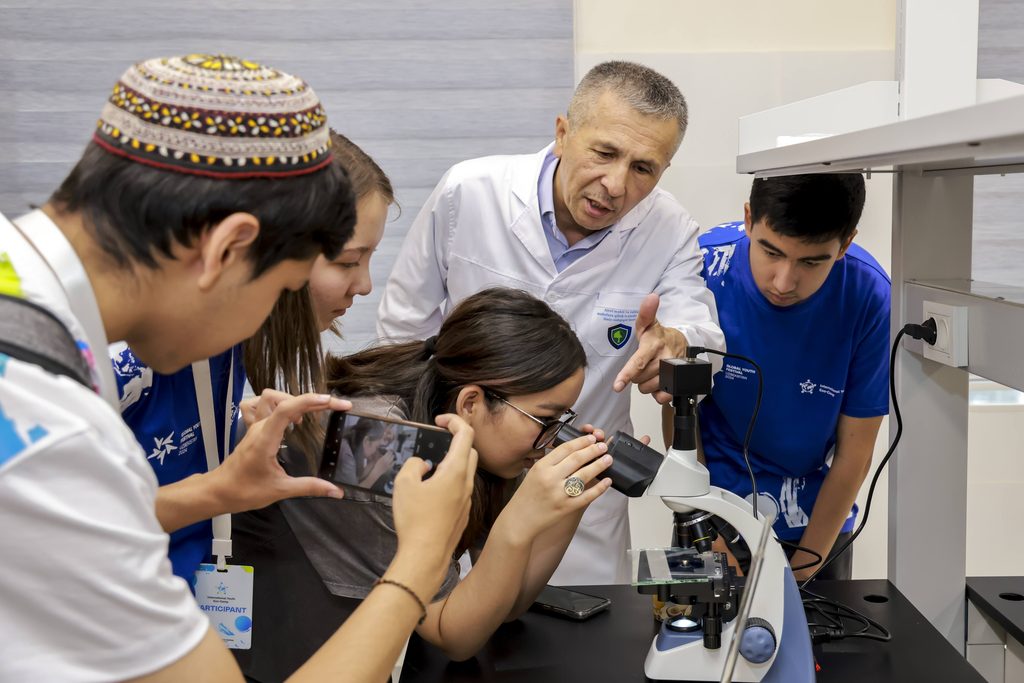
This year’s 52 Climate Champions were selected through an open call by Eco-Schools. Participants attended training, represented Uzbekistan at events including the Regional Environmental Summit in Astana, the International Youth Forum in Istanbul and the Eco Expo in Samarkand, and organised activities in communities across Uzbekistan.
According to programme figures, the participants have trained more than 17,000 of their peers, planted around 1,900 trees, collected more than 18 tonnes of waste for recycling and organised Eco Festivals in hundreds of schools.
At the Eco Expo in Samarkand in June, the scale of youth involvement was difficult to miss.
Green University students acted as ambassadors for their academic programmes. Teenagers Kamila and Veronica represented UNICEF and spoke about their UniSat project, which involved launching satellites over the Aral Sea. Other young activists put their language skills and local knowledge to use with international delegations, drawing attention to environmental initiatives from regions such as Syrdarya which might otherwise struggle for visibility.
But some of the most interesting projects were found in the Start-up Hall, where young entrepreneurs were attempting to turn environmental problems into viable businesses.
Turning environmental problems into businesses
Rayhona represented Organic Living, a Tashkent-based brand producing alternatives to plastic-heavy and chemical-intensive household products.
“We care about nature, we care about our health, and that’s why people who love a healthy lifestyle and nature choose us,” she explained.
The company produces items including soap made from coconut oil and detergent sheets designed to replace conventional washing detergents and their plastic packaging.
Organic Living’s products are already sold in shops in Tashkent and online. Its premise is simple: environmental awareness can create consumer demand, and that demand can make greener alternatives commercially viable.
For Shakhida Karlibayeva and Miyratdin Azhiniyazov, the problem they wanted to address was rooted much closer to home.
The two co-founders of ECOPOTS come from Karakalpakstan, where large-scale planting programmes are being used to stabilise soils and establish vegetation on and around the exposed seabed of the former Aral Sea.
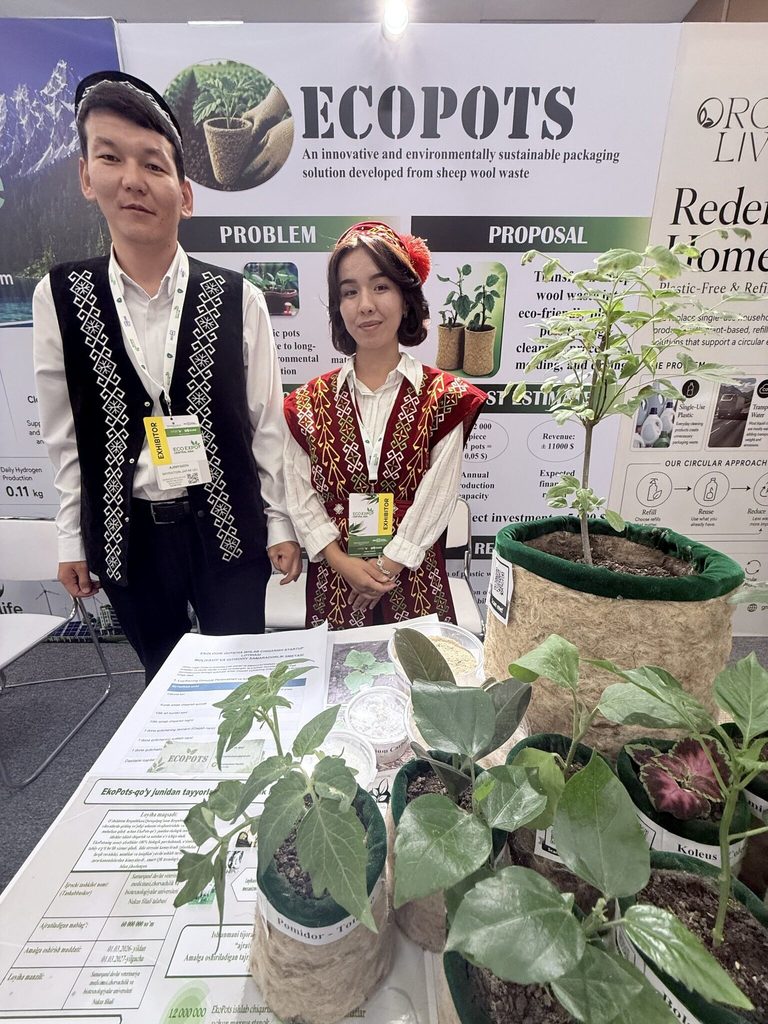
Tree planting creates an environmental paradox of its own. Seedlings are frequently raised and transported in single-use plastic pots, which can then become waste in a region where recycling infrastructure remains limited.
ECOPOTS offers an alternative. Karlibayeva and Azhiniyazov produce plant pots from wool and other natural ingredients. Seedlings can be planted directly into the ground without removing the container, reducing root disturbance while allowing the pot itself to biodegrade.
Such enterprises show how environmental problems can generate opportunities for innovation. But Uzbekistan’s ecological challenges extend far beyond problems that consumer choice or a successful start-up can solve.
Read more on Novastan: “My Childhood Was Spent on the Shore of a Sea That No Longer Exists”
For young activists from Karakalpakstan in particular, environmental action can mean confronting problems rooted in decades of ecological degradation.
Living with the Aral Sea crisis
“In Karakalpakstan, the drinking water crisis is inseparable from the legacy of the Aral Sea,” says Gulnaz Jagiderova, a former Youth Climate Action Consultant for UNICEF who recently completed an MA in Social Change, Environment and Sustainability as a Chevening Scholar at the University of Manchester.
For Jagiderova, the growth of youth environmental initiatives across Uzbekistan offers grounds for optimism – but not an excuse to underestimate the scale of the challenge.
“What gives me hope is the scale of youth-led climate and environmental action emerging across Uzbekistan,” she says.
“The challenges remain systemic and long-term. But when young people in frontline regions move from awareness to implementation, organising, innovating, and holding institutions accountable, solutions become grounded in lived reality.”
Few initiatives demonstrate that transition from awareness to implementation as directly as the work of another young environmental activist, Gulnaz Abutova.
Abutova divides her time between Nukus and Tashkent and is the founder of Clean Water, a non-profit organisation installing small-scale water treatment stations in villages in the Aral Sea region.
Each station can provide safe drinking water for up to 2,000 people and costs around UZS 120 million – slightly more than US$10,000 – to install.
“Clean water work is deeply personal to me because it turns a simple idea into tangible change,” Abutova says.
“Seeing this direct impact reminds me that meaningful change begins with taking action.”
The work requires not just environmental expertise but fundraising, logistics and cooperation with communities. Clean Water has so far installed stations serving ten villages, with plans for another five.
Abutova combines the voluntary initiative with her work at the Aral School, an ecological education programme commissioned by the Uzbekistan Art and Culture Development Foundation.
Her experience illustrates both the possibilities and the limitations of youth-led environmental action. A purification station can transform daily life in a village. Scaling that impact across an entire region facing structural water insecurity is a far larger task.
A generation willing to act
None of the young people I met appeared under any illusion about the scale of Uzbekistan’s environmental challenges.
Climate change intersects with problems that have accumulated over decades: the degradation of the Aral Sea basin, pressure on increasingly scarce water resources, waste management, desertification and the need to reconcile economic growth with environmental sustainability.
Youth programmes, social enterprises and local initiatives cannot resolve these problems alone. Nor should responsibility for tackling them be transferred onto a generation that did not create them. Large-scale change will ultimately depend on public policy, investment, infrastructure and cooperation between Uzbekistan and its neighbours.
But the growing involvement of young people matters.
Some are lobbying and educating their peers. Others are developing products, planting trees, launching environmental businesses or finding practical ways to bring clean water to communities. Their projects differ dramatically in scale, but they share a conviction that environmental problems are not simply something to be endured.
Uzbekistan’s young population will live longest with the consequences of the decisions being made today. Increasingly, its members are also demanding a role in shaping what happens next.
By Sophie Ibbotson, Uzbekistan’s Ambassador for Ecology.