





 How Uzbek Composers Made the Violin Their Own
Support Novastan, the European Central Asia magazine
By supporting Novastan, you are supporting the only English, French and German-language media specialising in Central Asia. We’re independent and we need your help to stay that way!From Tashkent classrooms to Miami conservatories, violinist and researcher Irina Antsiferova traces how Uzbek composers transformed a Western instrument by drawing on local melodies, rhythms and performance traditions.
One of my childhood memories takes me back to Tashkent in 1992. I am sitting beside my mother in a taxi as we make our way through the city streets to my music school. The radio is playing, and suddenly the sound of a gijak, a traditional Uzbek bowed string instrument, catches my attention. I listen closely, fascinated by how familiar it sounds, and turn to my mother.
“It sounds so much like a violin!”
She nods.
We are on our way to the Uspensky Specialized Music School, where I was studying violin at the time, a school that continues to educate talented young musicians today. When I arrive for my lesson, I unpack my instrument and take out one of the pieces I am studying: Uzbek composer Nazarov’s Song and Dance.
Read more on Novastan: From Uzbekistan to Strasbourg: Aziz Shokhakimov, a conductor between cultures and languages
Suddenly, I hear a connection. The sound of the gijak that I had just heard on the radio and the music written on the page in front of me seem to belong to the same musical world.
Something clicks: this is how this music should sound.
I did not know it then, but perhaps a small researcher was already beginning to emerge inside me. That curiosity stayed with me for decades. Eventually, it led me to become a Doctor of Musical Arts and to devote my doctoral research to the role of Uzbek composers in developing repertoire for Western string instruments.
Discovering Uzbek music from America
When I later came to the United States as a student, I encountered an extraordinary mixture of musical cultures. In Miami especially, Latin American and Afro-American traditions are everywhere. I also encountered music connected with Native American traditions. Russian symphonic repertoire, meanwhile, is a familiar part of American conservatory and orchestral life.
Uzbek classical music was different.
Outside relatively specialised circles – particularly among musicians who had grown up in Uzbekistan or studied at the State Conservatory of Uzbekistan – the composers I knew so well were largely unfamiliar.
Perhaps geography plays a role. Uzbekistan is thousands of kilometres from the United States. But its musical history is anything but isolated.
For centuries, the territory of present-day Uzbekistan stood at a crossroads of cultures. Persian, Turkic, Arab, Mongol and later Russian traditions intersected there. Its position along the Silk Road and centuries of political transformation produced a musical culture in which different traditions continually encountered and reshaped one another.
During the Soviet period, another major transformation took place. New theatres, concert halls and educational institutions appeared, including the State Conservatory of Uzbekistan, founded in 1936. Western classical forms and instruments increasingly interacted with Uzbek traditional melodies, rhythms and performance practices.
The result was not simply Western music with an “Uzbek flavour”. Over time, a distinctive musical language emerged, and with it generations of composers and performers who developed their own approach to Western classical instruments, including the violin.
Read more on Novastan: When the clarinet speaks Uzbek: bringing an overlooked classical repertoire to the world
One of the most fascinating figures in this story was Georgi Mushel.
Georgi Mushel: between Russia and Uzbekistan
Georgi Mushel was born in Tambov, Russia, in 1909 and studied at the Moscow Conservatory, where his teachers included Nikolai Myaskovsky, Mikhail Gnessin and the pianist Lev Oborin. The harmonic colours of Claude Debussy and Maurice Ravel also left a strong impression on his musical language.
In 1936, after graduating from the Moscow Conservatory, Mushel moved to Tashkent to teach at the newly established State Conservatory of Uzbekistan. The move transformed his musical life.
He immersed himself in Uzbek traditional music and became familiar with instruments such as the surnay, doira and dutar. He worked with Uzbek musicians and collaborated with ethnographer and composer Victor Uspenskiy. He eventually arranged 55 Uzbek folk songs, a project that became something of a compositional laboratory for him.
In his earlier compositions, Mushel sometimes quoted Uzbek melodies directly. Gradually, however, the influence became deeper.
Rather than simply inserting folk tunes into European compositions, he began to absorb their musical logic: modal writing, meaning music based on scales other than the conventional Western major-minor system; recurring rhythmic patterns; and textures that evoked the sound of instruments such as the dutar.
Read more on Novastan: Finding links between electronic and folk music in “Waiting for the Sea”
The Uzbek and European elements had begun to speak the same musical language.
A violin sonata that speaks Uzbek
The three-movement sonata follows a recognisable Western classical structure, but listening closely reveals another musical world beneath it.
The second movement, Moderato con anima, is particularly striking. It is written in an unusual 5/4 metre – five beats to a bar – and draws on the Uzbek folk melody Gazhagim (“My Curls”), which Mushel had previously harmonised as part of his collection of 55 folk songs.
But melody alone does not explain why the movement sounds Uzbek.
Rhythm is equally important.
The heartbeat beneath the melody: usul
One of the fundamental concepts in Uzbek traditional music is usul, a recurring rhythmic pattern that provides the structural foundation for a piece.
Traditionally, usul patterns can be played on the doira, a frame drum widely used in Uzbek music. Performers produce contrasting sounds, often described as bum, a lower sound struck towards the centre of the instrument, and bak, a higher sound played closer to the edge.
What fascinates me as a violinist is the relationship between this stable rhythmic foundation and the freedom of the melody above it.
The usul can remain remarkably precise while the melodic line breathes with rubato – flexible timing in which the performer slightly stretches or compresses the tempo for expressive effect.
This matters when a Western-trained violinist approaches Mushel.
The notes may be printed using familiar Western notation, but playing them exactly as one might play Brahms or Beethoven does not necessarily reveal their character. Uzbek rhythmic interpretation can involve subtle emphases and flexibility that notation alone cannot convey.
The performer sometimes has to read between the lines.
In the second movement of Mushel’s sonata, rhythmic patterns can be connected to traditional Uzbek structures, including those associated with Chambarcha Irok (a 5/4 rhythmic pattern (usul) associated with the Irok repertoire of Shashmaqom). They can be heard particularly clearly in the left hand of the piano part.
There are other clues.
The movement’s modal language helps create its distinctive Central Asian character. At another point, Mushel seems to evoke the sound of the dutar, the traditional Uzbek plucked string instrument.
For the violinist, this changes the physical approach to the instrument.
I find that playing the pizzicato – plucking the violin strings rather than using the bow – closer to the bridge gives the notes greater clarity and helps suggest the sharper articulation of a plucked traditional instrument.
These may seem like small performance decisions. But together they reveal something important.
Performing this repertoire requires understanding not only what Mushel wrote, but also the musical culture from which those sounds emerged.
More than borrowing
This is what makes the Uzbek violin repertoire so interesting to me.
It would be easy to describe it simply as a meeting between “East” and “West”, but that formulation is too simple. What happened in twentieth-century Uzbekistan was more complex.
Western instruments such as the violin entered an environment with its own sophisticated traditions of melody, rhythm, ornamentation and performance. Uzbek and Uzbekistan-based composers did not merely place folk material inside European forms. They increasingly adapted those forms to another musical sensibility.
For performers, that means technique cannot be separated from context.
A violinist can play every written note correctly and still miss the character of the music. Understanding the rhythmic logic of the doira, the articulation of the dutar, the expressive flexibility of Uzbek melody or the sound world of the gijak can fundamentally change how a passage is approached.
That was the lesson I had already begun to discover as a child, without yet having the vocabulary to explain it.
From Tashkent to Miami
Mushel’s sonata remains part of my repertoire today.
And so does Nazarov’s Song and Dance – the piece I remember opening as a child after that taxi ride with my mother more than three decades ago.
There is something beautifully circular about that memory.
Back then, my mother and I were riding through Tashkent towards my violin lesson at the Uspensky School. I was a child trying to understand why the violin music on my stand sounded somehow connected to the gijak I had just heard on the radio.
Read more on Novastan: From Q-pop to Hip-Hop: Kazakhstan’s Multilingual Sound
Today, I drive myself to teach at a conservatory in Miami.
And the question that began in that taxi has never completely left me.
Only now, instead of asking my mother why these musical worlds sound connected, I explore that question as a violinist, teacher and researcher – and introduce my own American students to the Uzbek music that first taught me to listen differently.
By Irina Antsiferova.
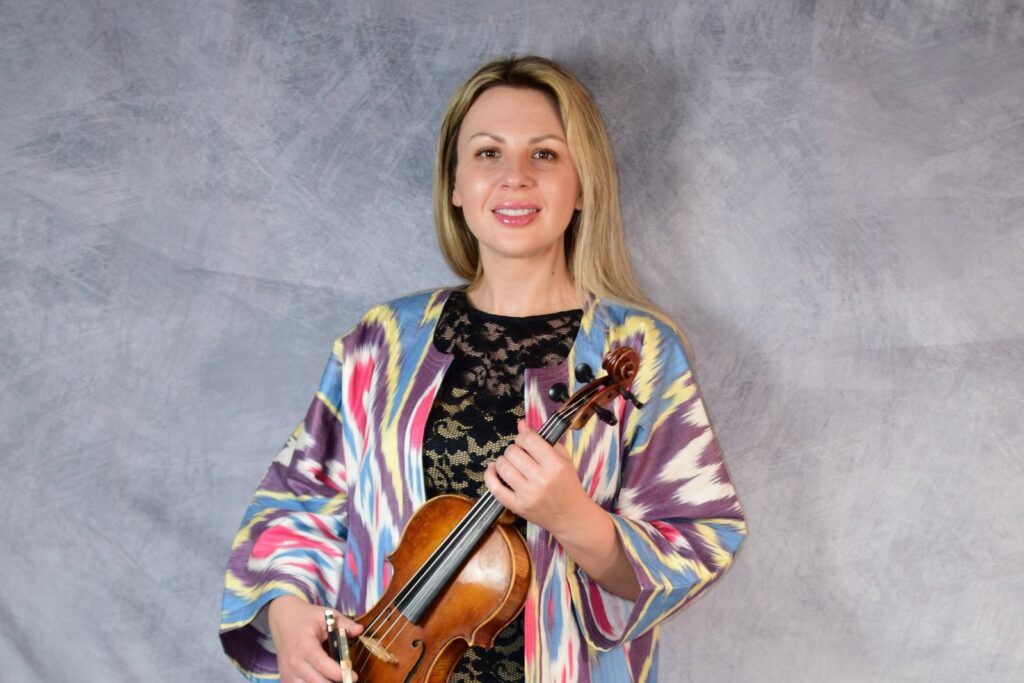
Irina Antsiferova is a violinist, educator and Doctor of Musical Arts. Her research examines the influence of Uzbek musical traditions on repertoire for Western string instruments. She is currently based in Miami.