


 In Kyrgyzstan, after the dismissal of the GKNB chief, the political-security apparatus is reshuffled
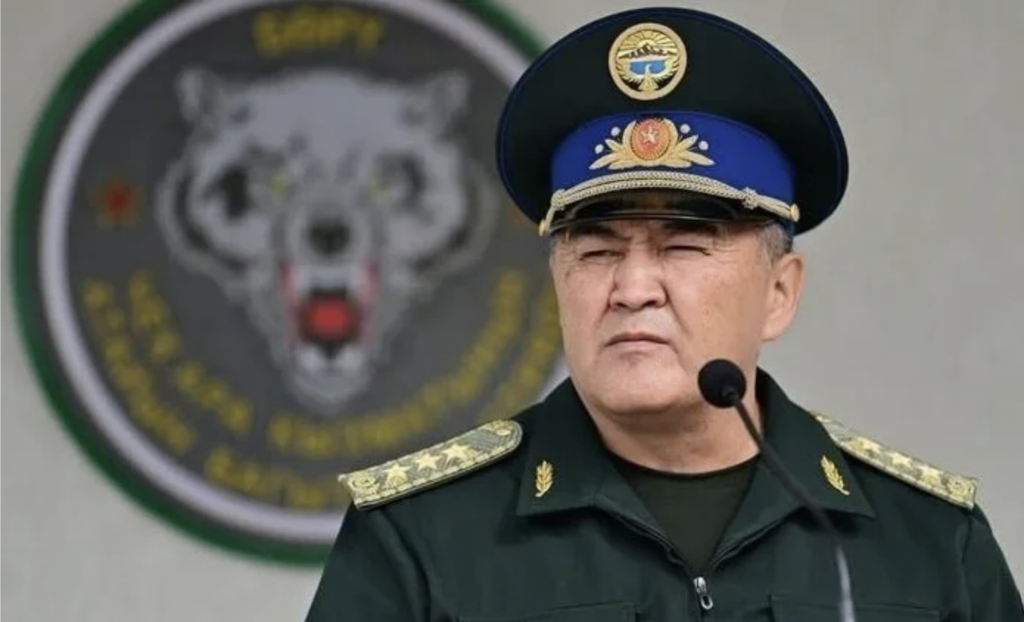
On 10 February, Kyrgyz President Sadyr Japarov dismissed Kamchybek Tashiev, head of the State Committee for National Security, or GKNB, and a central figure in power for several years. His removal, followed by dismissals targeting those close to him in several institutions, brings an end to an alliance that had structured Kyrgyzstan’s political-security apparatus.
The ruling tandem that had dominated Kyrgyzstan for more than five years has finally cracked. On 10 February, by dismissing Kamchybek Tashiev, head of the State Committee for National Security, by decree, Kyrgyz President Sadyr Japarov did not merely end a long-standing collaboration with his closest ally. He also regained control of the coercive apparatus that had until then been one of the pillars of the system established since he came to power in 2020.
For more than five years, Kamchybek Tashiev had been the most powerful man in Kyrgyzstan after the president, overseeing the main anti-corruption investigations. He appeared publicly during spectacular arrests and embodied an increasingly omnipresent security apparatus. A co-founder of the Mekentchil party and a key actor in the political upheavals that brought the tandem to the top of the state, he had gradually turned the security services into a pillar of the regime. In a political system marked by the personalisation of power, his influence extended far beyond the institutional framework of his position.
Under his leadership, the GKNB became one of the nerve centres of the state. Its prerogatives expanded, its resources increased and its visibility grew. Internal promotions, the allocation of housing to officers, nepotism and direct interventions in the management of sensitive economic cases: Kamchybek Tashiev had gradually built a network of authority and loyalty that structured the regime’s balance.
Kamchybek Tashiev, security architect of Sadyr Japarov’s regime
Kamchybek Tashiev began his political career in 2007 as minister of emergency situations. After disagreements with former Prime Minister Daniyar Usenov, he left his post in 2009, before siding with the opposition during the Kyrgyz revolution of 2010. These events enabled him to found his party, Ata-Zhurt, in 2006, and to win the early parliamentary elections of 10 October 2010 with 15.89% of the vote and 28 seats.
He thus returned to political life as a member of Kyrgyzstan’s Supreme Council from 2010 to 2013. In 2014, Ata-Jurt merged with Respublika in an attempt to win the 2015 parliamentary elections, but this merger displeased Kamchybek Tashiev, who left the party and joined Mekenchil, which he had co-founded with Sadyr Japarov on 16 June 2010 and which brought together many members of Ata-Jurt.
Novastan est le seul média en français et en allemand spécialisé sur l'Asie centrale. Entièrement associatif, il fonctionne grâce à votre participation. Nous sommes indépendants et pour le rester, nous avons besoin de vous ! Vous pouvez nous soutenir à partir de 2 euros par mois (défiscalisé à 66 %), ou en devenant membre actif par ici.
The parliamentary elections of 4 October 2020 once again turned into a conflict extending beyond the political sphere, with major demonstrations from 5 to 15 October 2020. Amid this new socio-political chaos, former Prime Minister Sadyr Japarov and his supporters, including Kamchybek Tashiev, increased pressure on former President Sooronbay Jeenbekov, who resigned on 15 October 2020. As a result, Sadyr Japarov became acting president and appointed Kamchybek Tashiev head of the GKNB on 16 October that year.
Also read on Novastan : Condamnation d’Almazbek Atambaïev : retour sur le parcours mouvementé des anciens présidents du Kirghizstan
His influence was also visible during the border clashes with Tajikistan in April 2021 and September 2022. As head of the GKNB, the body overseeing the border guards, Kamchybek Tashiev played a central role in managing operations and ceasefire negotiations. These crises strengthened his image as a strongman guaranteeing Kyrgyzstan’s territorial integrity.
Dismantling extended to several institutions
Tashiev’s departure has been accompanied by a wider reorganisation. Within the GKNB itself, his deputies for state security were removed, and a new acting head was appointed without delay.
President Japarov then stated that an Investigative Committee would be created and would report directly to the president, while the GKNB’s area of competence would be reduced. The agency will henceforth focus on intelligence, counterintelligence, counterterrorism and organised crime, Radio Azattyq noted. “It is necessary to depoliticise the State Committee for National Security and free it from the influence of political parties, ideologies and various stakeholders,” assured Jumgalbek Shabdanbekov, the new GKNB chief appointed on 19 February, in an interview with the local newspaper Vecherny Bishkek.
But the reshuffle goes far beyond the security apparatus alone. The minister of natural resources, ecology and technical supervision, Meder Mashiev, as well as his deputy minister, Bolot Jusupbekov, were dismissed. In the south of the country, considered Tashiev’s electoral stronghold, mayors, notably in Osh and Manas, are being replaced.
Also read on Novastan : Les pistonnés : portraits au vitriol des enfants des présidents kirghiz
Even more significantly, people directly close to Kamchybek Tashiev have been targeted. While the parliamentary mandate of his brother, Shaiyrbek Tashiev, has not so far been called into question despite rumours of dismissal, the head of the transport prosecutor’s office, Nurgazy Matisakov, who is Tashiev’s nephew, has been removed. These decisions reflect a desire to neutralise not only one figure, but an entire family and political network.
A shift ahead of the presidential election
This rupture comes one year before the 2027 presidential election, in a climate marked by criticism of the economic and energy situation, as well as by a petition calling for an early vote.
Also read on Novastan : Le Kirghizstan s’inquiète d’une crise énergétique majeure cet hiver
Presidential statements, however, have sought to ease tensions. On 13 February, the head of state told the state news agency Kabar that there was no division between his supporters and those of his former ally, assuring that his “friendship with Kamchybek Tashiev will continue”. A few days later, he added: “We remain friends. But he will not resume public office. He needs to rest and focus on his health.”
Want more Central Asia in your inbox? Subscribe to our newsletter here.
The end of the tandem between Sadyr Japarov and Kamchybek Tashiev thus marks a phase of increased concentration of power in the hands of the presidency. It remains to be seen whether this centralisation will durably strengthen the stability of Kyrgyzstan’s system, or whether it will reveal new fault lines within the political elites.
Lenny Cabrol Noto
Contributor for Novastan
Thank you for reading this article! If you have time, we would appreciate your feedback, either through this anonymous form or by email at editorial@novastan.org. Thank you very much!