




 Kazakhstan continues to assert itself as the “key link” in the Middle Corridor
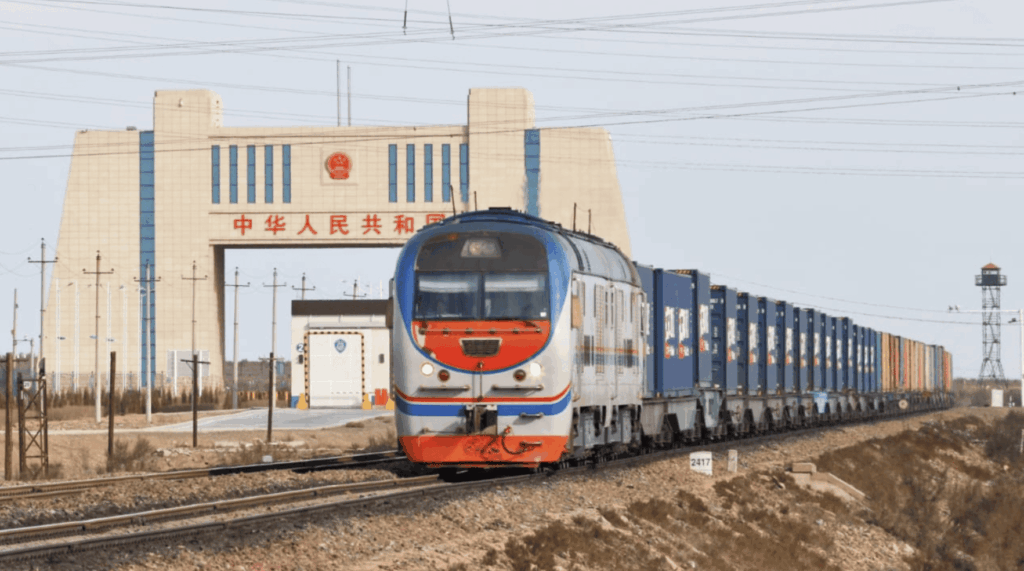
Last month, Kazakhstan hosted the 40th Conference of Directors General of Railways, bringing together representatives from more than thirty countries. It was an opportunity for Astana to showcase its ambitions for the “Middle Corridor”, against the backdrop of the war in Ukraine and the reshaping of global trade routes.
From Monday 20 April to Monday 24 April 2026, the 40th Conference of Directors General of Railways brought together more than thirty countries in the heart of the Kazakh capital, against a backdrop of geopolitical uncertainty. The Organisation for Co-operation between Railways, known as the OSJD, is an intergovernmental organization that brings together a network of more than 320,000 kilometres of railway tracks, carrying around 5.5 billion passengers and nearly 5 billion tonnes of freight each year.
Founded in 1956, the OSJD – the main forum for railway coordination between Europe and Asia and a legacy of technical cooperation from the Soviet era – has gradually expanded to include new members. It currently has 27 members, ranging from Albania to Vietnam.
This year, the 40th Conference of Directors General of Railways brought together more than 300 officials and representatives of railway companies. Kazakhstan’s Prime Minister, Olzhas Bektenov, spoke in person, a sign of the political importance attached to the event.
He recalled that “Kazakhstan’s railway sector, which plays a crucial role in economic development, aims to improve the population’s quality of life and ensure sustainable growth”. The Prime Minister also announced strong ambitions for the coming years, declaring that he wanted to “build an additional 5,000 kilometres of railway tracks” over the next four years and to “increase transit volumes to 100 million tonnes per year by 2035”, thereby underlining his desire to strengthen Kazakhstan’s pivotal role in trade between Europe and China.
An Afghan delegation representing the Islamic Emirate met Kazakh and Azerbaijani officials to discuss the strengthening of the Hairatan and Torghundi ports and regional transit, according to the Afghan news agency Pajhwok Afghan News. This presence, like the joint presence of Ukraine and Russia, shows that railway cooperation can sometimes go beyond conventional diplomatic logic.
In addition to financial management issues, the conference also focused on the OSJD’s future work programme and the organization of the next meeting. Emphasis was placed on increasing volumes, modernizing infrastructure and transitioning towards more advanced technologies to improve the efficiency and fluidity of rail transport, reports the media outlet Transport Corridors.
The Middle Corridor at the heart of global challenges
By speaking of “transforming Eurasia into a single, fully functioning transport mechanism”, the Kazakh Prime Minister is directly referring to the trade route that has been developing in the region for around twenty years, particularly since China’s Belt and Road Initiative in 2013.
The Middle Corridor, also known as the Trans-Caspian International Transport Route (TITR), is a 4,000-kilometre multimodal transport corridor linking Chinese factories to European markets via Central Asia, the Caspian Sea, the South Caucasus and Turkey.
It is also the shortest overland route between China and Europe, provided the necessary infrastructure is in place, which was long not the case. Delivery times, which once took several weeks, have now fallen to around 18 days, according to The Astana Times.
Read also on Novastan : L’Asie centrale face au défi de la réalisation du corridor médian
This reduction was made possible in part by digital transformation and the introduction of the TezCustoms system, which has reduced processing time at the borders with China from 8 hours to 30 minutes.
Mr Bektenov emphasized Kazakhstan’s pivotal role, with around 85% of Middle Corridor traffic passing through the country. He also announced the construction of 5,000 kilometres of new railway lines over the next four years, with the aim of reaching a transit capacity of 100 million tonnes per year by 2035.
A route that has grown rapidly since the geopolitical crises…
This Eurasian route has been one of the main beneficiaries of the global geopolitical situation of the past four years, with two successive shocks having propelled its importance.
The first is the war in Ukraine since 2022: Western sanctions imposed on Russia caused westbound freight volumes on Russian routes to fall by 51% in 2023, according to Transport Corridors. The Middle Corridor has thus established itself as the only practical land bridge between China and Europe that bypasses Russian territory.
Read also on Novastan : Le corridor sud, une menace pour le transport kazakh ?
The second is the war in the Middle East and the Houthi attacks in the Red Sea, which began in late 2023. According to the Qatari media outlet Gulf Times, amid uncertainty in the region, some companies redirected their traffic from the Strait of Hormuz and the Suez Canal towards the Cape of Good Hope, making land-based alternatives all the more attractive.
In 2024, the volume of goods transiting along the Eurasian route increased by more than 63% year-on-year, according to the US think tank Carnegie Endowment for International Peace, reaching 4.1 million tonnes compared with only 500,000 tonnes before Russia’s full-scale invasion of Ukraine. On the China-Europe segment alone, the number of containers transported increased twenty-fivefold between 2023 and 2024, according to the journal CEBRI.
…but remains constrained
However, according to an article by Friedrich Conradi published on the Carnegie Politika website, despite its potential to become a major competitive route, it could prove limited by structural problems. “The Middle Corridor is still far from competitive. It handles only around 6% of the annual capacity of the Northern Corridor via Russia, which stands at 100 million tonnes, and while many Western actors expect it to continue growing, several indicators instead suggest a slowdown,” the researcher explains.
The Middle Corridor’s infrastructure remains insufficient, with ports often saturated, particularly in Georgia, and an inherently fragmented route, since it relies on a succession of transport modes, making it slower, more expensive and less seamless than alternative routes via Russia or by sea.
Added to this is persistent geopolitical instability in the Caucasus and around Iran, as well as environmental challenges, particularly the falling level of the Caspian Sea, which directly affects port capacity and the continuity of maritime transport.
Lorenz Uberti
Contributor for Novastan
Edited by Elise Medina (French version) and Mathieu Lemoine (English version)
Thank you for reading this article! If you have time, we would appreciate your feedback, either through this anonymous form or by email at editorial@novastan.org. Thank you very much!