





 Lack of resources in Afghanistan undermines security on the border with Tajikistan
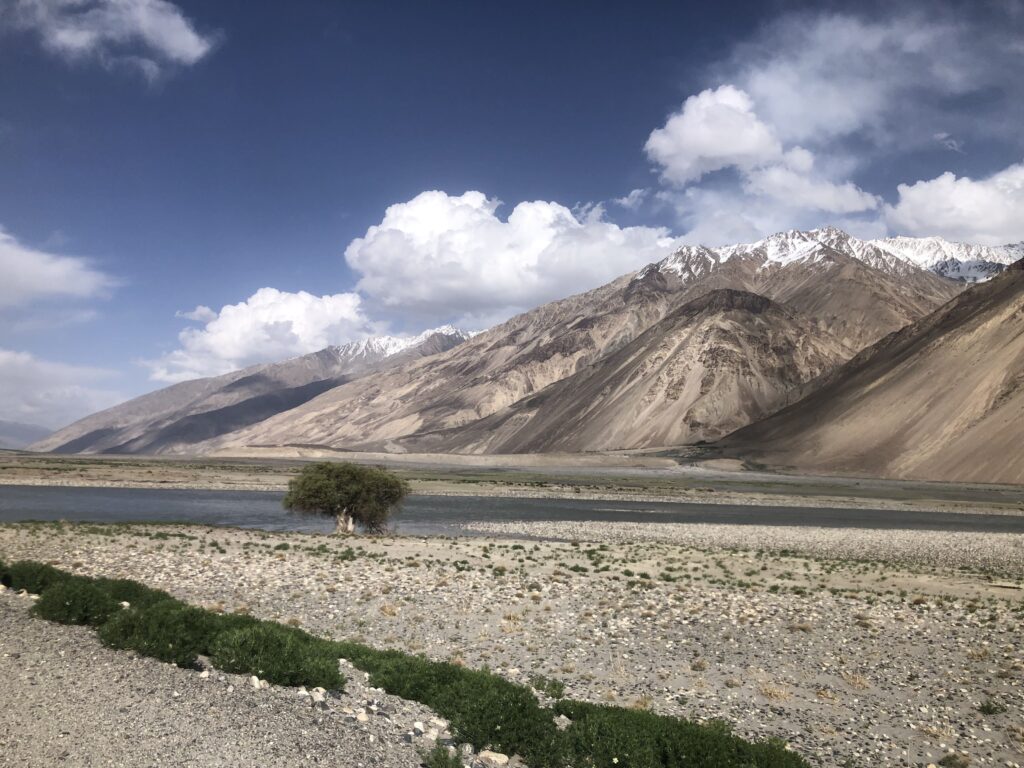
A recent report by a UN group reveals that the Taliban have sharply reduced the number of their security forces, disproportionately so in the region bordering Tajikistan. These budget cuts coincide with a resurgence of attacks along the border between the two countries. These developments are helping to reshape the previously strained relations between Kabul and Dushanbe.
Haibatullah Akhundzada, Afghanistan’s de facto leader, has ordered a 20% reduction in the number of security forces in response to budgetary constraints. This is according to a report by the Analytical Support and Sanctions Monitoring Team, submitted to the UN Security Council Committee last December.
However, these staff reductions are disproportionate near the border with Tajikistan. According to the document, out of more than 4,000 commanders and officers dismissed nationwide, around 1,000 were in Badakhshan province, which borders Tajikistan’s Gorno-Badakhshan autonomous region.
Support Novastan, the European Central Asia magazine
By supporting Novastan, you are supporting the only English, French and German-language media specialising in Central Asia. We’re independent and we need your help to stay that way!Takhar, another province bordering Tajikistan’s Khatlon region, is also among the three other provinces most affected by the measure. These security force cuts, ordered last April, coincided with a resurgence of armed clashes linked to drug trafficking at the border in late 2025. On 26 and 30 November, five Chinese workers were killed and the same number injured on Tajikistani soil in attacks launched from Afghanistan, while two Tajik officers and three attackers were killed on 23 December, according to media outlet Asia-Plus.
A resurgence of border clashes in late 2025
Since then, Taliban representatives have issued several statements of support, accusing “ill-intentioned circles” or “enemies” of seeking to undermine Afghanistan’s relations with Tajikistan and China. Indeed, it is certain that these attacks were not carried out by the Taliban. They have even said they arrested suspects in the border region, without providing details, according to Afghan media outlet Tolo News.
Also read on Novastan : Au Tadjikistan, la mort de cinq Chinois relance les inquiétudes sur l’instabilité à la frontière avec l’Afghanistan
The motives of those behind the attacks are difficult to determine. In the case of the most recent attack, which killed Tajik officers, Afghan media outlet Hasht-e Subh claims that the attackers were members of Jamaat Ansarullah, a terrorist group based in Afghanistan, hostile to the Tajik government and mainly made up of Tajik citizens.
In the case of the attacks against Chinese workers, uncertainty remains. For researcher Mélanie Sadozaï, affiliated with the University of Regensburg’s Department of Interdisciplinary and Multiscalar Area Studies, whose research focuses on the Afghanistan-Tajikistan border, it is impossible to accuse any specific armed group with certainty. Interviewed by Novastan, she suggests that the attacks may have been retaliation by “drug traffickers who do not want China to be present, as this could disrupt their activities”.
“One cannot rule out either that these were ordinary people rejecting China’s activities in the region, as China extracts mineral resources under bilateral agreements with Tajikistan and Afghanistan,” Mélanie Sadozaï continues. “People are well aware that Chinese companies come to ‘plunder’ their resources without redistributing them. It could also be an act of revenge, but again, it is difficult to say,” she adds.
A new forced cooperation
In this context, a reduction in Taliban personnel responsible for maintaining order at the border can only be viewed negatively on the Tajikistani side, as relations between the two countries have taken a new turn in recent months.
After the Taliban seized power in 2021, Tajikistan positioned itself as Afghanistan’s only neighbour openly hostile to Kabul’s new rulers. While other neighbouring countries quickly adopted a pragmatic stance and, without officially recognising the Taliban, maintained ties with them for economic reasons, Tajikistan has continued to stand apart.
Also read on Novastan : L’Afghanistan taliban, un faisceau de menaces sur les pays d’Asie centrale
But open hostility is now turning into forced cooperation. Barely two weeks before the attacks against the Chinese workers, a Tajikistani delegation visited Kabul to meet its counterparts and discuss counterterrorism cooperation, the fight against drug trafficking and the porous shared border, Tolo News reported. Similarly, the governors of Afghanistan’s Balkh and Badakhshan provinces had travelled respectively to the Tajikistani capital, Dushanbe, and to Tajikistan’s Gorno-Badakhshan region, although these visits were not publicised.
The latest attacks have accelerated this rapprochement at the highest level: for the first time since 2021, the foreign ministers of Tajikistan and Afghanistan held phone calls, with two taking place in December, Asia-Plus reported.
The political impossibility of recognising the Taliban
The Tajikistani authorities delayed this moment for as long as they could, and are now trying to find a way out of this diplomatic impasse. Tajik President Emomali Rahmon has long presented himself as a bulwark against religious extremism: real diplomatic contact with the Taliban would be difficult to legitimise, both within Tajikistan and abroad.
Emomali Rahmon’s clear stance against the Taliban and his support for the Afghan opposition in exile earned him invitations to the European Parliament and to France shortly after the Taliban’s takeover of Kabul, helping to ensure the continuation of international financial assistance on which Tajikistan heavily depends. Openly collaborating with the Taliban is therefore not an option if it risks jeopardising such important funding.
Domestically, Dushanbe also wants to present itself as the protector of ethnic Tajiks, portraying them as oppressed by the Pashtun Taliban. During the Taliban’s first period in power from 1996 to 2001, the Tajikistani president supported Ahmad Shah Massoud, the leader of the Afghan resistance, who visited Tajikistan several times. That support is now extended to his son, who is also effectively based in Tajikistan, and, to some extent, to the Afghan embassy, which has become a stronghold of the former regime.
This animosity is mutual: the Taliban appear to maintain cordial relations with Sharofiddin Gadoev, one of the exiled leaders of the opposition to the Tajikistani regime. He was invited to take part in discussions in Afghanistan last May.
Economic and security emergencies
In reality, economic realities had already forced the hand of the Tajikistani authorities. Electricity exports to Afghanistan have not stopped, showing that discussions, even if purely economic, have taken place between the two sides, Eurasianet reported. Other large-scale projects suggest that completely cutting off communication between the two countries was never truly conceivable, notably the CASA-1000 electricity export project.
But it is the security situation that is genuinely accelerating diplomatic contact. Bruce Pannier, a fellow with the Eurasia Program at the Foreign Policy Research Institute, notes that it was the launch of a missile towards Tajikistan in May 2022 that prompted the first formal contact between the Taliban and the Tajikistani authorities.
Moreover, ironically, it is the fight against extremism that has pushed Emomali Rahmon to open dialogue with the Taliban. After the Crocus City Hall attack in Moscow, carried out by Tajikistani citizens recruited by the Islamic State Khorasan Province, or ISKP, it became necessary to combat the involvement of Tajikistani citizens in international terrorism, both for obvious security reasons and for Tajikistan’s international image.
Also read on Novastan : Après l’attentat en Russie, les Tadjiks face à une xénophobie massive
Yet the fight against terrorism requires deeper cooperation with the Taliban, for whom these groups also represent a threat. Tajikistani citizens are sometimes actively recruited from Afghan territory, notably by ISKP.
Following Russia
Finally, Tajikistan’s uncompromising rejection of the Taliban was beginning to entail a level of isolation difficult for a small country to manage. Dushanbe’s gradual shift could be attributed to Moscow’s official recognition of the Taliban last July. Russia may expect an ally that still largely depends on it to follow its lead by also treating the Taliban as acceptable interlocutors.
Tajikistan is thus caught between the importance of Western funding and its relationship with Russia, which it cannot risk weakening. The country is one of the most remittance-dependent in the world: remittances accounted for more than 45% of GDP in 2024, mainly coming from migrant workers in Russia. A deterioration in relations with Moscow would therefore raise fears of even worse conditions for Tajik migrants, followed by catastrophic repercussions for the country’s economy.
A rapprochement with limits
However, Mélanie Sadozaï stresses that this rapprochement has limits. “Although we are beginning to see a few photographs of official meetings between the Taliban and Tajikistani authorities, all of this is taking place in the framework of trade, energy and economic cooperation, but really in the security sphere. It is very likely that this is the maximum Tajikistan can do,” she says.
As for transferring the Afghan embassy into Taliban hands, this remains highly unlikely. Here too, Mélanie Sadozaï believes that “support for the opposition is in fact fairly discreet and was mostly rhetorical. I imagine Tajikistan has no reason to stop supporting it or to expel Mohammad Zahir Aghbar,” the ambassador of the former regime, who remains in office, “and I think it can very well play both sides: maintain its current relations with the resistance while dealing with the Taliban. The two are not incompatible.”
Also read on Novastan : Le Tadjikistan reconnaît une vaste opération d’expulsion d’Afghans
Moreover, while media reports have stated that the Afghan consulate in Khorog, in Gorno-Badakhshan, had passed into Taliban hands, creating a dual authority with the embassy loyal to the former regime, Mélanie Sadozaï says she has always found the Taliban consulate closed and inaccessible since it was damaged by an avalanche in February 2023.
A worrying situation for Tajikistan and its relations with China
The fact remains that the lack of resources on the Afghan side and the latest attacks are a problem for all parties, whether they are directed against the Tajik government or against Chinese workers. A deterioration in relations with China would be extremely problematic for Tajikistan: the country’s infrastructure relies on partnerships or loans linked to China, loans that Dushanbe is struggling to repay.
China has taken the situation very seriously, calling on Tajikistan to shed light on these events and guarantee the safety of Chinese citizens on its territory. In a rare move, the Chinese embassy in Dushanbe asked its citizens to leave border areas and remain cautious.
Want more Central Asia in your inbox? Subscribe to our newsletter here.
“If the Chinese workers who were targeted are indeed employees of road construction companies, this creates an obvious problem for Tajikistan: the possibility that, in the long term, China might end up leaving and not finishing the projects it has started,” Mélanie Sadozaï says.
It is therefore possible that Dushanbe will seek to further protect its border, although no official announcement has been made on the matter. With the war in Ukraine, it seems unlikely that Russia will once again invest resources in the border, which Tajikistan has protected alone since 2004. “As for China, its army does not patrol along the border, but one possibility is that security will be reinforced around Chinese infrastructure, which is now very numerous along the border,” the researcher concludes.
Judith Robert
Author for Novastan
Proofread by Anaïs Boulard