



 Rinat Bekchintaev: “Almaty has an authentic cinematic image that cannot be repeated anywhere else”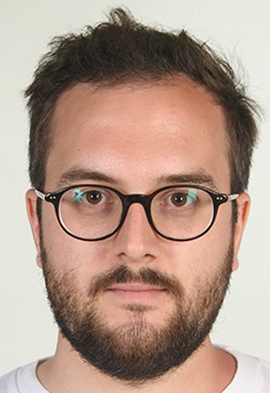
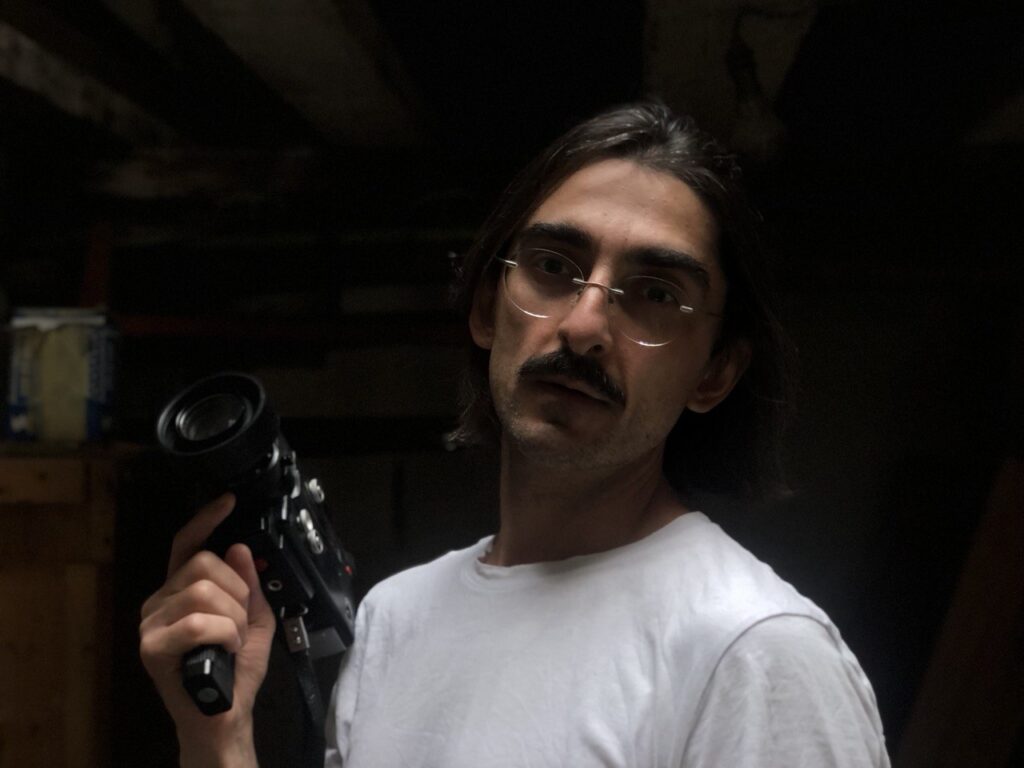
From Almaty to Moscow and Paris, filmmaker and editor Rinat Bekchintaev has built a creative identity shaped by movement, memory and displacement. In this interview with Novastan, he discusses Almaty’s cinematic power, his relationship with Kazakhstan, his work on films such as Salarié oriental, Crypto Rush and JOQTAU, and the independent cinema community he is helping to build in France.
From Almaty to Paris
Novastan : You studied in Almaty and then continued your studies at the Moscow School of New Cinema. What did Almaty give you as a filmmaker, visually, emotionally or intellectually?
Rinat Bekchintaev: Listen, Almaty is simply an unbelievably cool place. I can talk for hours about how cinematic this city is. It has its own distinctive, authentic vibe, its own tone. There is a kind of noir quality on foggy days, and the mountains, of course, create this “wall of the horizon”. But the most important thing is the people, they are very open and responsive. I am still in touch with my friends from Almaty, and I collaborate with people connected to cinema and the visual arts.
Read also on Novastan: Que sont devenues les premières salles de cinéma du Kazakhstan-Oriental ?
And of course, I dream of making not just one film in Kazakhstan, and in Almaty in particular. For example, I am currently at the development stage of a film called I Want to Be a Geologist Like My Father, a film about how ecological trauma becomes part of collective memory and continues to exist in people and landscapes decades after the disaster itself.
I studied engineering at Almaty University of Power Engineering and Telecommunications (AUPET) for five years, then took screenwriting courses at the Open Literary School. At the time, it did not seem important to me, as is usually the case. But after several years, I realized that it had given me a very important impulse to take up cinema.
Your biography is linked to several geographies: Sevastopol, Almaty, Moscow, Paris. How do these places coexist in your creative identity?
Yes, I have quite a complex, nomadic path. Sevastopol and Crimea are the most difficult starting point for me, and I think I still have to reflect on this original point of my journey. I don’t know, my mother took me away from there to Almaty when I was very young. I spent my entire conscious life in Almaty, and perhaps the only thing I can identify myself as now is an Almaty person, strange as that may sound.
Moscow also gave me a lot that was very important. It was part of my formation, an education at the Moscow School of New Cinema that mattered a lot to me, and people with whom I am still in contact.
Want more Central Asia in your inbox? Subscribe to our newsletter here.
I have not been in Paris for very long, and it is probably difficult to speak about it yet, but again, it is another chapter: new people, a new language, everything new. But I try to continue creating interaction with reality, with people and institutions. We created an association of independent filmmakers, K1NO1 (Kino 11), wrote a manifesto, organize screenings and discussions in Paris, and run a Telegram channel. Anyone can join the community, participate in events and so on. There is a website, Instagram and Telegram. In general, we are creating a kind of community, and it is international, not only made up of immigrants. I think this is important. I don’t know, at first glance it all looks like chaos, but I think it all mixes quite well in my ghostly creative identity.
Do you consider yourself a Central Asian filmmaker, a post-Soviet filmmaker, a filmmaker in exile, or do such definitions seem too limiting to you?
Perhaps for a career it is useful to manifest oneself in some way along these lines, but I do not think I would really manage to do that. I think all these labels coexist within me.
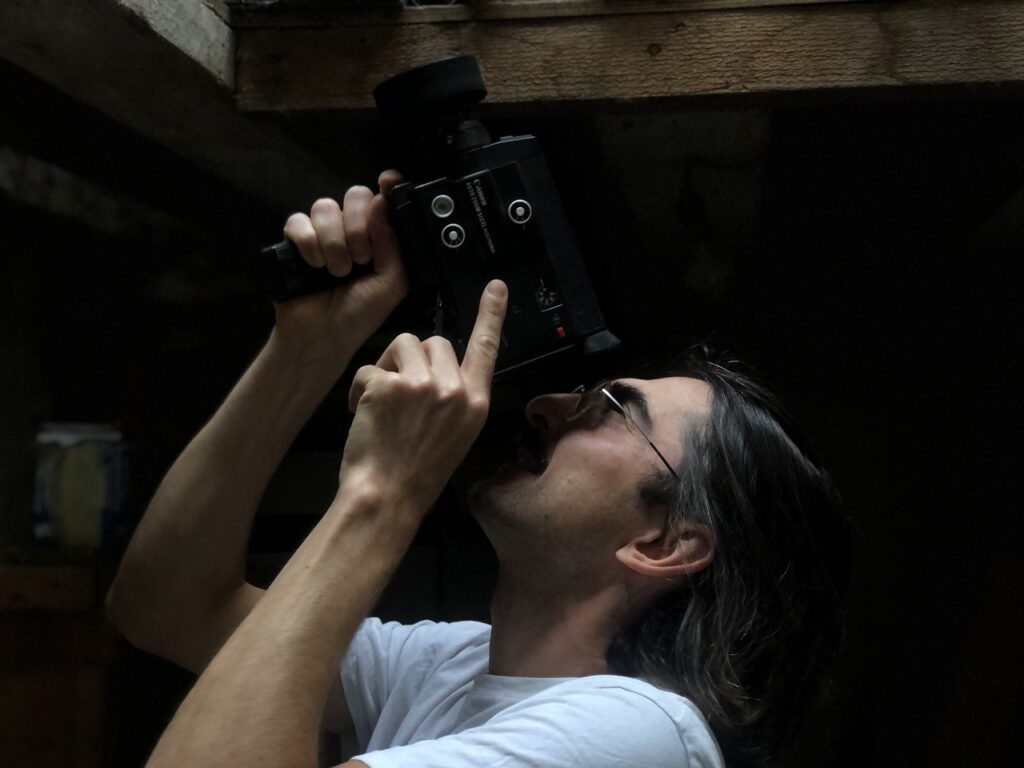
Has your perception of Kazakhstan, Central Asia or the post-Soviet space changed since moving to France?
Before moving to France, I came to Kazakhstan. I had not been in my native Almaty for about five years. And I was absolutely delighted. It seemed to me that everything was developing very well. Again, forgive me for being so complimentary, but I truly think that Kazakhstan is not stagnating at all, in any respect, and in the field of art, definitely not. After moving to France, I think it was only here that I began seriously considering the possibility of making a feature film in Kazakhstan. Perhaps the outside view is very important for me.
Note from Novastan: Bekchintaev’s work moves between directing and editing, fiction and documentary, personal stories and broader social questions. His filmography includes Salarié oriental (Vostochny rabochy), a short fiction film shaped by migration, labour and emotional distance; editing work on Crypto Rush, a documentary on the rise of cryptocurrency; and collaborations on Kazakhstani films such as Aruan Anartay’s JOQTAU and Dreams of the Sky Mausoleum.
Your films and artistic universe
One of your early fiction films, Salarié oriental (Vostochny rabochy), follows a story of emotional distance shaped by class, language and migration. Even its title seems to raise questions of labour, identity and perhaps irony. What story did you want to tell in this film?
The story in this film is simple: the impossibility of love because of class, language and other differences. But that is my interpretation now, ten years after the premiere. Perhaps at the time it was different. And of course, I believe that everyone should identify something for themselves in it. That, it seems to me, is the power of cinema.
I am also very glad that this film was once shown in Almaty, at the Arman cinema, the first cinema I ever visited in my life.
How did the idea for Salarié oriental come about, and what does this title mean to you?
The idea for the film came to my co-author Egor Shevchenko in a dream. After that, we developed it very seriously, and a lot came from reflecting on my perception of Moscow, as I had only just arrived there to study at the time.
The title appeared by chance. The sound designer named the folder with the files that way, we noticed it and immediately fixed it for ourselves. Before that, I do not even remember what the working title was.
You also worked as an editor on Crypto Rush, a documentary exploring the world of cryptocurrency across several countries and protagonists. What attracted you to this topic, and what did editing a film about such an abstract and global phenomenon teach you?
I was the editor on this film. It was a very important experience. We worked very closely with the director. At the time, she was very deeply immersed in the subject, and she had a very global project: several countries, protagonists and so on. In general, the most important thing was that we managed to combine a cinematic image and an informational one in this film. And I also learned a little more about crypto and so on.
Among your editing works is a movie connected to Kazakhstan, Aruan Anartay’s JOQTAU, rooted in Kazakhstani stories, landscapes and visual imagination. What attracts you to films shaped by this geography and cinematic world?
I think Kazakhstan has that authentic cinematic image that has enormous potential. This image consists of many elements, and it cannot be repeated anywhere else in the world.
JOQTAU is a film by my friend Aruan Anartay, and it is one of those examples where this image was captured. We searched for solutions for this film for a long time, and in the end, during editing, we found certain approaches that helped us bring this image out.
Directing, editing and cinematic language
You are both a director and an editor. Does working with editing make you a more disciplined director?
Yes, absolutely. As a director, I understand the editing process and try to make it less costly. In general, I believe that a contemporary director should be able to edit, shoot and work with sound themselves too.
Editing often remains invisible to the viewer, but it largely shapes the emotion and meaning of a film. In your view, what makes editing good?
It is not only about comfortable cuts, but about building the structure of the film, as well as creating refrains and syntagms. This happens almost entirely at the editing table. Not to mention rhythm and the flow of time. Sometimes a film comes together during editing, and this is not only my opinion.
Also read on Novastan: Le cinéma kazakh à l’honneur : retour sur la sixième édition du Festival du film kazakh à Paris
When you direct, do you already “edit” the film in your head during shooting, or do you try to leave space for discovery at the editing stage?
Yes, I do actually already edit in my head, and this gives me the opportunity to do fewer identical takes and shoot more variations of a scene. I felt this when I was shooting my film Gobelin, one of my own fiction projects.
What usually comes to you first: an image, a character, a place or a conflict?
Some kind of phenomenon or life situation appears first, or some place, or a figure, I don’t know, something that creates a sustained interest in exploring it. That is the starting point for a film.
What faces, landscapes, pauses or gestures attract your camera?
Those that transmit either vitality or a hauntological feeling.
Paris, emigration and artistic transformation
What are the main difficulties faced by a filmmaker who arrives in Paris without previous professional connections, a familiar linguistic environment or the usual film-production system?
Yes, there are many problems. First of all, not being embedded in the environment, the lack of connections, and the language too. That is probably the most difficult part, but I am trying to move in that direction. There is no shortage of ideas, and the film-production system is more or less clear.
Does emigration provide artistic freedom, or does it primarily create practical constraints?
Both. An outside view always gives a new lens on reality. Also, the reality around me is new to me, so one way or another I find interest in it. As for practical constraints, they always exist, and emigration intensifies them. It is difficult, but in my view not fatal.
Kazakhstan and Central Asian cinema
Which Kazakhstani or Central Asian filmmakers should French-speaking audiences know more about?
Aruan Anartay, a Kazakhstani director, screenwriter and producer whose debut feature JOQTAU brought a poetic, documentary-inflected vision of the Kazakh steppe to international festivals; and Katerina Suvorova, an Almaty-born documentary filmmaker known for Sea Tomorrow, which premiered at Locarno’s Critics’ Week, and for her work on Mediastan.
Which of your films would you advise Novastan readers to start with, and why?
They can watch Vostochny rabochy / Salarié oriental here.
Want more Central Asia in your inbox? Subscribe to our newsletter here.
Interview by
Mathieu Lemoine, Editor-in-Chief at Novastan-English
Maya Ivanova, Contributor at Novastan
Thank you for reading this article! If you have time, we would appreciate your feedback, either through this anonymous form or by email at editorial@novastan.org. Thank you very much!