





 In Tajikistan, daughters-in-law face a hidden system of control
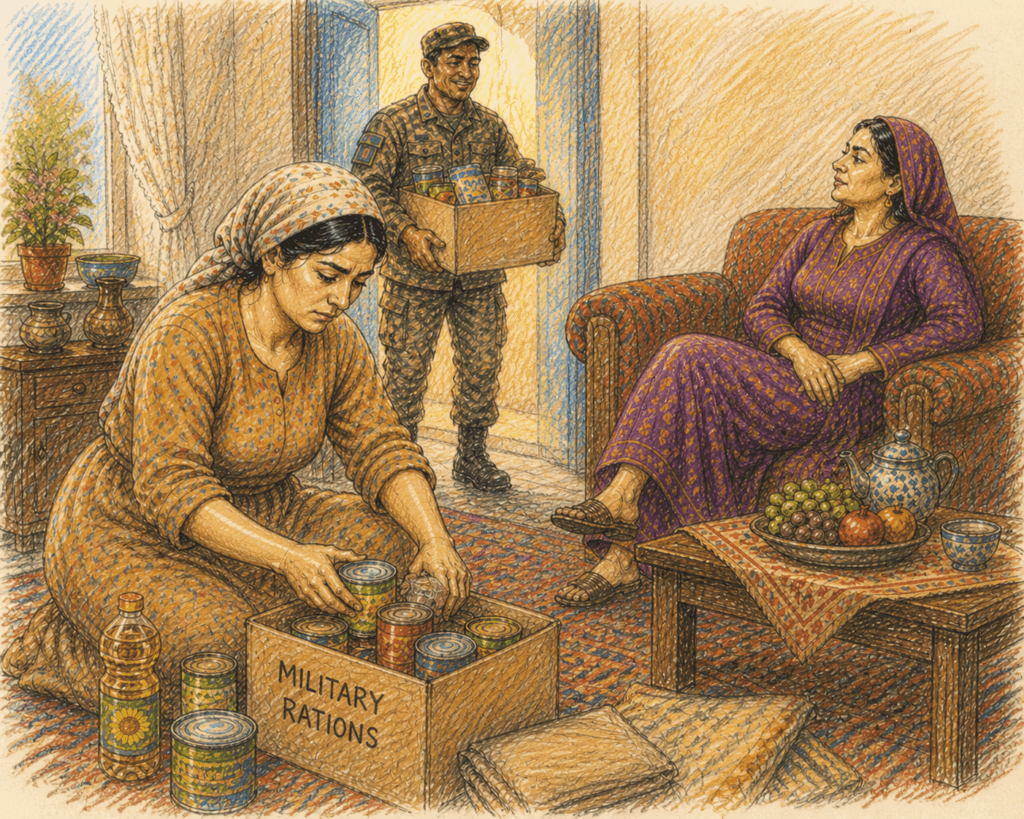
This article is published as part of a partnership between AUCA and Novastan, which brings graduate students’ academic work to a wider readership. Through this collaboration, Novastan aims to highlight research produced in and on Central Asia, and to make academic perspectives more accessible to the public.
In Tajikistan’s patrilocal households, many young brides enter a world where obedience, unpaid labour and constant surveillance are expected. Through the stories of four women, this article explores how control by in-laws, economic dependence and social pressure can turn marriage into a system of domination that remains largely invisible in public discussions of domestic violence.
In Tursunzade, 25-year-old Zarkhol Mustonova took her own life after reportedly facing psychological pressure from her mother-in-law. In Khatlon region, 27-year-old Sanat Ghafforova threw herself into a river with her two children after five years of abuse from her husband’s relatives. In Fayzabad, Manora Abdufattoh died from self-inflicted injuries, reportedly unable to endure “cruel treatment from her in-laws.”
In Tajikistan, such cases are rarely described as domestic violence. When the perpetrators are not husbands, but relatives, abuse is often explained away as “tradition” or as part of the “duty” of a kelin, a daughter-in-law. In this context, marriage binds a woman not only to her husband, but to his entire family.
“I never understood what my fault was”: A system of control
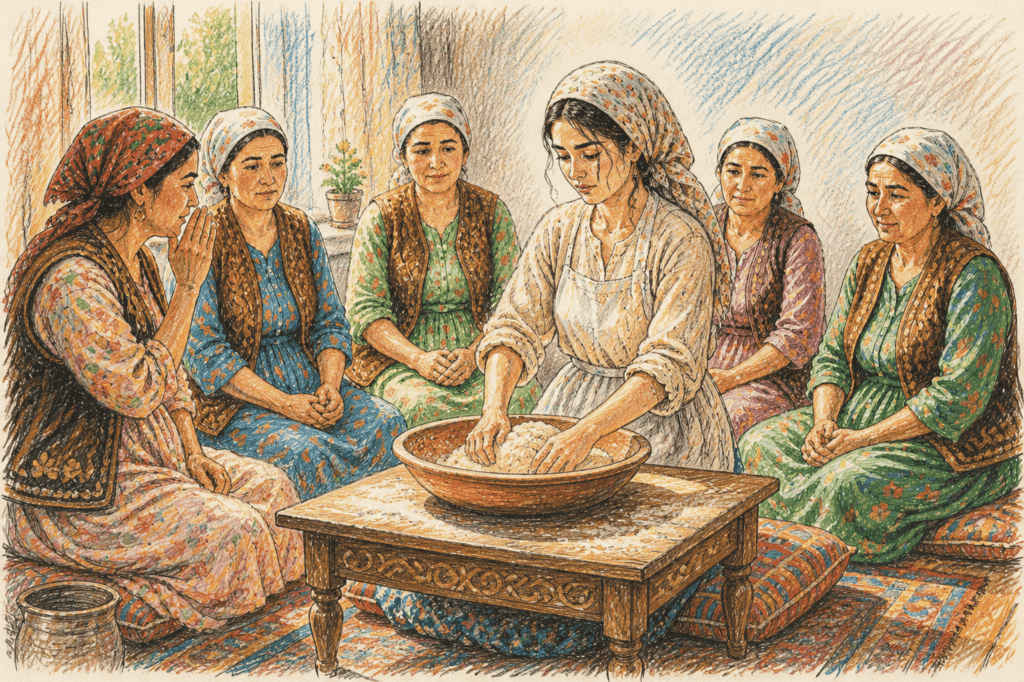
Surayo remembers the day after her wedding with painful clarity. She was asked to knead dough, a routine duty for any kelin. What felt unusual was not the work itself, but the attention.
Her mother-in-law, sister-in-law and several other relatives sat around her, carefully watching every move.
“They kept watching me the whole time,” Surayo recalls. “And I noticed them whispering to each other from the side.”
In Tajikistan, many households remain patrilocal: after marriage, the bride moves into her husband’s parental home. In this system, the kelin usually occupies the lowest position in the family hierarchy. She is expected to perform hizmat: cooking, cleaning and caring for her husband’s relatives. For a new bride, these tasks are not only chores. They become a probation period during which every movement is observed and every word noted.
Surayo lived in a large household. Her parents-in-law lived there, while her sister-in-law, who lived nearby, came over almost every day with her children. The house was rarely empty. By lunchtime, it was often filled with guests. Surayo cleaned up after them, washed the dishes and repeated the same routine with every new arrival.
Also read on Novastan: Tajik women reveal themselves through the “I am Tajik and…” trend
“I didn’t let my mother-in-law do anything around the house, and I always spoke to her respectfully,” she says. “I didn’t allow myself to do anything that might upset her or create tension.”
And yet her sister-in-law closely observed every detail and reported it. “She was like a second mother-in-law to me,” Surayo says.
Want more Central Asia in your inbox? Subscribe to our newsletter here.
Surayo had almost no freedom. Every action required permission. “I didn’t do anything by myself. If I went somewhere, they would ask: ‘Where are you going? Why? With whom?’”
Even her job did not give her autonomy. Instead, it intensified the surveillance. In the mornings, she cleaned up after everyone. Only once everything had been done properly did she leave for work. Yet her job displeased the family.
Also read on Novastan: Insecurity, Harrassment, and Lack of Inclusion: Young Women’s Experiences with Safety in Bishkek public spaces
No one explicitly told her to stop working. The pressure came through constant remarks: “Oh, how late she came.” “Her children are waiting for her, and she is still coming home late.” “You could go early in the morning so you can come back earlier in the evening.”
Most of these comments came from her sister-in-law. “Just for not arriving home from work exactly at five, she would tell my father-in-law. He would tell my husband, and we would end up arguing again.”
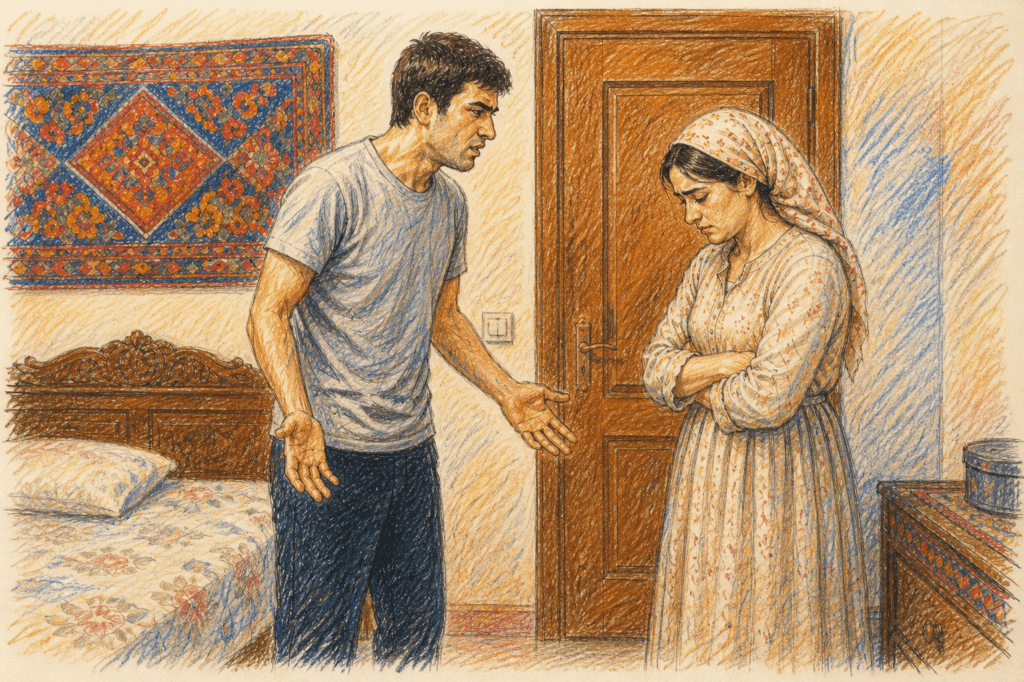
Over time, even conflicts between Surayo and her husband stopped being private. During one argument, her mother-in-law called Surayo’s parents and told them: “These two don’t match at all.”
Surayo left and lived with her parents for three months. While there, she found out that she was pregnant. A few weeks later, the pregnancy stopped developing. She had a miscarriage.
“Maybe it was because of too much humiliation,” she says, remembering those days as some of the hardest of her life.
Later, her in-laws came back for her. Leaving her husband’s home only two months after the wedding was considered shameful. When she returned, no one believed she had had a miscarriage. Her sister-in-law asked: “Why didn’t you call me when you went?” as if forgetting that they had been the ones to call her parents to take her away.
There was no support, no compassion, only blame. Despite devoting herself entirely to her husband’s household, Surayo felt like an outsider. As her father-in-law once told her: “You’re the black sheep. A daughter-in-law will always be talked about.”
“You start to feel like a slave”: Economic dependence
“I almost forgot what I was like,” Fatima says with a hesitant laugh. She used to be carefree and restless, constantly in motion. She had never imagined that her life would be limited to the walls of one house. Yet after marriage, this is exactly what happened.
“I was domesticated,” she says plainly.
She did everything expected of her: cooking, cleaning and even washing her brother-in-law’s clothes. “Since he had no wife, I had to wash his clothes. I washed everything, even his socks,” Fatima recalls.
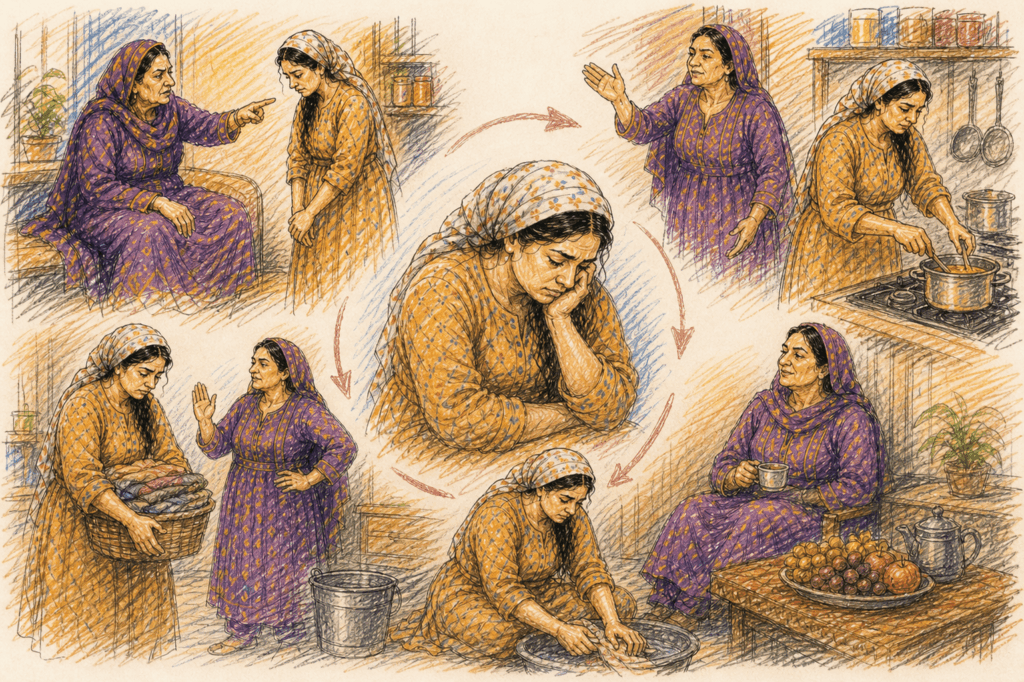
But housework was not considered enough. Money also mattered, and Fatima did not have enough of it.
She started working as a teacher, but her salary was extremely low. “I could only buy a pack of tea, nothing more.” Her low income became another source of conflict. “I was working, but it was as if no money was coming in.”
Since teachers worked part-time, Fatima sometimes had free time. But even that did not belong to her. “If I ever just sat down and rested, they would tear me apart.” If others were watching a film, she could only sit for a few minutes before being told to return to her chores.
Her mother-in-law had raised her children alone. Without a husband, she had worked, earned money and supported the family. This gave her an authority that everyone in the household accepted.
Also read on Novastan: Uzbekistan: when women demand to have a voice
“My mother raised us alone, so whatever she says, we do,” Fatima’s husband told her on the first day.
From the beginning, there was no equal relationship. Her mother-in-law expected more from her. “She wanted me to be more hardworking, but I was not hardworking enough for her. She wanted me to be wealthier, and somehow I was not to her liking.”
Power in the household did not belong only to the mother-in-law. “Her daughter was the main figure,” Fatima says. Her sister-in-law was educated and had medical training, but she did not work. “She stayed at home and did the housework. But from me, they expected money.”
The pressure came from all sides. The wife of her eldest brother-in-law, her mijad, also had a say in Fatima’s life. “In front of everyone, she would say: ‘You can’t give birth to a son. You don’t have a son.’”
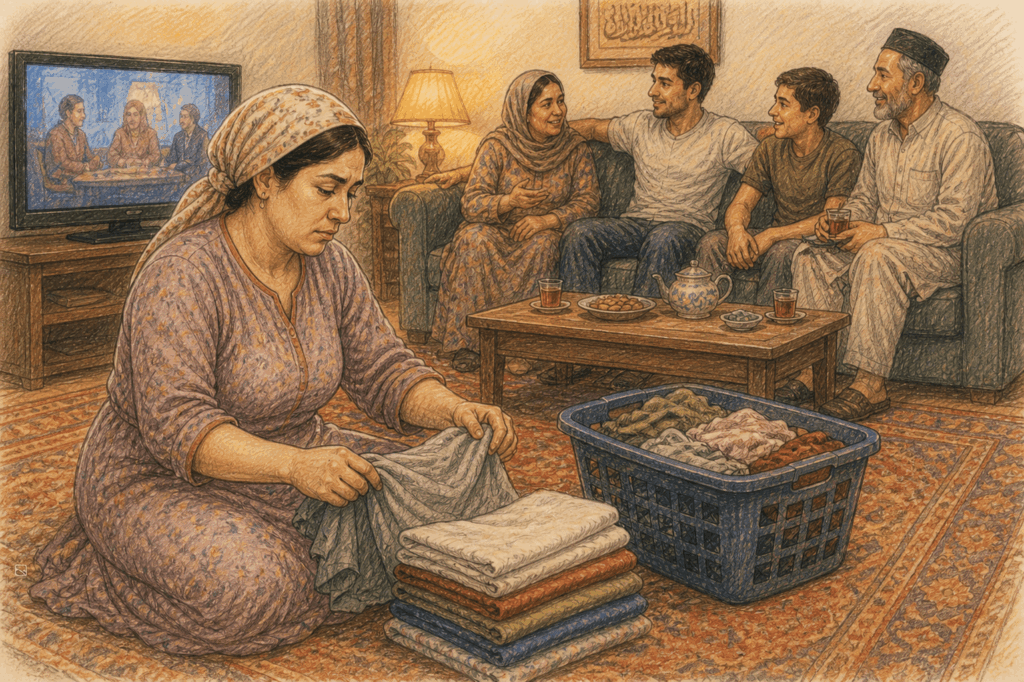
Fatima had three daughters. That was enough for her mijad to criticise her constantly. “A real child is a son. A daughter will be beaten. She won’t be allowed to hold her head high.”
In Tajik society, a son is often seen as the continuation of the family line. He is expected to become the main breadwinner, stay in the family and care for his parents. A daughter is raised to leave for her husband’s home and devote herself to his family.
After giving birth to three daughters, Fatima was told not to have more children. “Stop having children. You always give birth to daughters.”
In patrilocal families, kelins often lose control over their own bodies. Infertility is treated as shameful, while the number and timing of children may be shaped by elders in the household. “The pressure was huge, and I was struggling,” Fatima says.
“They were jealous”: A husband’s attention as a problem
“I was 19 when I got married,” says Nargiz. She had just started college. She had her studies ahead of her, a career to build and a husband by her side. He was attentive and caring.
She moved into a large family. At first, Nargiz felt accepted. A week after the wedding, her mother-in-law asked her to cook for the family. “Let’s see if you can cook,” she said. Nargiz was only 19, and her mother-in-law did not expect much. But Nargiz cooked well. From that moment, the relationship between them slowly began to change.
For the first eight months, she did not visit her parents once. “They were against it,” she recalls. Her mother-in-law worked at the bazaar all day. At home, Nargiz was the only adult woman, and all the responsibilities fell on her: cooking, cleaning, day after day. She simply could not leave.
“They wanted me to stay at home all the time and do housework.”
Her studies became the next source of pressure. First, she was not allowed to attend classes. Then she was not allowed to take her exams. “Don’t go,” they told her. “Just give us your student record book, we’ll handle everything.” Nargiz obeyed. But no one handled anything. In the end, she was expelled.

Such restrictions are common in extended families in Tajikistan. Kelins are particularly vulnerable because they often find themselves in a position where they cannot make decisions for themselves. Education may be perceived as a threat, not necessarily because families oppose knowledge, but because an educated woman is more likely to want to work, be independent and question family expectations.
Official data for the 2023-2024 academic year shows that women account for only 41% of students in Tajikistani universities. In other words, for every 100 male students, there are about 69 female students. Behind these figures are stories like Nargiz’s: a young woman who wanted to study, and a family that decided it was unnecessary.
Things got worse when she became pregnant. Her husband became even more attentive. “It was as if they were jealous,” she says.
In extended households, the attention of the man, both son and husband, can become a source of competition. “There is a clash between two roles: being a good husband and being a good son,” says Rustam Samadov, a masculinity researcher. According to him, the family may fear that the son will distance himself by shifting his focus to his wife. This creates tension, and that tension can become a source of conflict.
Nargiz believes her mother-in-law’s interventions were deliberate. After Nargiz’s brother found her a job, she returned home from a job interview to find her husband unexpectedly there. Suddenly, she felt a sharp pain: out of nowhere, her husband began beating her.
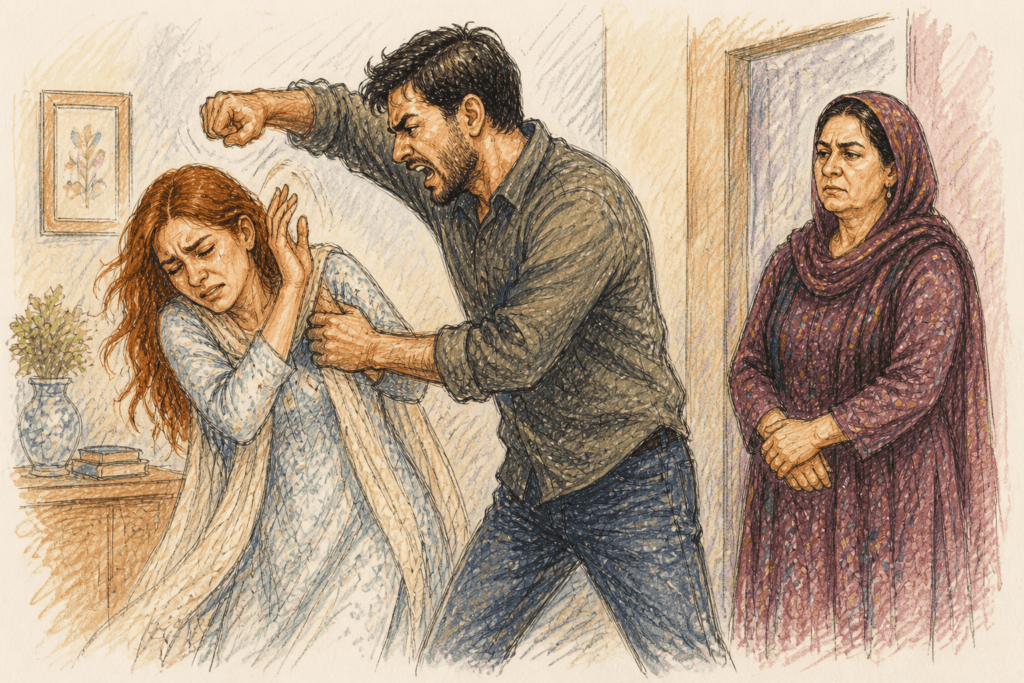
“I am pregnant, don’t do this,” was all she could say.
He replied: “I don’t give a damn about it.”
Her mother-in-law heard everything, but did not intervene. “She was there,” Nargiz says. “I will leave this house. I won’t live here anymore,” she whispered in desperation. “His mother called him home from work. I have no idea what she told him.”
Eventually, Nargiz gave her husband an ultimatum: either they would move out and live separately, or she would divorce him. They began living apart, and her life changed. Her husband started supporting her. There were no constant remarks, and far fewer conflicts.
Her mother-in-law still tries to intervene and insists that “if a woman works, she will develop inappropriate habits.” But Nargiz no longer reacts. “I don’t listen to her anymore. I don’t live with them, and I don’t even talk to them.”
Shattered promises
Aziza got married in her second year of university. She was 20 years old. Before the wedding, her husband promised her two things: she would continue her studies, and they would live separately from his family.
She was in love, and she believed him. For the first month, everything was as he had promised. Then things began to change. Later, she discovered that he had been spending his time and money at a computer club. Aziza became worried. She could not bring herself to speak to him directly, so she decided to talk to her mother-in-law, hoping she would raise the issue with her son indirectly.
Instead, her mother-in-law repeated everything to him word for word. Without explanation, he took Aziza and drove her to his mother’s home.
“Since you’re complaining to my mom, then live with her,” he said. “You’re staying right here and not leaving the house without my permission.”
Aziza spent three days there without changing her clothes. She had no clothes with her. “I just smelled so bad,” she recalls. No one intervened. No one even paid attention. Her mother-in-law simply said: “Go take a shower, I will give you my clothes.”
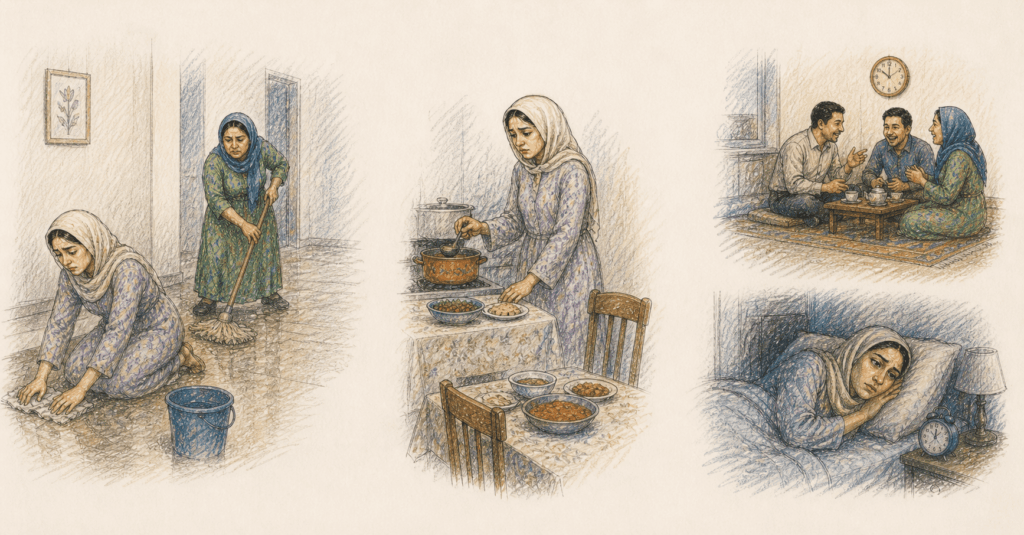
Aziza lived with her husband, his grandmother, his mother, his uncle and his brother. Six people shared a tiny apartment. Aziza waited for her mother-in-law to return from work. She mopped the floors, cooked dinner and set the table so that everything would be ready when she arrived. But when her mother-in-law came home, she would take a rag and mop the floors again, muttering: “I come home tired, and this is how it is.”
Aziza asked her husband why. “My mom has her own ways,” was all he said.
The same happened with food. Aziza cooked and left the meal on the stove. No one touched it. They simply threw it away. But her mother-in-law would still say: “I come home from work exhausted, and no one even cooks for me.”
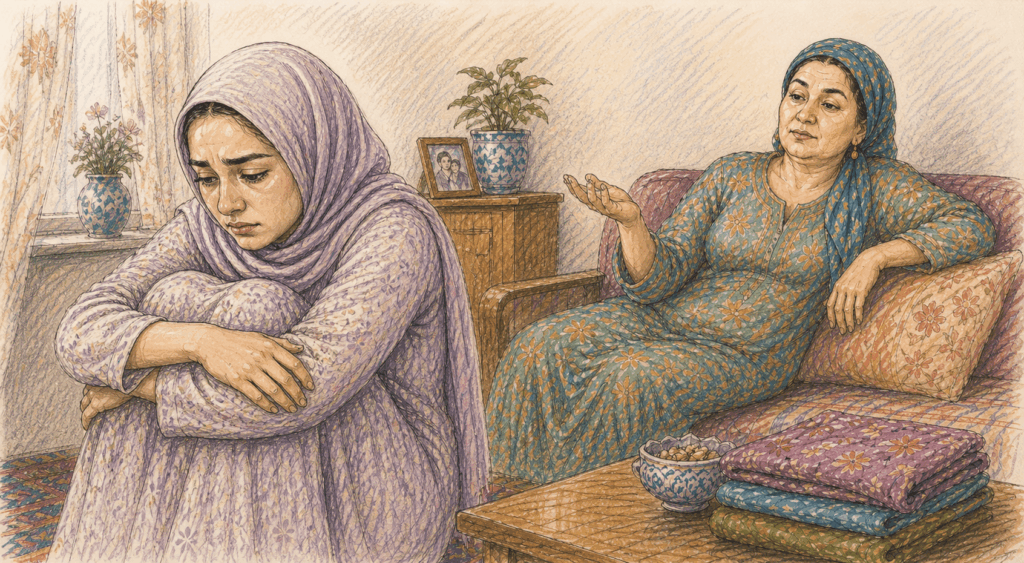
Aziza did not understand. No matter what she did, it was never enough.
Her husband left for Russia to work. The distance did not change anything. Even thousands of kilometres away, he found ways to control her every move. “When you go out, you will call me and ask for permission,” he would say. She could not even go to the shop without his approval.
Sometimes her mother-in-law encouraged her: “Go to the shop. How would he know?” Aziza would give in and go out. Every time, her husband would call and interrogate her. Somehow, he knew.
“She never interfered, but she turned out to be a real snake all along,” Aziza says. “She just watched and reported everything to her son.”
Month by month, things piled up. Eventually, her body gave in. “I had nervous breakdowns many times.” Then two cysts appeared in her left breast. They pressed on her heart and left arm. Her arm went numb. Aziza is left-handed, so she could not write or even cook.
She had a successful surgery and was discharged the same day. Days later, still with stitches, her husband demanded that she fly to Moscow. She could barely lift her hand. Her stitches had not yet been removed. She refused.
“I was fed up. The surgery hurt, but he just kept yelling and yelling.”
Her refusal made him furious. He called his mother. Soon, Aziza received a message from her mother-in-law: “Why do you always ruin my mood?” She did not ask how Aziza was feeling. Then came message after message:
“Once, at least say nice things to him. Congratulate him. Tell him everything is fine.”
“Can’t you find a way to your husband’s heart?”
“He’ll understand you if you explain it properly. Tell him calmly: ‘I can’t do anything right now, I can’t even lift my hand.’”
“If he calls, pick up the phone. Do not ignore him!”
Aziza lay there reading the messages, overwhelmed. She was recovering from surgery, while her mother-in-law was telling her to “find a way to her husband’s heart.”
Aziza left many times and returned many times. Each time, she convinced herself that things would be different. They were not. During another conflict, her brother-in-law discussed taking out a bank loan in her name. Aziza describes the atmosphere in the family as chaotic and unbearable.
Aziza fled. Her in-laws searched for her and pressured her to return. Eventually, she filed for divorce. Her husband did not appear in court. He went back to Russia.
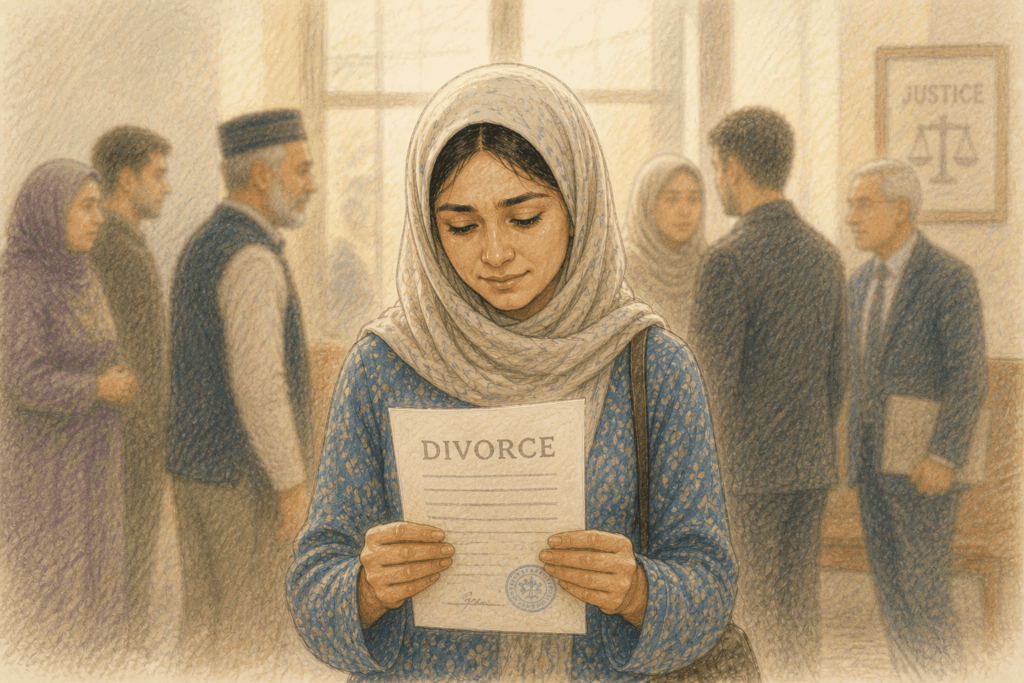
“We don’t know, we didn’t see. When she went to get her things, she took those documents with her,” his mother said in court in his defence. She called Aziza ungrateful. “How could you do this to my son?” Then she added something she had never said openly before: “I never liked you from the very beginning.”
Not individual cruelty, but a system
These are not only the stories of four women. They are part of everyday reality for many kelins across Tajikistan. After marriage, a woman is expected to become a “well-domesticated bride”: obedient, self-sacrificing and unwilling to question the system. Any failure to comply with these norms may be perceived as a threat to family honour, a concept deeply shaped by patriarchy.
The mother-in-law in this system is not only a source of pressure. She is also a product of it. When she first enters her husband’s house, a bride often has no voice, no independence and no status. The only path to power lies through her sons, years of obedience and proving her worth through hard work.
This is why some mothers try to keep their sons loyal to them. It is a way to preserve the limited power they have gained. A daughter-in-law may be perceived as a threat to that bond. Controlling her becomes a way to maintain authority earned through years of oppression. Without necessarily realising it, the mother-in-law repeats the same patterns because they feel like the only available way to survive.
This is not simply a matter of individual cruelty. It is a structural problem. The oppression is not always intentional, but the result is real: the system gives women very limited routes to power and few alternatives.
Family psychologist and cognitive-behavioural therapist Qimatgul Davlatbekova explains it this way: “This behaviour is often not driven by bad intentions, but by deeply held beliefs about what is ‘right’, or by the idea that ‘this is how I was raised’. However, even without any intent to harm, it can still cause serious psychological trauma for the kelin.”
From early childhood, girls in Tajikistan are taught what a “good kelin” should be like. This creates an intergenerational cycle in which norms are not only imposed from the outside, but internalised by women themselves. According to surveys, 97% of men and 72% of women in Tajikistan believe that women should tolerate violence to preserve the family.
The consequences go far beyond discomfort. “Constant control and a lack of boundaries certainly lead to chronic stress. I would describe this as emotional burnout. In this state, self-esteem drops. Often, it eventually leads to depression and a strong sense of helplessness,” Qimatgul says.
In extreme cases, the pressure becomes fatal. According to data presented by the Committee on Women’s Affairs, 212 women took their own lives in 2025 alone. Among the main reasons cited were domestic violence by husbands and their relatives, depression, emotional distress, conflicts and social isolation.
Why women do not leave
Even when they know what is happening to them, many women stay. Around 70% of Tajikistan’s population lives in rural areas, where cultural attitudes and customs are often stricter. There, divorce is not seen as a purely personal decision. A woman who leaves her husband may be labelled benomus, or shameless.
According to the Demographic and Health Survey for 2023, only 16% of women in urban areas sought help. In rural areas, the figure was even lower: only 9%. Domestic violence remains taboo in Tajikistan, which is one reason many women choose not to tell anyone what is happening to them.
This system persists across Central Asia not because people are unwilling to change, but because specific conditions keep it in place: women’s economic dependence on their husband’s family, weak legal protection and victim-blaming. Women may be blamed simply for speaking openly about family problems, which reduces their willingness to seek help or leave a harmful environment.
Culture is not fixed. It changes when legal, economic and institutional conditions change. Until that happens more fully across the region, the gap between formal gender equality and the lived reality of kelins will continue to grow.
Article by Kibriyo Qudratbekova, Journalism student at the American University of Central Asia (AUCA)
Edited by Mathieu Lemoine, Editor-in-Chief at Novastan-English
and Maya Ivanova, Contributor at Novastan
Thank you for reading this article! If you have time, we would appreciate your feedback, either through this anonymous form or by email at editorial@novastan.org. Thank you very much!