





 China-Kyrgyzstan-Uzbekistan railway: Who wins from Central Asia’s new trade route?
Support Novastan, the European Central Asia magazine
By supporting Novastan, you are supporting the only English, French and German-language media specialising in Central Asia. We’re independent and we need your help to stay that way!For more than two decades, the China-Kyrgyzstan-Uzbekistan (CKU) railway existed mainly on planning maps and in diplomatic communiqués. First discussed in the late 1990s, the project was repeatedly delayed by disagreements over financing, track gauge and route.
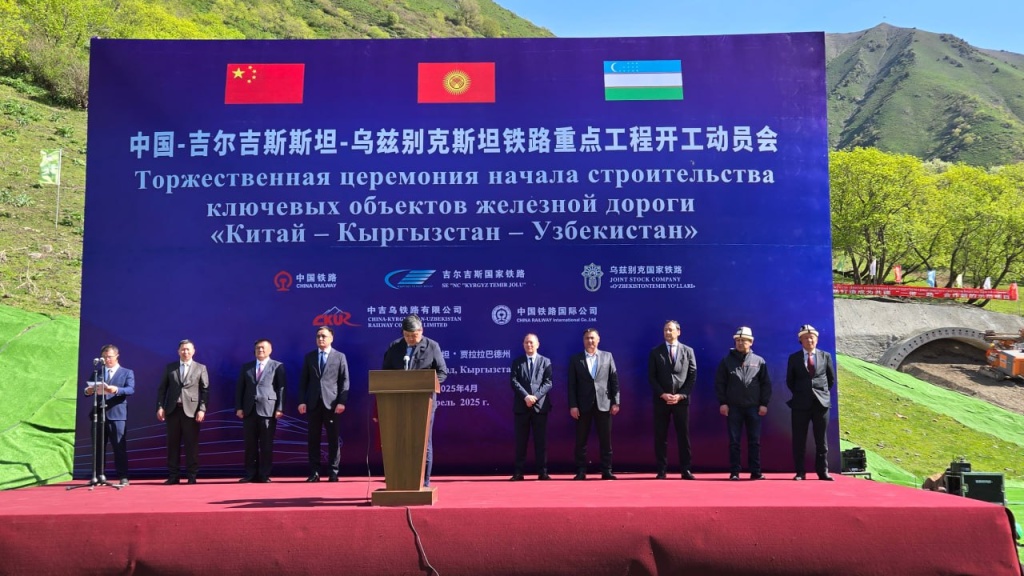
That changed when construction was formally launched in Kyrgyzstan’s Jalal-Abad region in December 2024. A year later, a syndicate of Chinese banks signed a loan agreement securing the project’s main external financing.
For the first time, the railway is taking physical shape rather than remaining a proposal. But its long-term significance will depend on more than steel, concrete and tunnels. The three governments will also have to manage debt, land disputes and environmental risks, while determining where the railway fits within an increasingly complex network of Eurasian trade corridors.
The planned route runs for approximately 523 kilometres. It begins in Kashgar in China’s Xinjiang region, crosses into Kyrgyzstan through the Torugart Pass, continues through Arpa and Makmal to Jalal-Abad, and then reaches Andijan in Uzbekistan, where it connects with the existing Uzbek and wider Central Asian rail network.
China’s railway network uses the 1,435 mm standard gauge, while the existing networks of Kyrgyzstan and Uzbekistan use the Soviet-derived 1,520 mm gauge. Under the CKU design, the standard-gauge line will extend from China into Kyrgyzstan as far as Makmal. There, a transshipment hub will transfer cargo to trains running on the broader 1,520 mm gauge for the western section of the route.
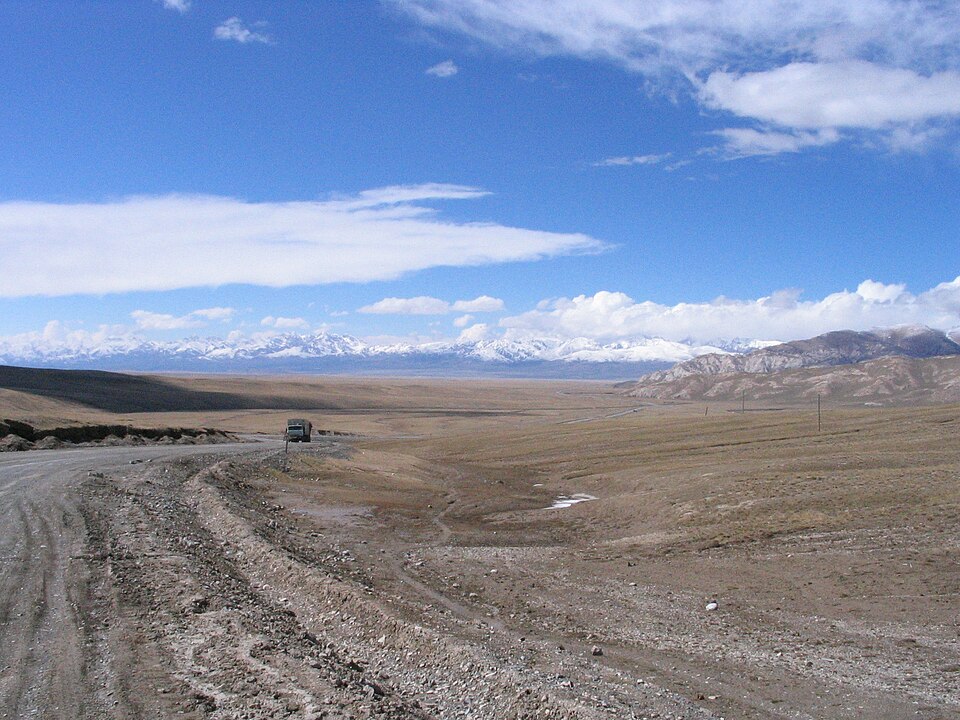
The Kyrgyz section carries most of the project’s engineering difficulty. Roughly 90 percent of the route through Kyrgyzstan passes through mountainous terrain. It will include 29 tunnels and 50 bridges with a combined length of around 120 kilometres – roughly 40 percent of the 304-kilometre Kyrgyz section.
A $4.7 billion bet
The total cost of the railway is estimated at around $4.7 billion.
Under the financing agreement signed in Bishkek in December 2025, approximately half of that amount – around $2.3 billion – is being provided through a 35-year loan from a consortium of Chinese banks led by the China Development Bank and the Export-Import Bank of China. The loan is to be repaid by the joint venture established to build and operate the railway.
The remainder is being provided as equity. The joint venture, registered under Kyrgyz law, is 51 percent Chinese-owned, while Kyrgyzstan and Uzbekistan each hold 24.5 percent.
Kyrgyzstan’s equity contribution amounts to approximately $609 million. Around half is to come from the state budget, while the other half is being financed through a $304.5 million preferential loan from China’s Export-Import Bank. The loan has a 25-year maturity, a five-year grace period and an annual interest rate of 1.5 percent.
Authorities hope to open the line by 2030, although the scale of the engineering works and the mountainous terrain leave significant room for delays.
Kyrgyzstan: transit opportunity, financial exposure
For Kyrgyzstan, the railway offers something the country has long lacked: a direct rail connection with China and the possibility of turning its geography from a constraint into an economic asset.
President Sadyr Japarov has said that the completed railway will transform Kyrgyzstan “into a transit power”. The government expects transit revenues, new jobs and a stronger role for the country in regional trade.
Around 5,000 people are currently employed on the Kyrgyz section, including some 2,000 Kyrgyz citizens. Supporting infrastructure, including substations and transmission lines, is also being built.
But the opportunity comes with financial exposure.
Kyrgyzstan already owed China’s Export-Import Bank around $1.5 billion in early 2026, making China the country’s largest single external creditor. The new railway adds further liabilities, even if the borrowing terms are relatively favourable.
This has prompted debate over whether the project could deepen Kyrgyzstan’s dependence on Chinese financing. The more useful question, however, is not whether the railway fits the contested label of a Chinese “debt trap”, but whether the revenues it generates will ultimately justify Kyrgyzstan’s additional exposure.
The loans have long maturities, low interest rates and grace periods intended to keep repayments manageable. Yet future debt servicing will depend in part on transit and logistics revenues that remain projections rather than receipts.
There is also a separate question over how much of the economic value generated by the railway will remain inside Kyrgyzstan. If warehousing, customs services, freight consolidation and other higher-value logistics activities are concentrated elsewhere, Kyrgyzstan could gain transit revenue while capturing a smaller share of the wider commercial benefits.
Uzbekistan: the logistics-hub strategy
Uzbekistan enters the project from a different position.
Andijan is already connected to the country’s national rail network, meaning Uzbekistan does not face the immense engineering challenge of building a new railway across the Tien Shan. Instead, the CKU line would extend Uzbekistan’s transport network eastward and give the country a more direct rail connection with China.
That fits a broader Uzbek strategy of turning the country into a logistics hub connecting East Asia, Central Asia and routes leading west and south.
Domestic infrastructure has already strengthened this position. The Pop-Angren railway links the Fergana Valley directly with the rest of Uzbekistan without requiring trains to cross neighbouring territory. Tashkent is simultaneously promoting other international routes, including the proposed Trans-Afghan corridor towards Pakistan and transport links across the Caspian towards the South Caucasus, Türkiye and Europe.
For Uzbekistan, the CKU railway is therefore not a stand-alone project. Its value lies in how it can connect with a wider network of existing and proposed corridors.
If those connections prove commercially viable, Uzbekistan could strengthen its position as one of the principal junctions between China and markets to the west and south.
Land, compensation and environmental costs
The railway’s benefits are national and regional, but many of its immediate costs are local.
Under the intergovernmental arrangements, Kyrgyzstan is responsible for a range of obligations on its territory, including social and environmental impact assessments, protection of cultural heritage, land acquisition, demolition and resettlement.
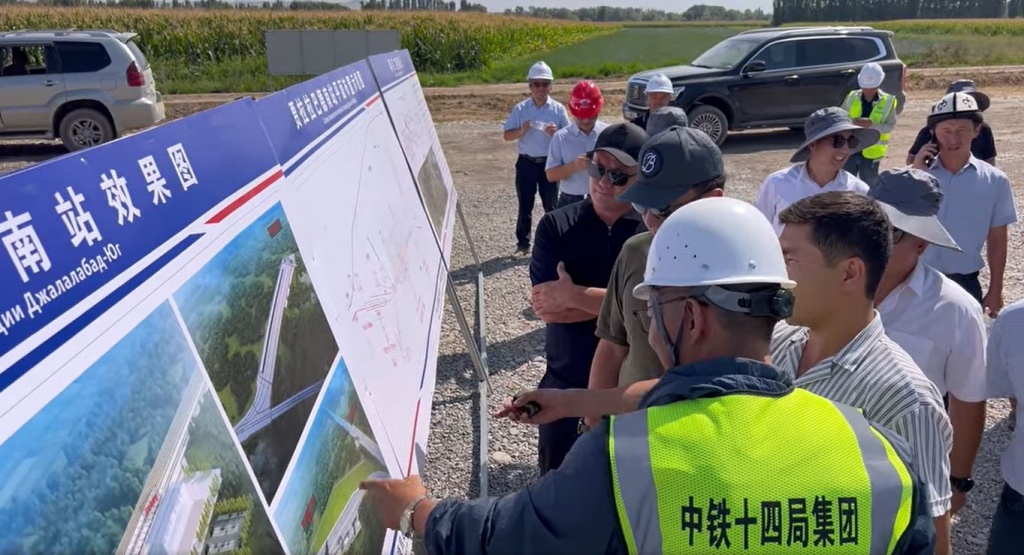
According to the Kyrgyz government, 214 homes are to be demolished to make way for the railway – 191 of them in Suzak district in Jalal-Abad region and the remainder in Naryn.
The government says that most affected owners have accepted compensation and that only a small number continue to dispute the amounts offered. However, some residents have publicly challenged the compensation process, while the use of compulsory acquisition has generated public resistance in affected communities.
Authorities have hired an independent company to assess the value of affected properties, but questions about transparency, participation and compensation remain sensitive as construction advances.
Environmental concerns are also becoming more visible.
Kyrgyz regulators have already fined contractors for environmental violations. Specialists have warned that large-scale tunnelling, blasting and earthworks in mountainous terrain can affect watercourses, habitats and local ecosystems.
Kyrgyz economist Kubat Rahimov has noted that mountain railway construction can require rivers to be redirected and concrete supports to be placed in watercourses, with potential consequences for surrounding flora and fauna.
Chinese and Kyrgyz officials have stressed environmental requirements in contractor selection and construction. But the scale of the engineering works means environmental management will remain an important test throughout the project.
A new route – but not a replacement for Kazakhstan
The strategic importance of the CKU railway comes less from the line itself than from the networks it can connect.
Once operational, it will create another overland rail route between China and Central Asia that bypasses Kazakhstan. From Uzbekistan, freight could continue west through existing networks towards Turkmenistan and the Caspian Sea, or connect with other routes feeding into the broader Trans-Caspian system towards Azerbaijan, Georgia, Türkiye and Europe.
Longer-term plans also envisage stronger connections south towards Afghanistan, Pakistan and Iran.
But CKU should not be understood as a replacement for the established China-Kazakhstan rail corridors.
The new line will cross difficult mountainous terrain and will operate largely as a single-track railway. Kazakh analyst Marat Shibutov has argued that these physical constraints will limit the number and length of trains that can use the route.
The difference in scale is considerable. Rail freight between China and Kazakhstan exceeded 32 million tonnes in 2024, while the CKU railway’s eventual annual capacity is commonly estimated at around 15 million tonnes.
Its importance therefore lies less in displacing Kazakhstan than in adding another option to the Eurasian transport network.
For China, this means greater route diversification. For Central Asian states, it creates additional bargaining power and greater resilience if disruption affects one of the region’s existing corridors.
Who captures the gains?
The strategic gains are easiest to identify at state level.
China acquires another westbound route that reduces its reliance on Kazakhstan and gives Xinjiang an additional connection to Central Asia. Kyrgyzstan gains a direct railway link with China and the possibility of substantial transit revenues. Uzbekistan advances its ambition to become a major logistics junction linking China with Central Asian, Trans-Caspian and southern transport corridors.
Construction companies, banks and logistics operators are also among the project’s most immediate economic beneficiaries.
Whether those gains will spread more widely is harder to predict.
Construction jobs are temporary. Families along the route are already dealing with displacement and compensation. And Kyrgyzstan will benefit most if it can develop logistics, warehousing, customs and other services around the railway rather than serving primarily as territory through which trains pass.
The same question applies regionally. The CKU railway could redistribute trade flows and create new economic opportunities, but the value generated by the corridor will depend on border procedures, customs governance, freight costs and connections with other transport networks.
None of this diminishes the railway’s historic significance. After decades of delay, the project is finally moving from diplomatic ambition to physical infrastructure.
But the CKU railway is also the beginning of a longer contest over financing, environmental protection, compensation, logistics and regional competition. The outcome of that contest – more than the rails themselves – will determine who ultimately benefits from Central Asia’s newest trade route.
Kodirjon Eshonkulov
Kodirjon Eshonkulov is an independent researcher specialising in Central Asian geopolitics, transboundary infrastructure and relations with the European Union. He is a recent graduate of the Graduate School of International Studies at Ajou University in South Korea. Since 2017, he has worked as a correspondent and television journalist covering social and political reforms in Uzbekistan. His writing on Uzbekistan’s water scarcity and Middle Corridor policy has appeared in The Times of Central Asia and the Central Asia-Caucasus Analyst.