




 Far from home, behind the wheel: A Kyrgyz truck driver on Europe’s roads
Support Novastan, the European Central Asia magazine
By supporting Novastan, you are supporting the only English, French and German-language media specialising in Central Asia. We’re independent and we need your help to stay that way!For three years, a truck driver from Kyrgyzstan has been working across the European Union, sleeping, cooking and living inside his vehicle for months at a time. His story reveals both the opportunities and the precarious realities faced by Central Asian drivers working far from home.
Alex is sitting on the bed inside the cabin of his truck, his head almost touching the ceiling.
“I can’t stand,” he says as he films the cramped space around him.
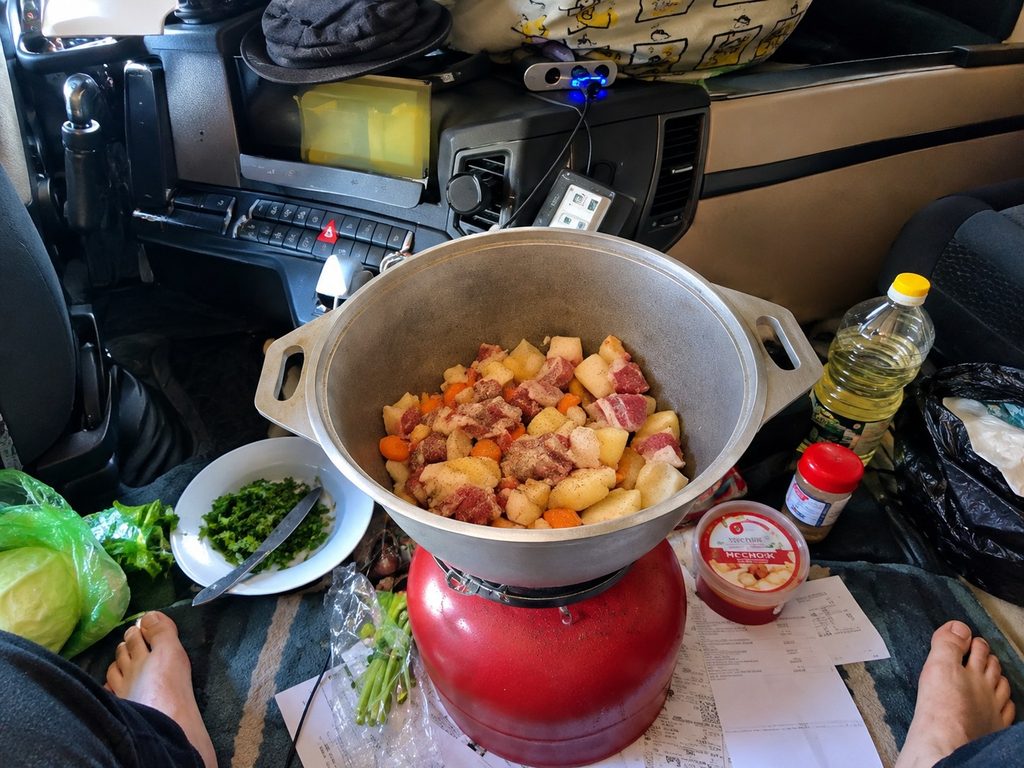
On the bed beside him, he chops a cucumber next to a box of garlic. Between his legs, a gas stove supports a kazan filled with pearl barley, meat, potatoes and garlic. The truck is not only his workplace. For much of the year, it is also his kitchen, bedroom and living room.
In another video, Alex opens the small refrigerator squeezed into the cabin. It is packed with salted fish fillets and what he estimates to be between 10 and 15 kilograms of meat. Above it sits a basket of dry goods: rice, pearl barley, salt and soy sauce. When the weather is good, he cooks outside in the truck park. When it is not, everything happens inside.
Alex, a pseudonym, is in his early forties and comes from Kyrgyzstan’s Talas region. For the past three years, he has worked as a long-distance truck driver in the European Union. The wages are considerably higher than those available to him at home, but getting to Europe was difficult, and life on the road has proved far more precarious than the promise of European employment might suggest.
Losing money before reaching Europe
Alex’s path into European trucking began with failure.
On his first attempt to find work abroad, he says he lost between 60,000 and 70,000 Kyrgyz som to a posrednik, or middleman, in Slovakia. He obtained the contact through an acquaintance. According to Alex, the intermediary promised to arrange a work visa, contracts and other documents.
“The money was burned,” he recalls.
He tried again and lost money a second time, though less than on the first occasion. It was only on his third attempt that he found a viable route. Rather than relying on another intermediary, Alex contacted a Lithuanian logistics company directly through WhatsApp. According to him, the company prepared a contract, invitation letter and the other documents he needed. Within two or three months, the process was complete, and his principal expenses were administrative fees and flights.
The experience left him deeply suspicious of intermediaries. Although some of his criticism is based on what he has heard from other drivers rather than his own experience, he believes agencies can withhold information or charge workers for poorly explained services.
His experience reflects concerns documented more widely among migrant truck drivers. Research on the European road transport sector has described cases in which drivers paid high recruitment fees, faced unexpected charges after arrival or were misled about working conditions. Other research on Central Asian migration to Europe has similarly identified weaknesses in recruitment systems, including inadequate contract verification and limited pre-departure information.
A truck that doubles as a home
Once Alex started working in Europe, the realities of the job became clearer.
He has worked for companies based in Lithuania and Czechia, driving across large parts of the European Union. Alex says he initially started on around €85 per day, but once he moved into vehicle transport – the work he now specialises in – his pay rose to around €100-€120 per day, sometimes reaching €130.
His current Czech employer, he says, allows him to work for considerably longer periods and with fewer expenses than his previous Lithuanian company. By comparison, the Lithuanian employer operated what Alex describes as a “cadence” system, with drivers moved in and out of different routes and countries by minibus.
“They split drivers up across Europe, over to Germany, France, Italy and Belgium,” he says. One driver would arrive with his belongings and continue the work while another returned home in the same minibus.
The financial attraction of Europe is obvious to him.
“In Kyrgyzstan a driver’s salary is roughly $800 per journey,” Alex says, but a single trip can mean collecting cargo in China and returning to Kyrgyzstan, or driving from Kyrgyzstan through Kazakhstan and onwards to Russia.
On those routes, “nothing is provided”, he says. Repairs, tyre changes and other costs may have to be handled by the driver. Border queues can also consume days. Drivers may wait two or three days, or sometimes as long as a week, he says, while spending part of their earnings on food and other expenses along the way.
By contrast, he considers trucking in the EU better paid and, in some respects, easier. But that income comes with a lifestyle dominated by the vehicle itself.
Even buying groceries can become an expedition. In one video recorded in Germany, Alex walks back from Lidl carrying a full shopping bag. On that occasion, the supermarket was only 2.5 kilometres from where he had parked. At other stops, he says, drivers may have to walk five or even ten kilometres to reach a large shop.
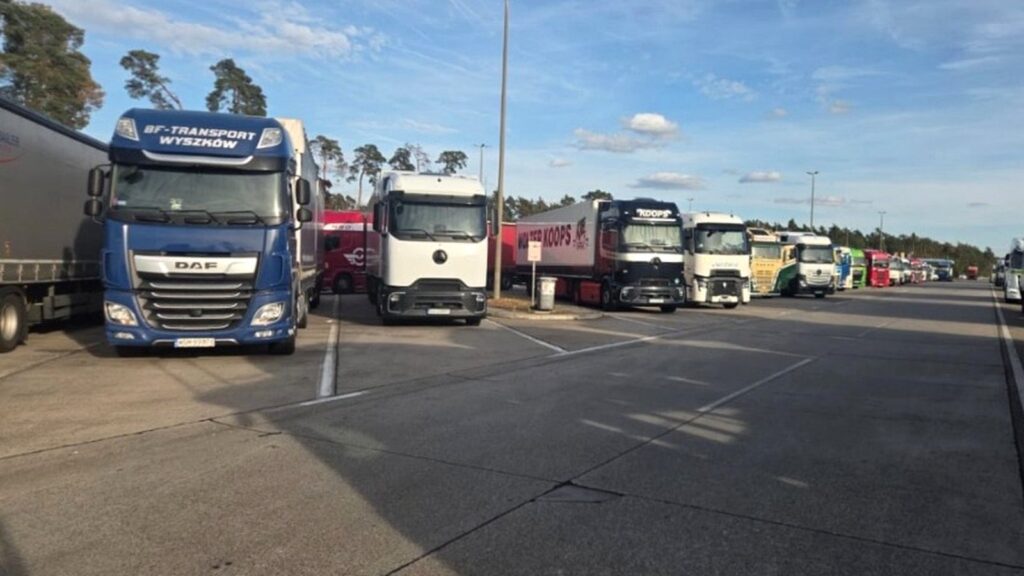
Truck parking determines much of daily life. Drivers cannot simply take their vehicles into many city streets, while roadside facilities do not always provide the food or services they need. Finding somewhere to stop is itself a recurring problem. Alex has filmed parking areas where trucks double-park, occupy exits or line the roadside because designated spaces are full.
“The number one problem is always parking,” he says, especially in Germany, the Netherlands, Belgium and Czechia. Spain and France are somewhat easier, though he says parking around Lyon and Paris can also be difficult.
Basic facilities vary considerably. Alex carries his own water and has recorded truck stops without showers.
“The most important thing,” he says, “is that it has a toilet.”
Sleeping where you work
Alex says he rarely stays in a hotel or hostel while on the road. Most nights, he sleeps in the bed built into the truck cabin.
That can mean spending entire days and nights inside the same few square metres. The truck becomes somewhere to eat, sleep, exercise, store food and wait between assignments.
At night, security is another concern. Alex loops the seatbelts through the interior door handles in an attempt to make it harder for thieves to force open the cabin while he sleeps. He says he has not personally experienced a break-in, but learned the technique from other drivers and from stories circulating among them.
EU rules prohibit drivers from taking their regular weekly rest period of at least 45 hours inside their vehicles. Suitable accommodation outside the truck should instead be provided, with the cost covered by the employer.
Alex is familiar with the rule.
“For 45 hours the driver must rest and the company must provide him with a proper room so that he can go in there and sleep and rest,” he says.
But according to him, that often does not happen.
“No one arranges hotel accommodation. The driver is the one who has to sort it out,” he says, adding that in his experience only a minority of companies consistently comply.
At his former Lithuanian employer, Alex recalls drivers being housed between assignments in three large dormitories. He personally saw two of them, one with five floors and another that appeared to have four. Drivers could spend periods there waiting to be assigned another route.
His current Czech employer, he says, gives him more freedom to decide when and for how long to take a break.
When the driver carries the risk
Pay is another source of uncertainty.
Alex says his experience has varied considerably between employers. At his first company in Lithuania, drivers waiting to be deployed were supposed to receive the Lithuanian minimum wage, he says, but he claims this did not happen. Instead, while he and several other drivers waited between assignments, the company charged them €15 per night for accommodation.
Alex also alleges that one former manager at the Lithuanian company accepted payments from drivers in return for preferential treatment. According to him, drivers could pay to receive trucks with more spacious, higher-roof cabins or to move more quickly into an assignment, while others remained in the dormitories waiting for work.
When he returned to work, Alex says further sums were deducted from his salary without a clear explanation.
The reasons were difficult for him to understand. His contract was in Lithuanian, a language he does not speak. When he was eventually given a Russian-language contract, he remembers employers telling workers to sign quickly.
“Come on, sign here quickly, quickly, quickly. No need to read it, just sign it quickly,” he recalls.
“We were glad they were taking us on, so we just agreed.”
Damage to cargo can also become a financial burden.
Alex recalls transporting BMW cars for his Lithuanian employer and being charged €1,000 after some of the vehicles were found to have scratches.
His current Czech employer, he says, operates differently. The company covers the first incident of damage. On a second occasion, the cost may be divided between employer and driver, while after a third incident the driver can be expected to cover the full amount.
According to Alex, this arrangement was explained to him verbally rather than set out in his contract.
He considers such systems unfair because drivers may not always be able to see damage while loading vehicles. Snow, rain, poor lighting or darkness can make scratches difficult to identify, he says. At unloading, by contrast, inspectors may examine vehicles under bright lights or with mirrors and lamps.
“The driver does not have such capabilities,” Alex says.
Even theft can become the driver’s problem. He recalls a friend whose fuel was stolen and who, according to Alex, had to give up around half of one month’s salary to cover the loss.
A wider dispute over working conditions
Alex says his own relationships with employers have generally remained manageable. Other migrant truck drivers in Europe have experienced much more direct confrontations.
In 2023, dozens of drivers, many of them from Uzbekistan and Georgia, staged protests at the Gräfenhausen motorway service area in Germany in a dispute with their Polish employer. They accused the company of withholding wages and criticised working conditions, including long periods spent living inside trucks.
The Gräfenhausen protests attracted wider attention because they brought grievances normally scattered across motorways, parking areas and logistics depots into public view.
Alex’s own experience is not identical to that of the striking drivers. But some of the pressures he describes – long periods inside a truck, deductions he struggles to understand, and dependence on employers far from home – echo concerns raised elsewhere in the road transport sector.
The Road Transport Due Diligence Foundation has documented broader patterns in which third-country drivers may be formally employed in one EU member state while spending much of their working time elsewhere, alongside delayed wages and deductions that workers struggle to understand.
Europe through a windscreen
Alex’s life in Europe is not defined entirely by work.
During rest stops, he tries to exercise. He bought a skipping rope and trains in truck parking areas. When time allows, he walks around wherever he happens to be parked.
His journeys have also brought unexpected encounters: ships in Belgium, local markets, unfamiliar towns and landscapes, and animals he had never seen before.
On one occasion in Antwerp, Alex and some colleagues visited the zoo.
“That’s where, for the first time, I saw a flamingo,” he says. He also remembers seeing elephants and giraffes.
One thing he particularly appreciates about Europe is the greenery.
“There are even bridges that simply connect the wildlife on the right side of the motorway with that on the left-hand side,” he says, referring to wildlife crossings. “Not for cars, not for anything else, not for trains, but specifically for animals, so that the animals can cross back and forth.”
He also values being able to travel around the Schengen area during his time off without needing separate tourist visas. He has visited Paris and the Louvre, Madrid, Antwerp, Prague and Luxembourg. Rome remains on his list.
Another difference he notices is policing. In his experience, traffic police in Europe behave differently from those he remembers at home.
“They aren’t like we have back home, always waving their batons and handing out fines,” he says. “That sort of thing doesn’t happen here.”
Other aspects of life are less convenient. Alex says truck stops often offer little beyond fast food, and he sometimes struggles to find halal options along his routes.
More broadly, he feels that migrant drivers are treated as more interchangeable than local workers.
“For their own drivers they treat them differently and provide them with better vehicles,” he says of some employers.
In his view, migrant drivers are easier to replace.
“If an Indian won’t do the work, then a Russian will come to do it. If not a Russian then a Ukrainian. If not a Ukrainian then a Filipino. If not Filipino then an Uzbek, Tajik or Kazakh.”
It is his interpretation of a labour market in which drivers from different countries are constantly moving through the same companies, routes and parking areas.
Earning in Europe, imagining a future in Kyrgyzstan
But these glimpses of Europe are incidental.
Alex did not come for tourism, and he does not describe trucking as a long-term dream.
“If I could have the job I do back home, I would do it,” he says.
The reason he stays is money.
Flights to Kyrgyzstan are expensive, and Alex has relatives to support. Until recently, he says, he had spent almost two years in Europe without returning home because leaving work and paying for the journey made little financial sense.
He has two daughters. He speaks to them regularly and sends money, clothes and other things home.
Read more on Novastan: Money, boxes and absent men: the hidden economy reshaping Central Asia
“Going home is not profitable,” he says.
For now, the truck is a means to something else.
Alex is saving. His ambition is to buy one or two apartments in Kyrgyzstan and eventually establish a farm with sheep, sweetcorn and potatoes.
In Talas, he estimates that suitable land costs around €10,000 per hectare. A decent farm, he says, would require at least five to ten hectares, alongside additional investment in buildings, equipment and livestock. By his own estimate, establishing the kind of farm he imagines could ultimately require around €200,000.
“My children are growing up,” he says. “Until my pension I will work, I think. In the future I will receive a European pension.”
The cramped cabin, the long walks to supermarkets and the nights spent sleeping behind the steering wheel are, in his mind, temporary sacrifices.
Europe is where he earns the money.
Kyrgyzstan is where he imagines his future.
By Anvar Whitlock, Contributor for Novastan.