




 “Join Us for Laghman”: Foodways, Poetry, Identity, and an Uyghur Film in Verses

Support Novastan, the European Central Asia magazine
By supporting Novastan, you are supporting the only English, French and German-language media specialising in Central Asia. We’re independent and we need your help to stay that way!This article explores how a 1986 Soviet Kazakh film about Uyghur culinary expert and poet Réhimjan Ushurov uses laghman, poetry, and communal traditions to illuminate Uyghur identity, cultural memory, hospitality, and foodways across Central Asia.
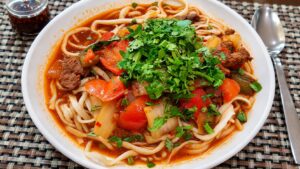
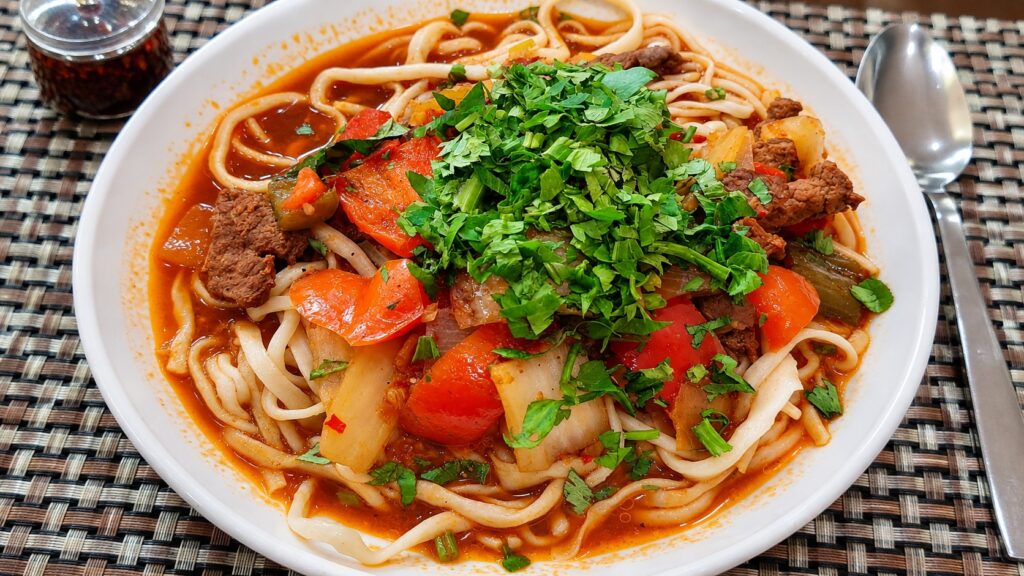
Laghman, a dish of hand-pulled noodles served with a savory topping, occupies a central place in Uyghur cuisine and has become an emblem of Uyghur identity alongside its growing popularity across Central Asia over the past several decades. Much as the dish’s noodles and toppings complement one another, philosophical poetry and striking imagery intertwine in a seamless montage in a 1986 short film produced in Soviet Kazakhstan, which examines laghman’s cultural significance and explores the customs, social practices, collective memory, communal bonds, and philosophical ideas that inform Uyghur foodways. The film reaffirms the convergence of art, creativity, and gastronomy in Uyghur traditions and the centrality of hospitality, particularly in meshrep, the tradition of communal gatherings fundamental to Uyghur social and cultural life.
Laghman, Identity and the Uyghur Table
The film centers on the Soviet Uyghur poet and culinary expert Réhimjan Ushurov, whose work as a journalist, editor, and cookbook author combined literary creativity with the practice and preservation of Uyghur cuisine. Born in Przhevalsk (present-day Karakol, Kyrgyzstan) in 1928, Ushurov moved with his family to Ghulja, in what is today China’s Xinjiang Uyghur Autonomous Region (historically referred to by many Uyghurs as East Turkistan), in the 1930s to escape forced collectivization in Soviet Central Asia. After attending school in Ghulja, he studied philology in Ürümchi in the 1950s and subsequently resettled in Soviet Kazakhstan. Ushurov cooked for Ishaq Beg Munonov (Ysakbek Monuev), commander of the East Turkistan Republic’s army, and received encouragement from Ehmetjan Qasimi, a founding figure of the republic, to preserve Uyghur culinary knowledge for future generations. His friendships included the Kyrgyz literary giant Chinghiz Aitmatov and filmmaker Bolot Shamshiev, and his journalistic career included work in the 1970s for Yéngi hayat (New Life), a supplement to the Almaty-based Uyghur newspaper Kommunizm tughi (Banner of Communism). His poem Sadir qoshaqchi (Sadir the Crooner) was published as a book in Soviet Kazakhstan in 1981. He also prepared an extravagant banquet for participants in the 1979 Second All-Union Conference on Uyghur Studies in Almaty. His culinary magnum opus, a comprehensive Uyghur cookbook containing more than 700 recipes, was first published in Uyghur in 1985. A Russian translation followed in 1991.
A Poet, a Cook and a Keeper of Memory
Uyghur migration from what is now China’s Xinjiang region in the 1950s and early 1960s helped popularize laghman across Soviet Central Asia, where culinary practices reflected both regional preferences and differences among Uyghur communities. Uyghur preparations of laghman generally emphasize noodles (chöp) accompanied by a separately cooked meat-and-vegetable topping (sey), whereas soupier versions often serve as first courses in Uzbekistan and Tajikistan. Uyghur restaurants in Almaty and Tashkent commonly present the noodles and topping on separate plates, while in Xinjiang both components are often served on the same plate. Within the household, mastery of noodle-making (khemien) is among the culinary skills most highly valued in a kélin (daughter-in-law). Utensil preferences also reflect migration histories: chopsticks (choka) are particularly associated with families who arrived from the historical Yarkent region in the mid-twentieth century and later, while forks are more common among longer-established Soviet Uyghur communities. In his review of Ushurov’s cookbook, the Yarkent-born Soviet Uyghur writer Ziya Samedi compared the preservation of culinary knowledge with that of the Twelve Muqam, the classical Uyghur musical suites reportedly collected by the sixteenth-century Yarkent noblewoman Amannisakhan.
How Laghman Became a Central Asian Staple
The etymology of laghman (leghmen) reflects a broader history of culinary exchange across Inner and Central Eurasia. According to the most widely accepted etymology, the dish’s name derives from Chinese lāmiàn (literally, “pulled noodles”). The corresponding Chinese-based (Kanji) characters also appear in Japanese rāmen, from which Korean ramyeon (most recently popularized in the United States by McDonald’s Ramyeon McShaker Fries) was subsequently borrowed. A competing theory postulates the word’s stem is a corruption of an old Turkic verbal stem, läg-, meaning “to float.” Laghman is also the name of an Afghan province, whose toponymy is more Indo-Iranic than Turkic. A phantasmagoric culinary genealogy appears in the pronouncements of the celebrated Kazakh poet Olzhas Suleymenov, who, in a 2007 interview, proposed an unsubstantiated derivation of Italian spaghetti from Old Uyghur (not a direct predecessor of modern Uyghur), combining words for “meat” and “noodles” with an apocryphal account of Marco Polo’s alleged introduction of pasta to Italy. Among Suleymenov’s best-known prose works is Az i Ia, which examines Turkisms in the twelfth-century East Slavic epic The Tale of Igor’s Campaign (Slovo o p’lku Igorevye).
From Lāmiàn to Laghman
Produced in 1986 by Kazakhtelefilm, Soviet Kazakhstan’s republican film studio, the short film Join Us for Laghman (Priglashaem na lagman, possibly echoing the Uyghur invitation “Leghmenge merhemet”) showcases Ushurov’s poetry and culinary skills alongside diverse Uyghur cultural practices, above all the communal institution of meshrep. Ushurov’s original Uyghur speech remains partly audible beneath a Russian voiceover, while his poetry appears in Russian translation in the narration.
An Invitation to Laghman
Throughout the film, Ushurov presents cooking and poetry as complementary art forms grounded in cultural knowledge and creative skill. He introduces his cookbook, which contains approximately 700 recipes, while emphasizing that Uyghur cuisine encompasses a far greater variety of dishes. Recurring close-ups show him browsing its pages and proudly displaying its cover and rich, full-color illustrations. His appearances in work clothes, festive attire, and a formal suit accompany his various roles as poet, practicing cook, participant in communal celebrations, culinary judge, and author. His account of why a poet cooks emphasizes the pleasure of work well done, which he associates with both culinary and literary/artistic pursuits. He introduces laghman through a playful comparison with spaghetti and an open-ended allusion to Marco Polo. He also invokes a proverb from Central Asian tales of Nasr-e-din (Hoja) Effendi – that saying “halva” does not sweeten the mouth – to emphasize tasting as an essential basis of culinary understanding.
Cooking as Poetry
The film recounts a romanticized ancestral legend that associates nourishment with human labor, love, and collective survival in an inhospitable desert landscape. Illustrations resembling Persianate miniatures accompany the story of wandering ancestors amid desert expanses, poplar groves, and oases, evoking Kashgaria more readily than the lush mountain landscapes of Kazakhstan’s Zhettysu (Semirech’e) region, home to most of the country’s Uyghur population. In the legend, a mythical creator instructs the Uyghurs’ ancestors to cultivate a tree of life in the desert through the labor of their hands and the love of their hearts. The film also shows a woman pouring milk from a traditional ewer and juxtaposes her image with views of a river flowing through the desert. Milk nourishes the body as water sustains the land; their pairing connects the provision of food with the conditions necessary for a community’s survival.
Labor, Love and the Tree of Life
The film presents hospitality – the centerpiece of meshrep – as a central Uyghur social obligation that sustains communal relationships through shared meals and conversations. Ushurov distinguishes eating from hosting guests, emphasizing the responsibilities involved in welcoming others. Scenes set in warm, bright courtyards show steaming samovars, guests seated beneath grapevines on tapchans – raised platforms for dining and reclining – and people carrying nan (flatbread), tea, and melons. Elders (aqsaqals) play checkers (shashki) and converse over food and tea, while the narration compares their restorative company to a withered garden revived by spring and a river of memories. These scenes evoke meshrep, an informal institution central to Uyghur communal life that provides ethical guidance, communal leadership, opportunities for gathering, and entertainment outside formal structures of governance, although the film does not explicitly name it, likely due to Soviet censorship. In a direct address to the camera, Ushurov invokes the Uyghur folk saying “A thousand at the bazaar, one in the heart” (“Bazarda ming kishi; könglida bir kishi”) and describes the care required to receive a cherished, long-awaited guest. The remarkable variety of the Uyghur table, he explains, accommodates a prolonged feast and heartfelt conversation, as he credits generations of cooks with preserving and developing dishes valued for both flavor and beauty.
Hospitality and the Spirit of Meshrep
The film presents Uyghur culinary knowledge as an inheritance sustained through shared domestic work and intergenerational transmission. Early scenes show women pulling dough together in a household kitchen while chatting and laughing, associating culinary proficiency with the sociability of collective work. The preparation of nan in a brick oven (tonur) and the soothing of an infant occur in the same domestic setting, where cooking accompanies other forms of household care. Ushurov recalls asking his father what makes laghman delicious and being told simply, “Labor,” rather than secret spices or special ingredients. The film’s sustained attention to cooking processes develops this principle through close observation of the effort and skill required to prepare food. Furthermore, Ushurov describes himself as a hereditary cook and traces his culinary lineage through his father and grandfather, emphasizing the family instruction and accumulated experience behind his expertise.
Casting laghman as a work of art, the film showcases noodle-making as a skilled craft whose aesthetic appeal depends on precise, rhythmic movements. From preparing flour with a large wooden-rimmed sieve to mixing and kneading the dough, Ushurov demonstrates practiced control at each stage. His khemien mastery is particularly apparent as he repeatedly stretches, twists, gathers, and folds the dough, producing progressively finer and more numerous strands. Repeated slow-motion shots emphasize the broad arcs of his arms, while close-ups reveal the coordination of his hands and fingers. His enlarged shadow against a white wall in several scenes further accentuates the movements involved in pulling the noodles. At ordinary speed, his widening smile and cheerful exchanges with off-camera interlocutors convey the confidence and pleasure that accompany his practiced control.
The Art of Making Laghman
Patience and sensory judgment are essential to Ushurov’s conception of culinary mastery, as he insists that food must be allowed to “ripen” (sozret’, possibly translated from the Uyghur verb pishmaq). He describes eating as an experience that begins with the ears, nose, and eyes before food reaches the mouth, emphasizing the sounds, aromas, and appearances that precede tasting. The invocation of a folk proverb contrasting the patient person who completes a task with the hasty person who gets only halfway reinforces his counsel: “A cook has to make haste slowly” (Povar dolzhen pospeshat’ medlenno). The host’s responsibility, therefore, includes giving a dish enough time to be ready, while the guest’s enjoyment begins before it is served.
Visual appeal figures alongside flavor as a measure of culinary accomplishment, most evidently in the film’s displays of carved produce and elaborately arranged dishes. The montage juxtaposes bees among flowers with vegetables carved into floral forms. Women in traditional etles (adras; half silk, half cotton) dresses chop vegetables and bake nan, while the narration heaps praise on women’s hands that turn beets into roses, onions into tulips, watermelon rinds into ornate baskets, and ordinary ingredients into sumptuous Uyghur dishes.
The diversity of dishes, utensils, and cooking methods in the film accentuates the technical knowledge behind the abundance of the Uyghur table. Close-ups follow the chopping of ingredients with a cleaver and the preparation of laghman sey in a qazan (cast-iron cauldron) over an outdoor stove (ochaq). A group of women shape raised rims and press ornate patterns into nan dough with bread stamps (chekich) before using a baking cushion to place the loaves in the tonur; they collect the finished bread in a round basin. A cook fans the fire beneath skewers of shish kebab (zikh kawap) on a brazier (mangal). Several pairs of hands assemble chüchüre (dumplings) around a round board, while the narration invokes the folk proverb “Ten hands are needed to prepare chüchüre; one mouth is needed to eat it.” In one scene, a woman lifts the lid from a large wooden steamer (mantovarka) filled with manta (steamed dumplings); in another, a man ladles pilaf (polo) onto two plates held by another.
Music, dance, and the meshrep spirit of collective merrymaking are intimately connected to food in the film’s portrayal of Uyghur communal life. Slow-motion footage alternates between Ushurov pulling dough and a young woman performing a traditional dance. The woman’s outstretched arms, swinging braids, and flowing veil echo the broad curves of the dough that Ushurov dexterously pulls into laghman noodles. The juxtaposition emphasizes the artistic inspiration and reverence for tradition evident in both activities. In another scene, women sing the folk love song “Altun tataymu” (“Shall I sift for gold?”) while chopping vegetables. These scenes extend Ushurov’s synthesis of cooking and poetry to music and dance.
Children’s participation in gatherings and life-cycle events in the film reinforces its emphasis on communal meshrep traditions. A girl first seen smiling heartily behind grapevines later participates in group dances at a gathering. Her bangs accord with a Uyghur custom in which preteen girls wear their hair over their foreheads until a substantial haircut at around nine or ten marks a transition toward adolescence. A lengthy slow-motion sequence depicts tey-tey bésish, a first-steps ceremony (a regional tradition not practiced by all Uyghurs), during which an older child leads a crying toddler across a Khotan rug while family members and guests shower him with cotton bolls, symbols of life and joy. The accompanying blessing in the narration wishes the future dzhigit a clean, bright path, an end to his tears, and happiness associated with a generous heart and an abundant table (although Russian usage often associates dzhigit with Caucasian horsemen, its Uyghur cognate, yighit, means “young man” and appears in the title yighit bash, a male communal leader in meshrep traditions). Ushurov smiles and claps while observing the dancing beside musicians and a steaming samovar.
Food, Music and Community
Ushurov’s final appearance in the film is at an extravagant public exhibition of Uyghur dishes, which reaffirms Uyghur culinary heritage as a source of communal pride and shared enjoyment. As two formally dressed women guide Ushurov, now wearing a suit, along long tables laden with food, he carefully surveys grouped platters of baked goods and cooked dishes. At one table, Ushurov lifts untopped laghman noodles with chopsticks to inspect their texture and elasticity. Cooks in white coats and tall hats, alongside formally dressed visitors, admire the dishes on display. The exhibition culminates in communal sharing in the spirit of meshrep, as cooks distribute the food to spectators of all ages.
Many of the film’s scenes are set in Jarkent (Panfilov from 1942 to 1991), about 185 miles (300 kilometers) east of Almaty. The city shares its Uyghur name with Yarkent (Yerken), the late medieval cultural and political center of East Turkistan, and has been a center of Uyghur life in Kazakhstan since the late nineteenth century. The city’s most iconic structure is the Jarkent Mosque, whose compound repeatedly provides a setting for music and dance in the film. The mosque’s façade synthesizes three regional architectural styles, evoking Jarkent’s position near the former Russian-Qing frontier in Central Asia. The upturned eaves and tiered wooden towers display Chinese architectural elements, while the pointed arches and dome in the front portal reflect Central Asian Islamic forms. Rectangular windows beneath triangular pediments also recall Eastern European architecture. A brief street scene shows a donkey-drawn cart passing a bookstore beneath tall poplars, with sunlight filtering through their leaves. Grapevine arbors, shaded gardens, and flowing irrigation canals (ériq) further highlight the idyllic surroundings of cooking and communal gatherings.
The Legacy of Laghman
Ushurov’s closing reflections affirm the enduring value of culinary traditions in sustaining communal life. Over images of the culinary exhibition, the narration compares the dishes to masterpieces of art while acknowledging their ephemeral shelf life. The labor invested in cultivating the earth and preparing food, Ushurov explains, is renewed in the subsequent work of those who consume it. Recipes recorded in Ushurov’s cookbook and memories preserved in folk songs likewise allow cultural knowledge to outlast a meal or a gathering. In a scene where cooks joyfully distribute food to jubilant spectators, Ushurov describes his own modest work as nourishing the “evergreen tree of life,” returning to the ancestral legend introduced earlier in the film. The film ends with an old man sitting cross-legged and playing the dutar (a two-stringed lute) in the Jarkent Mosque compound, which reaffirms the perpetuation of a distinct Uyghur cultural identity in Kazakhstan.
From Ürümchi to Uralsk, from Turpan to Turkmenbashi, laghman is served ubiquitously across Central Asia’s urban centers in restaurants catering to local tastes. Its popularity attests to Uyghur cuisine’s deep embeddedness in the regional culinary landscape and the exceptionality of a dish distinguished by the skill and creativity of its creators. Laghman’s uniqueness and centrality to Uyghur identity require no justification through apocryphal Eurocentric legends about Marco Polo or romanticized Silk Road genealogies. Such accounts of imagined premodern connections between the eastern and western ends of the Eurasian landmass not only gloss over the richness of Uyghur culinary heritage but also cast Central Asian cultural symbols as lesser doppelgangers of European high culture. The artistry, hospitality, and meshrep traditions celebrated in Join Us for Laghman affirm the laghman’s cultural significance through the people who inherit, prepare, appreciate, and transmit it, as well as the customs and relationships sustained around the Uyghur table.
By Diego Benning Wang.
Diego Benning Wang is a historian of Eurasia and Eastern Europe. Having received a PhD in history from Princeton University, an MA in Russian studies from Columbia University, and a BA in Russian studies from New York University, he is currently a visiting scholar at Harvard University.