
 How Central Asia became home for the Koryo-Saram
Support Novastan, the European Central Asia magazine
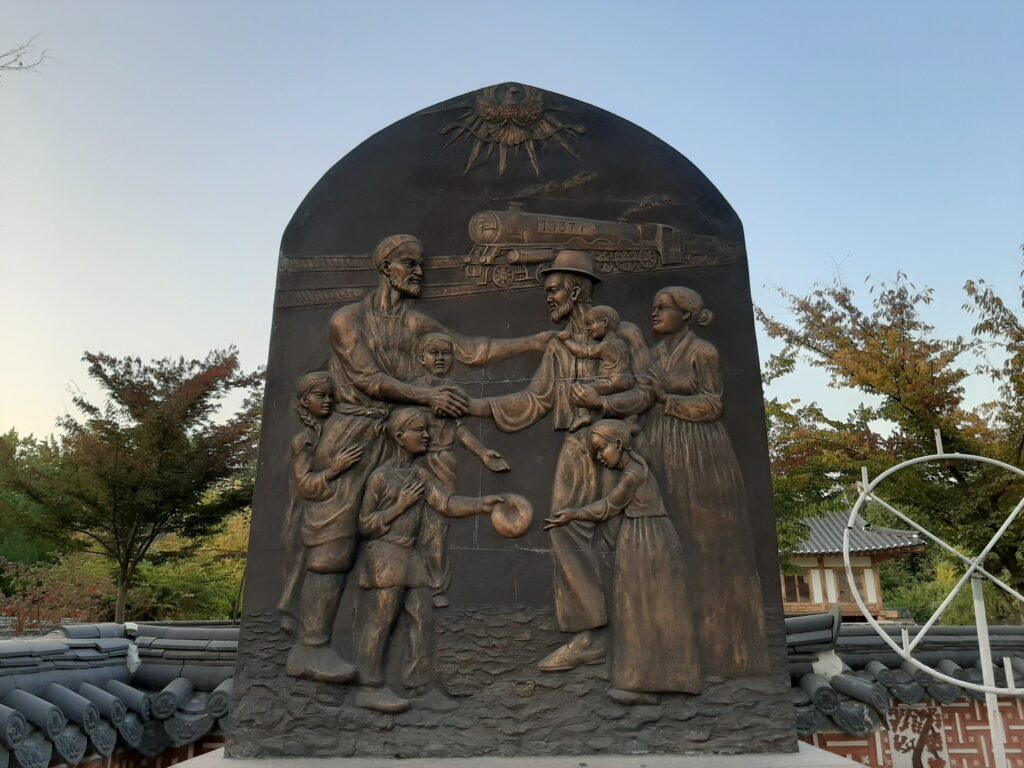
By supporting Novastan, you are supporting the only English, French and German-language media specialising in Central Asia. We’re independent and we need your help to stay that way!In Tashkent’s Seoul Garden, a train marked “1937” runs across the background of a bronze memorial. In the foreground, a Korean family arrives with children and bundles. An Uzbek elder extends a hand of welcome.
The monument, erected for the 80th anniversary of the resettlement of Koreans to Uzbekistan, carries inscriptions in Uzbek, Korean and Russian. It thanks the Uzbek people for their warmth and kindness toward the Korean diaspora. The scene compresses the Koryo-Saram story into a single image: forced movement, uncertainty, survival and the later memory of Central Asia as both a place of exile and a place of refuge.
Read more on Novastan: « Nous sommes plus Russes que Coréens » : biographie d’une Coréenne au Kazakhstan
The Koryo-Saram are often described as the Korean diaspora of Central Asia. The phrase is accurate, but incomplete. Their history begins in Korea, passes through the Russian Far East, is violently reshaped by Stalinist deportation, and continues in the cities, collective farms, theaters, newspapers, kitchens and families of Kazakhstan and Uzbekistan.
For many Koryo-Saram, Central Asia is not only the place to which their ancestors were sent. It has become home.
From Korea to the Russian Far East
The ancestors of the Koryo-Saram began moving from Korea to the Russian Empire in the second half of the 19th century. Some were fleeing poverty, famine or social instability. Others crossed into the Russian Far East in search of land and security. Later, Japanese colonial domination of Korea added another layer to this movement.
In the Russian Far East, Korean communities took root. They farmed, built villages, created schools and organized cultural life. After the 1917 revolution, they became part of the Soviet Union’s complex nationality system, developing a distinct Soviet Korean identity.
The name Koryo-Saram can be roughly understood as “Korean people,” with “Koryo” referring to an older name associated with Korea. By the 1930s, Soviet Koreans had become a visible community in the Far East. But their position near the border with Korea and Manchuria, at a time of growing tension with imperial Japan, made them vulnerable to suspicion. Soviet authorities increasingly viewed them through a security lens, despite the fact that most had no connection to Japanese power.
In 1937, that suspicion became mass punishment.
The train to Central Asia
In the autumn of 1937, Soviet Koreans were forcibly deported from the Russian Far East to Central Asia. Around 172,000 people were moved, mainly to Kazakhstan and Uzbekistan. Families were loaded onto trains and sent thousands of kilometers away from the region where many had lived for generations.
The deportation was not an orderly transfer of population. For those who lived through it, it began not with policy language, but with a knock at the door. Families were told to gather what they could carry and leave. Most had no clear idea where the trains were going.
The journey across the Soviet Union could last weeks, in crowded wagons where people slept, cooked and relieved themselves in the same confined space. Children, elderly people and the sick were the first to die. Others arrived in Kazakhstan or Uzbekistan weakened by hunger, cold and disease, only to be placed in barracks, warehouses or unfinished settlements.
Read more on Novastan: Qu’est-ce qu’être un Coréen au Kazakhstan aujourd’hui ?
In official documents, this was “resettlement.” In family memory, it was something else: the moment an entire people was torn from one landscape and forced to begin again in another.
The deportation of the Koreans was one of the earliest Soviet deportations of an entire ethnic group. It prefigured later mass deportations of Chechens, Crimean Tatars, Ingush, Volga Germans and others under Stalin. But unlike some of those cases, the Korean deportation remains less widely known outside specialist circles.
The official justification was security. In practice, it meant the removal of an entire population from a borderland because of their ethnicity and because of the geopolitical anxieties of the Soviet state.
Yet the deportation did not erase them. In Kazakhstan and Uzbekistan, the Koryo-Saram rebuilt.
Survival in Kazakhstan and Uzbekistan
Central Asia was not an empty stage on which the Koryo-Saram simply appeared. It was already a complex region of Kazakh, Uzbek, Tajik, Kyrgyz, Turkmen, Russian, Tatar, Ukrainian, Jewish, German and other communities. The arrival of deported Koreans added another layer to the Soviet remaking of the region.
Koryo-Saram families adapted quickly, often under harsh conditions. Many became associated with agriculture, including rice cultivation and vegetable production. Korean collective farms became known in parts of Kazakhstan and Uzbekistan. Over time, Koryo-Saram also entered education, science, engineering, medicine, administration, culture and trade.
Their integration was shaped by Soviet structures. Russian became the main language of public life and, increasingly, of many Korean families. Soviet education opened pathways into professional careers. At the same time, the trauma of deportation and the pressure of assimilation weakened the transmission of Korean language and customs.
The result was not simple disappearance. Instead, a new identity emerged: Korean by ancestry, Soviet by experience, Russian-speaking in daily life, and Central Asian by geography, memory and belonging.
This hybridity is central to the Koryo-Saram story. They did not remain a sealed diaspora, separate from the societies around them. Nor did they fully dissolve into the Soviet majority. They became one of the many communities through which Central Asia’s multiethnic reality was lived.
A culture of adaptation
The most visible traces of Koryo-Saram culture are often everyday ones: food, family names, markets, holiday tables, memories of grandparents, and stories told about deportation.
Food is especially important because it shows how identity can survive through adaptation. In the Russian Far East, Korean cuisine had already been shaped by migration. In Central Asia, ingredients and conditions changed again. Dishes were adjusted to what was available.
The most famous example is morkovcha, the carrot salad now known across the former Soviet Union as “Korean carrot.” Made with carrots, garlic, coriander, vinegar and oil, it is not traditional Korean food in the narrow sense. It is a Soviet Korean invention, born from displacement and improvisation. Like the Koryo-Saram themselves, it belongs to more than one world.
Other dishes, such as kuksi and pigodi, also carry family memories. Yet for many younger Koryo-Saram, food may be one of the few remaining links to an older cultural world. A person may no longer speak Korean or Koryo-mar, but still recognize certain dishes as part of home.
This partial inheritance can be intimate and painful. It reminds younger generations that something was preserved, but also that much was broken by deportation, Soviet assimilation and decades of linguistic change.
Language, memory and silence
Language is one of the most sensitive parts of the Koryo-Saram story. Older generations preserved varieties of Korean, often referred to as Koryo-mar. But over the Soviet decades, Russian became dominant for many families. In Kazakhstan and Uzbekistan, younger Koryo-Saram often grew up speaking Russian as their first language, while also navigating Kazakh, Uzbek or other local languages depending on their environment.
For some, this language shift is experienced as loss. For others, it is simply part of the reality of being Koryo-Saram. Identity is not always carried through fluent language. It may be carried through food, surnames, family stories, photographs, rituals, or the memory of an old village in the Russian Far East that descendants have never seen.
The Soviet period also shaped what could be said publicly. Like many deported peoples, Koryo-Saram families often lived with memories that were painful, fragmented or only partly transmitted. Grandparents might speak of the train journey, the first winters, the hunger, or the difficulty of beginning again. But the political meaning of deportation could remain difficult to discuss openly.
After the collapse of the Soviet Union, it became easier to revisit these histories. Yet memory remains uneven. Some younger Koryo-Saram know the story of 1937 in detail. Others know only fragments. Some feel a strong desire to reconnect with Korean language and culture. Others feel that their identity is primarily Central Asian or post-Soviet.
This is not a contradiction. It is the normal result of a history marked by migration, coercion and adaptation.
For younger Koryo-Saram, reconnecting with Korean roots is often a search through fragments. In many families, the language has faded. What remains may be a surname, old photographs, a family story about deportation, or a few dishes prepared at home.
This makes contemporary reconnection with Korea both meaningful and complicated. South Korea may represent ancestry, opportunity and cultural pride, but also distance. The Korean Wave, language classes or migration to Seoul do not simply restore a lost identity. They reveal how much that identity was transformed in Central Asia.
For many Koryo-Saram, the question is not whether they are Korean or Central Asian, but how to live with an inheritance made of both memory and absence.
Institutions of memory
Koryo-Saram culture was never only domestic. Institutions mattered too.
One of the most important is the Korean Theater of Kazakhstan. Founded in Vladivostok in 1932, it was relocated after the deportation and eventually became a major cultural institution in Kazakhstan. Its survival tells a larger story: a community uprooted by force continued to produce art, performance and collective memory in a new land.
The newspaper Koryo Ilbo also became a key institution for Soviet Koreans in Kazakhstan. Together with theaters, associations and cultural circles, it helped maintain a public Koryo-Saram identity even as language use shifted and generations became increasingly Russian-speaking.
These institutions complicate any simplistic narrative of loss. Deportation was devastating, but it also generated new forms of cultural production. Koryo-Saram identity did not remain frozen in the past. It was remade in Almaty, Tashkent, Kyzylorda and other Central Asian spaces.
The Koryo-Saram story also reaches far beyond the communities usually associated with Kazakhstan and Uzbekistan. Viktor Tsoi, the legendary frontman of Kino and one of the defining voices of late Soviet rock, had Koryo-Saram roots through his father, whose family came from Kyzylorda in Kazakhstan after the 1937 deportation. Tsoi himself was born in Leningrad, and his public image was shaped above all by the Soviet rock scene of the 1980s. Yet his family history also linked him to the deported Korean communities of Central Asia.
Read more on Novastan: « Igla » : plongée dans le Kazakhstan sombre de la perestroïka avec le mythique Viktor Tsoï
Others left their mark in sport, art, scholarship and popular culture: Olympic gymnast Nellie Kim, historian German Kim, playwright and filmmaker Lavrenti Son, designer Jenia Kim, singer Anita Tsoy and Uzbekistani painter Nikolai Shin all point, in different ways, to the breadth of Soviet Korean experience.
Their lives show that the Koryo-Saram story is not only one of victimhood or preservation, but also of cultural production, mobility and influence across the post-Soviet world.
Tashkent’s Korean traces
In Uzbekistan, the Koryo-Saram story is not only preserved in official histories or family memories. It also appears in the quieter figures of urban life.
In 2023, our media partner Gazeta.uz profiled Yuri Kim, a second-hand bookseller in Tashkent known to customers and fellow sellers as “Uncle Yura.” The article presented him as a guardian of printed heritage, the owner of a large book collection and a familiar presence in the city’s book culture.
His story offers another way of seeing the Koryo-Saram place in Uzbekistan. Beyond the collective farms, deportation records and demographic categories, there are individual lives woven into the everyday fabric of Tashkent: booksellers, teachers, engineers, doctors, artists and neighbors. Through figures like Kim, the history of a deported community becomes part of the city’s cultural memory.
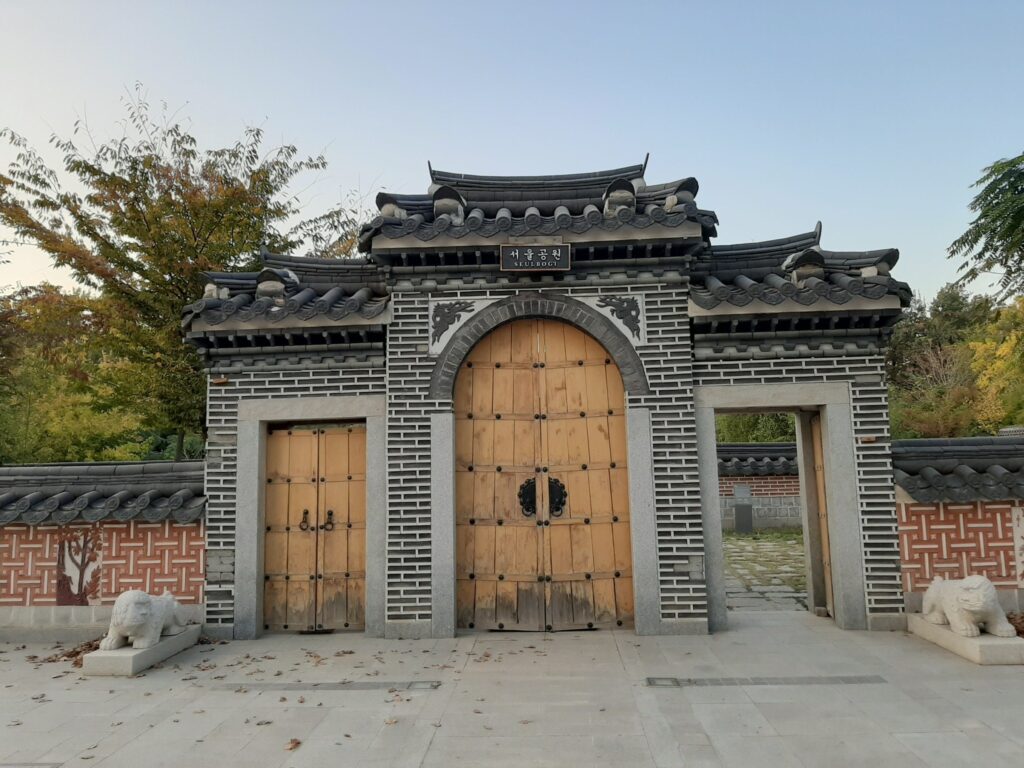
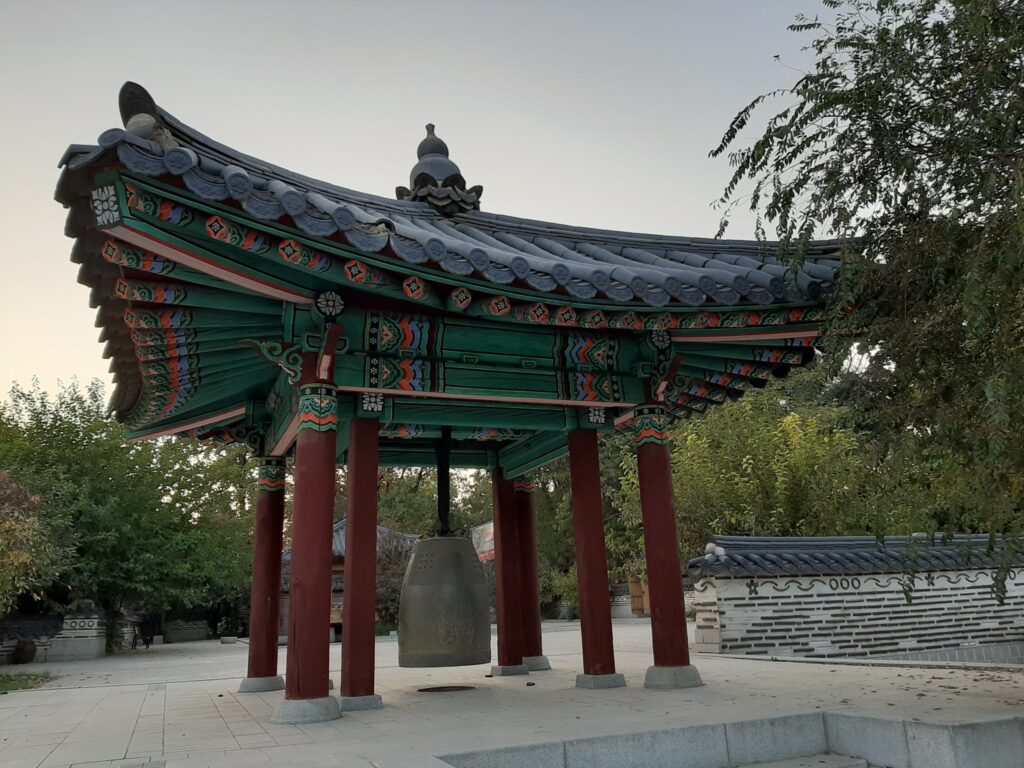
That memory is also visible in Seoul Garden. Its gate, pavilion, bell and memorial create a deliberately Korean space in the Uzbek capital. Yet the story they tell is not simply one of return to Korean tradition. It is a story of transplantation, rupture and reconstruction.
The memorial’s inscription thanking the Uzbek people reflects a common way in which the history is remembered in Uzbekistan: the deportation itself was a Soviet act of violence, but the local population is remembered as having helped the deportees survive and rebuild.
This narrative of gratitude should not obscure the brutality of 1937. But it helps explain why many Koryo-Saram families came to see Uzbekistan and Kazakhstan not only as places of exile, but also as places where life became possible again.
After 1991: new borders, old identities
The end of the Soviet Union changed the Koryo-Saram world again. Communities that had once lived within a single Soviet space suddenly found themselves divided between Kazakhstan, Uzbekistan, Kyrgyzstan, Russia, Ukraine and other newly independent states. New national languages, citizenship regimes and economic realities reshaped daily life.
For some Koryo-Saram, the post-Soviet period brought emigration. Russia, South Korea, Europe and North America became destinations. South Korea, in particular, acquired new importance. It was no longer only an ancestral reference point, but also a place of study, work, migration and cultural imagination.
Yet the relationship with South Korea can be complicated. Koryo-Saram may be ethnically Korean, but many do not speak standard Korean. Their food, history and family memories were shaped in the Soviet Union and Central Asia, not on the Korean Peninsula. In South Korea, some discover that they are seen as foreigners despite their Korean ancestry.
This creates one of the central paradoxes of Koryo-Saram identity: the ancestral homeland can feel foreign, while Central Asia, the land of deportation, can feel like home.
The global popularity of Korean culture has added another layer. K-pop, Korean dramas and South Korean soft power have made Korea more visible among young people across Central Asia. But Koryo-Saram history is not the same as the Korean Wave. It is older, more painful and more deeply embedded in the Soviet and Central Asian past.
For younger Koryo-Saram, this can produce a complex self-understanding. They may be proud of Korean ancestry, attached to Kazakhstan or Uzbekistan, Russian-speaking in daily life, curious about Seoul, and conscious of a deportation history that does not fit neatly into national narratives.
From deportation to partnership
Today’s relationship between South Korea and Central Asia is visible far beyond monuments. Korean universities recruit students from Uzbekistan and Kazakhstan. Korean dramas and pop culture circulate widely. South Korean companies are present in energy, automobiles, technology and infrastructure. In Tashkent, even a sign for KOGAS, the Korea Gas Corporation, outside Seoul Garden hints at a larger transformation.

In 1937, Koreans arrived in Central Asia in forced trains, uncertain whether they would survive the journey. Nearly 90 years later, South Korea has become one of Uzbekistan’s important Asian partners. Between those two moments lies the story of the Koryo-Saram: a community transformed from victims of forced displacement into an integral part of Central Asian society and, increasingly, a bridge between two regions that history once separated.
This bridge should not be romanticized. The Koryo-Saram are not simply intermediaries between Seoul and Tashkent, or between Korean capital and Central Asian markets. They are a community with their own history, losses and forms of belonging. Their experience cannot be reduced to diplomacy, business or soft power.
But their story does reveal something important about Central Asia itself.
The region is too often described through empires, borders, energy routes or great power competition. It is also a region made by movement: voluntary migration, forced deportation, labor mobility, exile and return.
Koryo-Saram history belongs to this larger story. It reminds us that Central Asia was not only the homeland of Turkic and Persian-speaking peoples, nor only the destination of Russian settlers. It was also a place where deported communities were forced to rebuild their lives, sometimes under terrible conditions, and where new forms of belonging emerged over time.
In Kazakhstan and Uzbekistan, the Koryo-Saram are not simply a remnant of Soviet nationality policy. They are part of the social and cultural fabric of the region. Their story can be found in theaters, newspapers, apartment blocks, family kitchens, markets and cemeteries. It is present in the popularity of Korean salads, but also in quieter memories of trains, collective farms and grandparents who started again in a land they had not chosen.
To call Central Asia home after deportation is not to erase the violence of 1937. It is to recognize the strength of those who survived it, and the generations who turned exile into belonging.
Mathieu Lemoine, Editor-in-Chief for Novastan-English