



 Manas and the Making of Kyrgyzstan
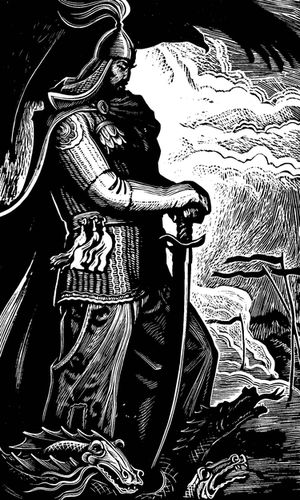
Few works of literature are as politically alive as the Kyrgyz epic Manas. It is not simply an old poem, nor only a heroic tale recited by specialists. In Kyrgyzstan, Manas is a national reference point, a school subject, a monument, an airport name, a political symbol and a language of identity. It tells the story of a people gathering around a hero, but it also helps explain how modern Kyrgyzstan imagines itself: independent, mountainous, resilient, threatened from outside, and always searching for unity.
A story too large to stay in the past
The origins of Manas are difficult to date precisely because the epic was transmitted orally for centuries before being written down. Kyrgyz tradition often presents it as a very ancient work, sometimes linked to events of the ninth or tenth century; Western scholarship has been more cautious, pointing out that the earliest references are much later and that parts of the plot may reflect political realities from later centuries. In 1995, four years after independence, Kyrgyzstan turned Manas into a state-building event: the UN General Assembly formally recognized the year as the millennium commemoration of the Kyrgyz national epic.
What is certain is that Manas belongs to a living oral tradition. It was performed by manaschi, epic reciters who chant the story without musical accompaniment and who are respected not just as performers, but as carriers of memory. UNESCO describes the trilogy of Manas, Semetey and Seytek as a work that expresses the historical memory of the Kyrgyz people and tells of the unification of scattered tribes into one nation.
The story behind the epic
At its core, Manas is a heroic epic about unity, warfare, migration, leadership and survival. The central figure, Manas, is a warrior who gathers and defends the Kyrgyz people against powerful enemies. The wider trilogy continues through his son Semetey and grandson Seytek, turning the story into a multi-generational saga of struggle, succession, loyalty, betrayal and renewal. The trilogy is a narrative about Manas’ uniting the forty scattered Kyrgyz tribes against attacks by powerful neighbours and leading his people through the Altai and toward the Alai region.
Also read on Novastan: « Manastchy » : l’âme kirghize dans toute sa poésie
The epic is enormous, but its political grammar is clear: a people survive when they unite; a leader is legitimate when he protects the community; enemies are both external and internal; and identity is forged through memory, sacrifice and struggle. This is why Manas is not read merely as literature. It is often treated as a national code.
Support Novastan, the European Central Asia magazine
By supporting Novastan, you are supporting the only English, French and German-language media specialising in Central Asia. We’re independent and we need your help to stay that way!Why Manas matters so much to Kyrgyz people
For Kyrgyz people, Manas is important because it offers a deep narrative of origins and continuity. It links modern Kyrgyz identity to a heroic past, to nomadic culture, to the mountains, to clan memory and to the idea of unity among the “forty tribes”, a motif also echoed in the forty rays of the Kyrgyz flag. This matters especially because Kyrgyzstan, like other post-Soviet states, had to build a national story after 1991. Manas offered something older than the Soviet Union and broader than a modern state border. It gave independent Kyrgyzstan a heroic genealogy, a cultural anchor and a language of sovereignty. In a young state marked by regional divisions, political upheaval and economic vulnerability, the epic’s promise of unity has remained attractive.
Manas in school and education
Yes, Manas is studied in Kyrgyzstan. It appears in school education and in higher education through literature, cultural history and “Manas studies” or Manasovedenie. In schools with the Kyrgyz-language teaching Manas is studied in eighth grade, in schools with the Russian-language teaching – in ninth grades and the eleventh grade in courses on Manas studies.
The epic is also used more broadly as a source of moral and civic education. Research on Kyrgyz education links Manas to the upbringing of schoolchildren and youth, especially through themes of cultural heritage, wisdom, moral values and national identity. At university level, the University of Central Asia has offered a “Manas Studies” course examining the epic’s role in the formation and development of Kyrgyz society and national identity.
Also read on Novastan: Le président kirghiz a signé le décret pour renommer Djalal-Abad en Manas
This educational presence is important politically. Teaching Manas is not just about preserving folklore. It is about shaping citizens through a national story.
Manas in everyday life
In Kyrgyzstan, Manas is everywhere. It appears in statues, street names, school lessons, cultural festivals, public ceremonies, tourism branding, official speeches and national iconography. Performances by manaschi remain part of social gatherings, celebrations and ceremonies. Traditional Manas performances take place at social gatherings, community celebrations and ceremonies, preserving the practice as a living form rather than a museum object.
The epic is also physically present in Bishkek. The statue of Manas on Ala-Too Square places the hero at the symbolic centre of the capital. Streets, institutions and cultural initiatives carry his name. Bishkek’s main airport was named “Manas” at the suggestion of Chinghiz Aitmatov, in honour of the hero of the Kyrgyz national epic. Manas functions as the country’s most recognisable national symbol. Even people who have never read or heard the full epic know Manas as the emblem of Kyrgyz strength, unity and sovereignty.
The political uses of Manas
After the collapse of the Soviet Union, Manas acquired a new political function. Kyrgyzstan was no longer a Soviet republic but an independent state, and nation-building had to reconcile two potentially competing ideas: Kyrgyz ethnic identity and citizenship in a multi-ethnic country. For ethnic Kyrgyz, independence meant becoming the titular people of a sovereign state. For many Russians, Uzbeks, Germans, Jews and other minorities, it could also create a sense of sudden displacement within a country they had long considered home.
President Askar Akayev therefore used Manas carefully. He presented the epic as a unifying source of national values, but avoided turning it into an openly exclusionary ethnic ideology. This was politically important after the Kyrgyz-Uzbek clashes in the Ferghana Valley and amid fears that Russians, Germans and Jews would leave the country in large numbers. Drawing on the Soviet-era recognition of Manas as cultural heritage, Akayev promoted seven principles inspired by the epic as a basis for independent Kyrgyzstan’s national ideology. These principles softened the epic’s more divisive themes, including ethnic conflict, religious antagonism and hostility toward China, and instead emphasised ethnic pride, friendship among nationalities, hard work, respect for nature, humanism, nobility and forgiveness.
Also read on Novastan: L’épopée de « Manas » : encyclopédie de l’histoire et des mœurs kirghizes
This political use has continued in different forms. After 2010, the promotion of Manas intensified partly because of heritage politics, including concern over China’s 2009 UNESCO inscription of the Manas tradition associated with Kyrgyz communities in China. More recently, Manas has returned as a tool of state symbolism under President Sadyr Japarov. In September 2025, Japarov signed a law renaming Jalal-Abad, Kyrgyzstan’s third-largest city, as Manas.
This is where the epic becomes current affairs. Invoking Manas allows political leaders to wrap infrastructure, centralisation, regional development, sovereignty and national unity in heroic language. It can inspire cohesion, but it can also serve as political theatre: a way to claim legitimacy by presenting contemporary decisions as continuations of an ancient national mission.
A national epic, but also a political risk
The political power of Manas lies in its flexibility. It can be used to promote unity in a divided country, cultural pride in a globalised world, and sovereignty in a region shaped by Russian, Chinese and broader geopolitical influence. But the same flexibility can also narrow public debate.
When leaders invoke Manas, they borrow the authority of the nation’s deepest cultural symbol. That can make ordinary political choices appear sacred or inevitable. A city renaming, a state-building project, a moral campaign or a geopolitical message can be presented not merely as policy, but as loyalty to ancestral memory.
Also read on Novastan: Un conteur récite l’épopée de Manas pendant plus de 14 heures pour battre le record du monde
This is the double edge of Manas. As an epic, it preserves a people’s imagination. As a political symbol, it can elevate power above criticism.
Why Manas still matters today
Manas remains valid today because Kyrgyzstan still faces many of the questions the epic dramatises: how to hold a diverse society together, how to defend sovereignty between larger powers, how to balance regional identities, how to define leadership, and how to transform memory into a future rather than a museum.
Also read on Novastan: Manas, de la tradition orale au jeu vidéo
The epic’s message of unity is still powerful, especially in a country with strong regional identities and a history of political upheaval. Its warnings are also still relevant. Manas shows that unity cannot be reduced to slogans. It depends on justice, loyalty, wise leadership and the ability to hold a community together without erasing its differences.
That is why Manas should be read not only as a monument of Kyrgyz culture, but as a living political text. It is the story Kyrgyzstan tells about where it comes from. It is also one of the languages through which power in Kyrgyzstan still explains where the country should go.
Maya Ivanova for Novastan