




 70 years of Xinjiang: Beijing celebrates and enacts new political doctrine
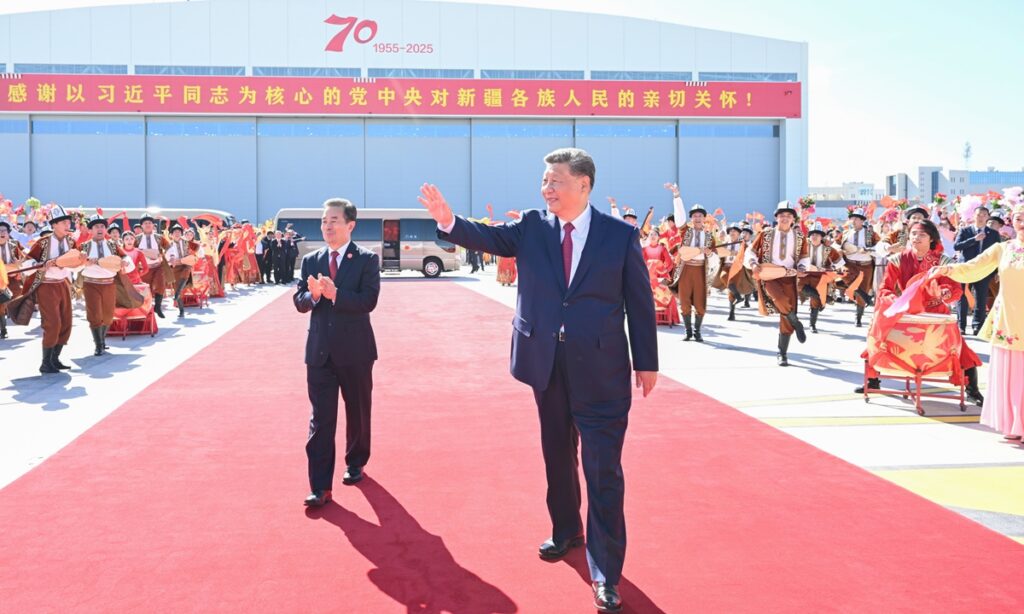
The 70th anniversary of Xinjiang, China’s Uyghur region, was celebrated with great fanfare in Ürümqi. The ceremony was marked by the presence of Xi Jinping, the first Chinese president to attend this event.
From September 23 to 25, the Xinjiang Uyghur Autonomous Region celebrated its 70th anniversary with a gala. Among those present were Chinese President Xi Jinping and members of the Politburo of the Communist Party of China, Wang Huning and Cai Qi. Officially established in 1955, this region, which is central to the development of China’s “New Silk Road,” has been the focus of tensions between Beijing and the Uyghur minority for decades.
The gala, titled “Beautiful Xinjiang,” served as a tool for internal and external communication, conveying political themes and thus going beyond the purely artistic. Xi Jinping gave a short speech in which he repeatedly addressed the issues of security and stability in Xinjiang.
Want more Central Asia in your inbox? Subscribe to our newsletter here.
“Ensuring social stability and lasting peace”
Xi’s speech to local authorities focused on social control as well as security. The president emphasized the comprehensive efforts to maintain social stability in Xinjiang and to raise public awareness of the fight against terrorism. According to the official Xinhua news agency, Xi said it was imperative to promote a strong awareness of the Chinese nation as a community in Xinjiang and to advance the development of this community.
The emphasis on security serves to justify the continued existence of an extensive security apparatus. It accompanies the publication of the “Chinese Communist Party (CCP) Guidelines for Governing Xinjiang in the New Era: Practices and Achievements” by the State Council Information Office, the CCP’s new doctrine for the future of the region.
In the 42-page document, Beijing proclaims a “historic success” in the fight against terrorism and points out that there have been no violent attacks for several years; the last one dates back to May 22, 2014. To justify maintaining the reinforced security apparatus, Beijing denounces “Panturkism” and “Pan-Islamism” as existential threats and implicitly cites the Al Qaeda-affiliated “Islamic Party of Turkestan” (IPT), which now cooperates with the Syrian Ministry of Defense.
Read also on Novastan: Total surveillance, segregation, and internment in Xinjiang: a discreet report on the daily life of the Uyghurs
The text also justifies surveillance, re-education, and religious control policies as legal and preventive measures, while rejecting Western accusations of “genocide” and “forced labor.”
The CCP also welcomes the region’s economic development: regional GDP is expected to grow from 750 billion yuan (€90.8 billion) in 2012 to more than 2 trillion yuan (€242.1 billion) in 2024. Beijing highlights poverty reduction, rapid urbanization, and the creation of the Xinjiang pilot free trade zone in 2023, which is part of the Eurasian “New Silk Roads” corridor, an international logistics and transport infrastructure network announced in 2013.
Erasure and appropriation of Uyghur culture
No explicit mention was made of the repression and internment camps imposed on the Uyghur population since 2014, which have been regularly denounced by the Uyghur Human Rights Project (UHRP). A UHRP report dated April 25, 2024, states that one in 26 individuals in Xinjiang, mainly Uyghurs or non-Han Chinese, were imprisoned in 2024, representing nearly one-third of China’s total prison population. Yet these same populations represent only 1% of the national population.
Although there are no comprehensive official data on the exact number of internment camps in the Xinjiang region, NGOs such as the UHRP estimate that at least 578,500 people were incarcerated between 2017 and 2022, not counting those still detained in the camps. The Uyghur region has the highest incarceration rate in the world, with 2,234 prisoners per 100,000 individuals. A study by the Australian Strategic Policy Institute (ASPI) think tank has identified approximately 380 detention centers in operation since 2017 using satellite imagery.
Read also on Novastan: Escape from Xinjiang – Stories of those who escaped the camps
But current Chinese doctrine now emphasizes the concept of the “Chinese nation community.” This involves actively promoting standard Mandarin in education, encouraging cultural and urban fusion, and strengthening control over religious institutions so that Islam and other religions are “compatible with socialism.”
In addition, the CCP promotes selective preservation of local heritage (sites in Kucha, Turfan, Kashi, and Kashgar), integrated into a Chinese historical narrative, as well as the predominance of Han culture in education and public life.
Rewriting history
The document presents Xinjiang’s policy as a model of national governance, combining security, cultural assimilation, economic development, and ideological control. It seeks to legitimize the CCP’s actions in the face of international criticism by framing the region’s governance within the logic of “Chinese-style modernization,” similar to the situation in Tibet, where Beijing has exercised military domination and implemented policies of assimilation of the population for 75 years.
Between the CCP’s centralizing tendencies and persistent jihadist threats, Xinjiang remains a flashpoint for tensions, caught between security and repression.
Lenny Cabrol Noto for Novastan
For more news and analysis from Central Asia, follow us on Twitter, Facebook, Telegram, Linkedin or Instagram.