
 How New Is the “New Uzbekistan”? The Legacy of the Nukus Protests
Support Novastan, the European Central Asia magazine
By supporting Novastan, you are supporting the only English, French and German-language media specialising in Central Asia. We’re independent and we need your help to stay that way!What happens to a society when people are afraid not only of what might happen to them, but of what they might say about what has already happened?
In Uzbekistan, the memory of the 2005 Andijan massacre has long been shaped by silence. Nearly two decades later, Uzbek playwright Roma Egorov revisited the events in his theatrical piece Andijan Polka. But Andijan is not the only episode to raise questions about fear, memory and repression in Uzbekistan. The violence in Karakalpakstan in July 2022 also left its mark on a country undergoing profound transformation under the banner of Shavkat Mirziyoyev’s “New Uzbekistan”.
Nukus, July 2022
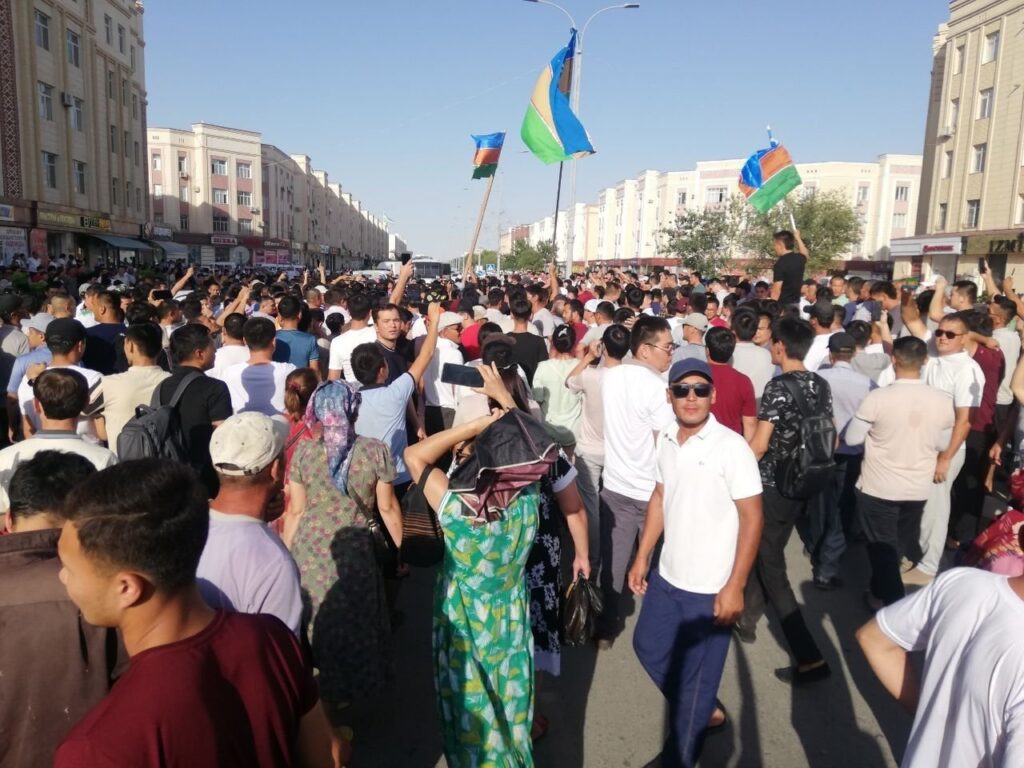
On 1 July 2022, thousands of protesters gathered in Nukus, the capital of Karakalpakstan, after proposed constitutional amendments threatened the republic’s special status and its constitutional right to hold a referendum on secession. What began as opposition to constitutional change became the most serious political crisis of Shavkat Mirziyoyev’s presidency.
Security forces used lethal and other excessive force to disperse protesters. Twenty-one people were killed and more than 270 injured, while more than 500 people were initially detained. Human Rights Watch later concluded that law enforcement officers had used excessive or unnecessary lethal force against largely peaceful demonstrators.
Read more on Novastan: Karakalpakstan: long prison sentences for participants in last year’s protests
The government declared a state of emergency and severely restricted access to information. Internet connectivity in Karakalpakstan faced major disruptions and near-total blackouts. I was in Uzbekistan that summer. For several days, Telegram – one of the country’s principal channels for news and public discussion – became inaccessible.
Information controls were hardly unprecedented in Uzbekistan. Following the 2005 Andijan massacre, the Karimov government had also sought to prevent independent reporting and restrict competing accounts of what had happened.
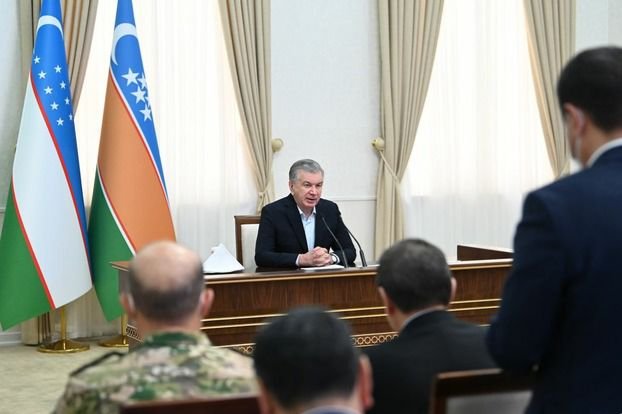
Yet the government’s response in 2022 also revealed an important difference from the Karimov era. Mirziyoyev travelled to Nukus and withdrew the disputed constitutional amendments, opting for political de-escalation even as security forces resorted to lethal force. Such a willingness to reverse a controversial policy in response to public pressure would have been difficult to imagine under Islam Karimov.
The concession, however, did not prevent the prosecutions that followed. The violence and subsequent trials exposed a contradiction at the heart of Mirziyoyev’s “New Uzbekistan”: the state had become more responsive and pragmatic, but its willingness to use coercion when its authority was challenged had not disappeared.
This combination of concession and coercion makes Nukus particularly revealing. It suggests that the reform era has changed the way the Uzbek state manages dissent without fundamentally altering the limits it places on political mobilisation.
Why Karakalpakstan reacted
To understand why the protests escalated so quickly, it is necessary to look beyond the constitutional amendments themselves.
Karakalpakstan occupies a distinctive position within Uzbekistan. The autonomous republic has its own constitution, while Uzbekistan’s Constitution historically recognised it as sovereign within the country and provided for the possibility of secession on the basis of a referendum. The proposed 2022 amendments would have removed constitutional provisions underpinning this special status.
For many Karakalpaks, this was not simply a technical legal change. It raised questions about autonomy, dignity and whether Tashkent was prepared to respect Karakalpakstan’s distinct political identity.
Geographically distant from Uzbekistan’s political centre and profoundly affected by the environmental catastrophe of the Aral Sea, Karakalpakstan has also faced serious economic and social challenges. Questions of representation, regional marginalisation and the relationship between the central government and the periphery formed part of the background against which the constitutional amendments were received.
As political scientist Sergey Horák has argued, the protests cannot simply be understood as a coordinated separatist campaign. Regional identity, constitutional anxiety and anger over the treatment of Karakalpak activists also shaped the mobilisation.
The government’s emphasis on separatism nevertheless helped recast a political dispute over constitutional rights, representation and regional identity as a question of state security. Once dissent was interpreted primarily through the language of threats to the constitutional order, the space for political dialogue narrowed considerably.
The events in Nukus therefore cannot be reduced either to a separatist movement or to a spontaneous outburst. They reflected a deeper unresolved question about the relationship between Karakalpakstan and the Uzbek state – and about how much political space the “New Uzbekistan” is prepared to leave for dissent.
What really changed under “New Uzbekistan”
The significance of Nukus becomes clearer when set against the substantial reforms introduced since Mirziyoyev came to power in 2016.
Following Karimov’s death, Mirziyoyev inherited a politically stable but economically restrictive and internationally relatively isolated state. At the centre of his reform programme was the concept of “New Uzbekistan” (Yangi O’zbekiston), which presented the new administration as a departure from the excesses and rigidities of the Karimov era.
The programme promoted economic liberalisation, administrative modernisation, regional diplomacy and greater international cooperation while preserving political stability and a strong presidential system. Its rhetoric presented Uzbekistan as a confident, reform-oriented state increasingly integrated into the global economy.
Some of the most consequential reforms occurred in the economic sphere. In 2017, the government liberalised the Uzbek som, ending years of rigid exchange-rate controls that had distorted the economy and sustained a large black market for foreign currency.
The change was visible in everyday life. Under Karimov, bazaars and streets were filled with informal currency traders calling out “Tenge! Dollars! Rubles!” With hard currency difficult to obtain at official rates, many Uzbeks relied on the black market. Currency liberalisation largely dismantled this system and was welcomed by international financial institutions and investors as a major step towards a more predictable economic environment.
It was followed by measures to ease business regulation, promote private enterprise and attract foreign capital. World Bank data show foreign direct investment net inflows increasing substantially over the longer term, from around $213 million in 2005 to approximately $2.7 billion in 2022, although flows varied considerably from year to year.
Equally important was Uzbekistan’s shift in foreign policy. Under Karimov, relations with neighbouring states were frequently characterised by mistrust, border disputes and limited regional cooperation. Mirziyoyev instead prioritised diplomacy and regional integration, improving relations with Kazakhstan, Kyrgyzstan, Tajikistan and Turkmenistan through reopened crossings, increased trade and negotiated settlements of long-standing disputes.
The difference could be felt at the border. Crossing Gishtkuprik between Uzbekistan and Kazakhstan once meant long waits, cumbersome controls and, not infrequently, informal payments. For families separated by the border, even short journeys could become exhausting. The experience today is markedly different.
These changes matter. “New Uzbekistan” cannot convincingly be dismissed as a branding exercise. The country has become economically more open, internationally more engaged and, in important areas, administratively more responsive than it was under Karimov.
What did not change
Political liberalisation, however, has been much more limited.
Independent political parties continue to face major barriers. Elections remain tightly managed, while independent civil society organisations encounter significant obstacles to registration and operation. Freedom of expression has expanded compared with the most restrictive years of the Karimov era, but clear red lines remain.
Human Rights Watch, for example, has documented prosecutions under Article 158, part 3 of Uzbekistan’s Criminal Code, which criminalises public insult or slander against the president through the press, telecommunications networks or the internet and carries a maximum prison sentence of five years.
The apparent paradox is important. The reforms undertaken since 2016 were genuine, but genuine reform does not necessarily amount to democratisation.
Political scientist Vladimir Gel’man describes authoritarian modernisation as a model in which governments pursue socioeconomic development and technical reform while political freedoms remain outside the modernisation agenda or are postponed to an indefinite future. Although Gel’man develops the concept primarily in relation to Russia, it provides a useful framework for understanding the reform trajectory of Mirziyoyev’s Uzbekistan.
“New Uzbekistan” can therefore be understood as a form of authoritarian modernisation pursued through controlled liberalisation. Economic modernisation, improved public administration, international engagement and carefully managed openness can strengthen state capacity and legitimacy without fundamentally redistributing political power.
Rather than weakening the state, many reforms have made it more effective. Rather than dismantling presidential authority, they have operated within a system in which political power remains heavily concentrated around the presidency.
This is precisely why Nukus matters. The state has become more responsive, pragmatic and outward-looking, but political power has not been fundamentally redistributed. Authoritarianism was not dismantled. It was recalibrated.
Nukus and Andijan: continuity and adaptation
The comparison between Nukus and Andijan is central to understanding both what changed under “New Uzbekistan” and what did not. The two episodes were very different in scale and context, and equating them would obscure more than it explains. Yet the contrast between them reveals important continuities and changes in the Uzbek state’s approach to protest and coercion.
The defining episode of state violence under Karimov occurred in May 2005 in Andijan. Protests developed following the trial of 23 local businessmen accused of Islamic extremism and grew into a broader expression of anger over poverty, corruption and political repression.
Uzbek security forces opened fire on a largely peaceful crowd that included protesters and bystanders.
The true death toll remains disputed. The Uzbek government reported 187 deaths, while independent organisations, witnesses and activists produced considerably higher estimates. The New Humanitarian, reporting in the immediate aftermath of the massacre, cited local human rights activists who believed that more than 1,000 people may have been killed. No independent international investigation was permitted, and no one has been held accountable for the massacre.
The political aftermath was equally significant. The Karimov government rejected outside scrutiny and resisted international calls for an independent investigation. Uzbekistan subsequently entered a period of increased isolation from Western governments and institutions, while discussion of Andijan inside the country remained severely restricted.
The government’s behaviour during the 2022 unrest in Karakalpakstan was noticeably different. Mirziyoyev travelled to Nukus, acknowledged public opposition to the constitutional proposals and withdrew the amendments. The scale of the killing was also dramatically lower than the estimates associated with Andijan, and Uzbekistan did not retreat into the kind of prolonged international isolation that followed the 2005 massacre.
Yet the continuities remain difficult to ignore.
Security forces again resorted to unjustified lethal force against protesters. Protest leaders were prosecuted. Claims of torture and ill-treatment emerged. Meaningful accountability for the deaths and serious injuries has remained elusive.
The contrast with Andijan is therefore best understood not as a simple transition from repression to reform, but as a change in the way repression operates.
Karimov’s government answered political challenge with overwhelming force, denial and isolation. Mirziyoyev’s government showed a greater capacity for tactical retreat and political management. It withdrew the most controversial constitutional changes while simultaneously using coercion to reassert state authority.
Concession and coercion were not alternatives. They operated together.
That capacity to absorb pressure without surrendering political control may be one of the defining characteristics of the “New Uzbekistan”.
What happened afterwards
The authorities did not simply withdraw the constitutional amendments and close the episode.
More than 500 people were initially detained in connection with the July 2022 unrest. Human Rights Watch later reported that 61 people were criminally prosecuted over their alleged involvement in the demonstrations.
The most prominent was Karakalpak lawyer and blogger Dauletmurat Tazhimuratov. Before the unrest, he had spoken against the proposed constitutional changes and called for a peaceful protest. In January 2023, a court sentenced him to 16 years in prison on charges including organising mass riots and attempting to seize power.
His conviction has remained one of the most prominent symbols of the post-Nukus crackdown. In 2025, the UN Working Group on Arbitrary Detention concluded that his detention was arbitrary and called on Uzbekistan to release him and provide reparations.
The pressure has extended beyond those directly prosecuted over the July demonstrations.
In February 2024, Uzbekistan’s Supreme Court designated the opposition movement Alga Karakalpakstan as “extremist” and banned its activities. Its leader, Aman Sagidullaev, who lives in Norway, had already been prosecuted in absentia and sentenced to 18 years in prison. Other people have subsequently been prosecuted for alleged membership in the organisation.
Uzbekistan has also pursued Karakalpak activists living abroad. Several diaspora activists in Kazakhstan were prosecuted in absentia, while Kazakh authorities detained others following extradition requests from Uzbekistan. Among them was Aqylbek Muratbai, a Karakalpak activist living in Almaty whose case Novastan has followed closely.
The crackdown therefore became transnational. Leaving Uzbekistan did not necessarily place Karakalpak activists beyond the reach of Uzbek criminal proceedings or extradition requests.
Accountability for the state’s own actions, meanwhile, has proceeded very differently. A parliamentary commission established to investigate the July 2022 events submitted its findings to parliament in December 2024, but the report was not made public. Human Rights Watch reported in 2025 that no one had been held accountable for 20 of the 21 deaths and that no senior official had been prosecuted over the excessive use of force.
The asymmetry is striking: numerous protesters and activists have faced prosecution, while accountability for the state’s use of lethal force has remained extremely limited.
The aftermath of Nukus therefore reveals the boundaries of political responsiveness under Mirziyoyev. The government could reverse the constitutional proposal that triggered the unrest, but it remained unwilling to accept autonomous political mobilisation challenging the state’s authority – or to subject the state’s own conduct to equivalent scrutiny.
What Nukus tells us about the limits of reform
“New Uzbekistan” is best understood as an authoritarian political system undergoing significant modernisation.
Its leaders have recognised that economic openness, administrative reform, better relations with neighbouring countries and international engagement can strengthen rather than weaken the state. They have also demonstrated that public pressure can sometimes require policy concessions.
But those changes have not extended to political pluralism, independent accountability or the redistribution of political power.
This brings us back to the initial question: what happens to a society when people are afraid not only of what might happen to them, but of what they might say about what has already happened?
Roma Egorov’s Andijan Polka matters because it returns through theatre to an episode long surrounded by silence. Nukus demonstrates that, despite significant political and economic change under Mirziyoyev, the state continues to influence the boundaries within which dissent, political mobilisation and collective memory can be expressed.
The contrast between Andijan and Nukus is therefore not a story of an authoritarian state simply becoming less violent. It is a story of an authoritarian system becoming more adaptive.
Karimov responded to a major political challenge with mass violence, denial and isolation. Mirziyoyev combined force with concession and political management. His withdrawal of the constitutional amendments demonstrated a flexibility largely absent under his predecessor, but the prosecutions, restrictions on political mobilisation and continuing lack of accountability demonstrated the limits of that flexibility.
The question is therefore no longer simply whether Uzbekistan has changed. It clearly has.
The more difficult question is how much of the past – and how much of the present – can be openly remembered, discussed and challenged in the “New Uzbekistan”.
Egorov’s return to Andijan through theatre suggests that memory can survive even when political space is restricted. Nukus poses the next test. The “New Uzbekistan” may have changed the way the state responds to dissent, but it has not yet resolved the fundamental question of what happens when citizens demand not only that the government change its policies, but that it answer for violence committed in its name.
Originally from Uzbekistan, Aliya Zaynullina is a human rights activist with a background in political science and law from Sciences Po Paris and Leiden University. Her work focuses on authoritarian regimes, human rights, feminist movements and foreign policy in Central Asia.