


 From Küi to Metallica: How Aldaspan Electrified the Kazakh Dombra
Support Novastan, the European Central Asia magazine
By supporting Novastan, you are supporting the only English, French and German-language media specialising in Central Asia. We’re independent and we need your help to stay that way!When Nurzhan Toishy first heard Metallica in the late 1980s, he recognised something unexpected in the riffs: the rhythmic language of the Kazakh dombra. More than two decades later, that intuition gave birth to Aldaspan, a band that replaced electric guitars with electric dombras. What began as a musical experiment also became part of a wider debate over tradition, modernity and the place of Kazakh culture in contemporary music.
In 1988, Nurzhan Toishy was listening to Metallica when the opening of Motorbreath caught his attention.
To many listeners in the late Soviet Union, the aggressive riffs and speed of American thrash metal represented a musical world far removed from traditional Central Asia. To Toishy, however, something about it sounded strangely familiar.
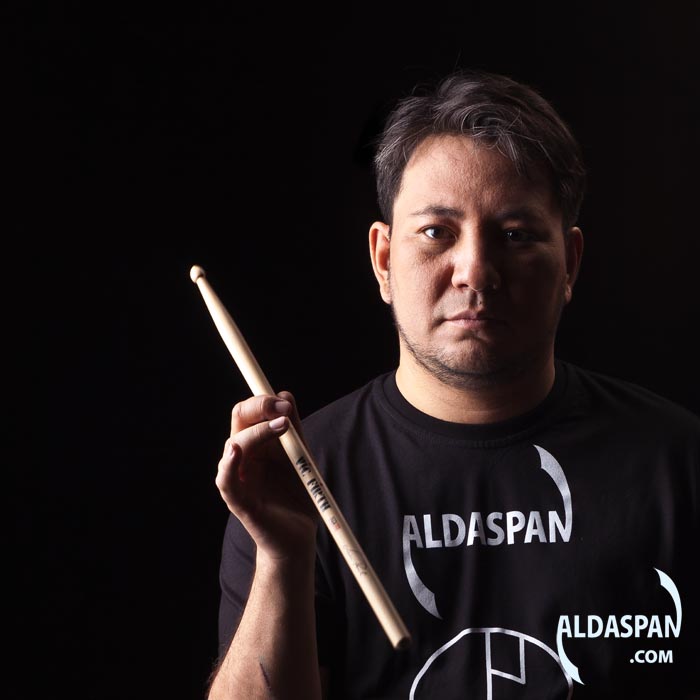
“I recognised in the first riffs a manner of playing characteristic of the dombra,” the founder and producer of the Kazakh band Aldaspan told Novastan.
It was an observation that would stay with him for decades.
Metal and dombra music, he says, had effectively been playing alongside each other in his head since childhood. But it took around twenty years before he had the money, time and musicians capable of turning the idea into something tangible.
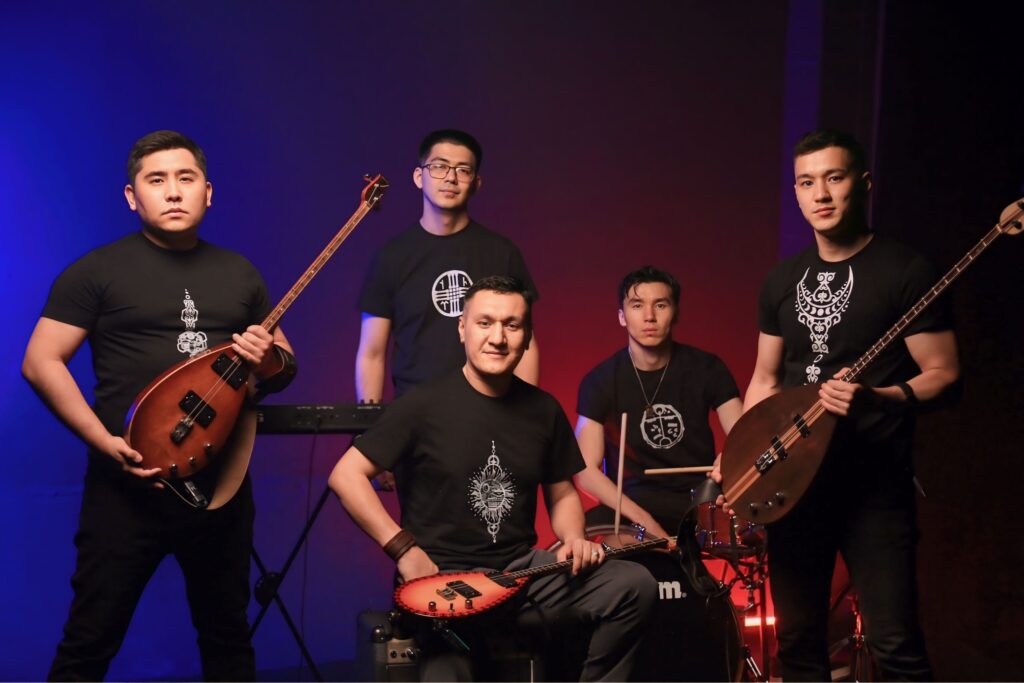
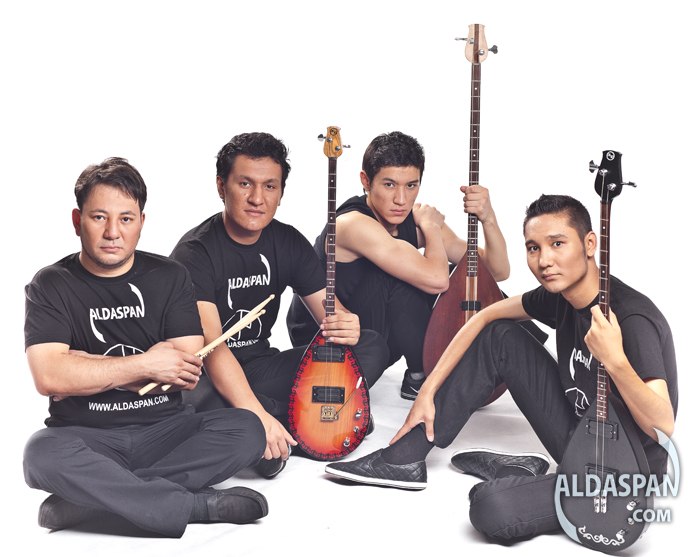
The result was Aldaspan: a rock project built not around the electric guitar but around electrified versions of Kazakhstan’s emblematic two-stringed instrument.
Its premise might sound like a novelty. In practice, however, Toishy argues that the musical distance between the Kazakh steppe and heavy metal is considerably shorter than it appears.
How the Kazakh dombra became a metal instrument
To understand his argument, Toishy says listeners should first hear the dombra without distortion, amplifiers or drums.
The dombra is a long-necked, two-stringed plucked instrument at the centre of Kazakh musical culture. One of its most important traditions is the küi: an instrumental composition which can communicate stories, historical memory and emotion without sung lyrics.
UNESCO inscribed the traditional art of dombra küi on its Representative List of the Intangible Cultural Heritage of Humanity in 2014, describing it as a practice that connects communities to their historical roots and helps transmit Kazakh cultural knowledge between generations.
Within that tradition, two broad performance styles are usually distinguished: tökpe and shertpe. The distinction is more complex than simply “fast” and “slow”, although that is how Toishy initially explains it to an unfamiliar listener.
Tökpe, historically associated particularly with western Kazakhstan, tends towards a more forceful and expansive style, often involving rapid movement across the strings. Shertpe, strongly associated with central and eastern Kazakhstan, places greater emphasis on individual plucking, melodic nuance and lyricism. Ethnomusicological research describes tökpe as characteristically rapid and broad in scope, while shertpe tends towards greater subtlety and expressive variation.
For Toishy, the connection with rock becomes particularly apparent in the faster tökpe küi tradition. He recommends first listening to traditional tökpe küi performances – including the pieces collected in this playlist – and only then returning to Metallica’s Motorbreath.
By contrast, Seken Turysbek’s well-known Köñil Tolqyny is an example of the slower, more lyrical shertpe küi tradition. Toishy mentions it to illustrate the stylistic range of dombra music rather than as a direct comparison with Motorbreath.
“If you listen to what I have mentioned, you will understand how obvious these things are yourself,” he says.
Aldaspan later explored the two traditions in different releases. Toishy points in particular to Elge Qait and Tokpe Light. The band’s own discography describes the 2012 Elge Qait as a collection primarily of slow shertpe küi.
For him, then, putting the dombra into heavy rock was less an attempt to force two incompatible genres together than to amplify a connection he believed was already there.
Six strings, but no guitars
Aldaspan’s crucial decision was not simply to place a traditional instrument over a conventional rock arrangement.
There would be no electric guitar.
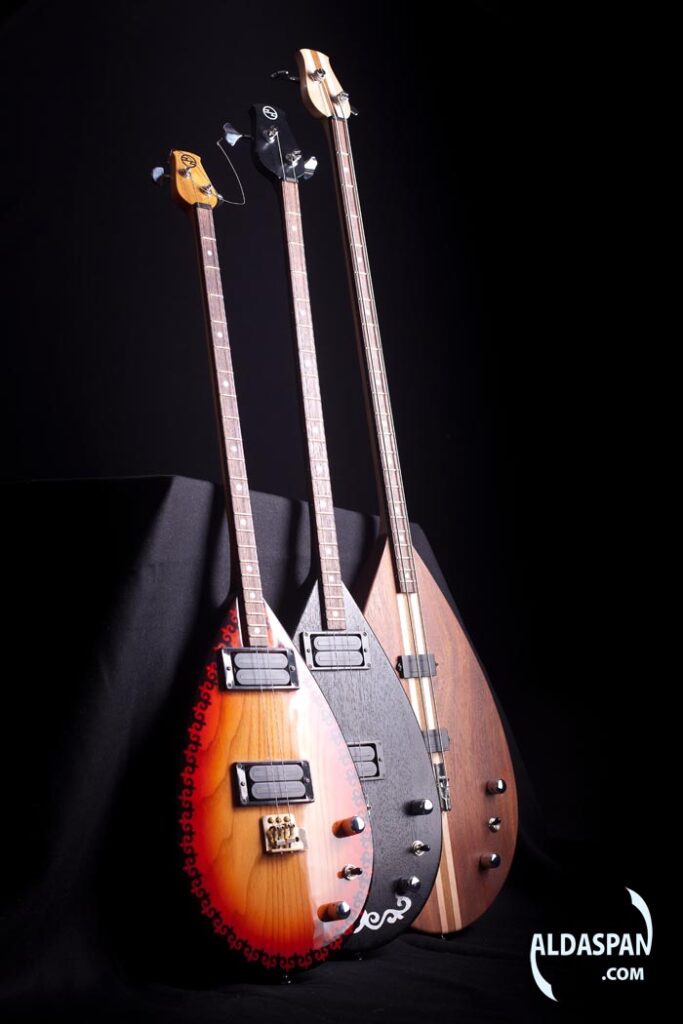
The project instead developed around lead, rhythm and bass electric dombras. Its original formation paired three variants of the instrument with drums; the band’s debut album Attila, released in 2011, mixed ethno-rock and thrash metal with throat singing. Aldaspan’s current official history dates the fully formed concept to 2009, when Toishy began pursuing the idea of running the sound of the dombra through overdrive and distortion.
For a musician, electrification presented an obvious problem.
The attraction of the dombra lies precisely in the distinctive character of its sound. If amplification and distortion simply made it imitate an electric guitar, the experiment would lose much of its purpose.
“That was what I feared most – that the sound of the dombra would become the sound of a guitar,” Toishy says.
His conclusion after experimenting was that the distinctive timbre survived.
In his own estimation, around “90 percent” remained recognisably dombra, while perhaps “10 percent” acquired a metal character. The numbers are subjective, of course, but they capture the balance he was seeking: power without erasing identity.
Even Toishy says he did not initially know exactly what kind of ensemble would emerge once overdrive and distortion were applied to the instruments. Only after recording, mixing and listening back to several albums did he feel that Aldaspan had created not simply one sound but several variations of ethno-rock.
Among the works he considers particularly important in that evolution are El Dastan, Uly Kosh, tracks from Attila, and the albums Tokpe Light and Elge Qait.
There is also a striking economy to the band’s basic setup.
“Across our whole group, there are six strings,” Toishy says of the three two-stringed dombras.
The apparent simplicity is precisely what surprises audiences, he says. A small traditional instrument associated by many with acoustic performance can suddenly produce the density and physical impact expected from a rock band.
Toishy believes another quality differentiates the instrument from the guitar.
“The dombra is close to the timbre of a man’s voice,” he says. “When it plays, physiologically its sound is closer to the human voice than a guitar is.”
He is careful to present that as a personal perception rather than a scientific claim.
“How dare you ruin such an instrument?”
If rock audiences were intrigued, some guardians of musical tradition were considerably less enthusiastic.
Toishy remembers the first reactions of Kazakh audiences as a kind of astonishment: how could such a small instrument make so much noise – and so many different kinds of noise?
“Even now at our concerts, people genuinely feel the impact of the live performance and don’t believe their eyes,” he says.
Rock listeners, he recalls, were particularly won over by the band’s first album Attila and the solo in the track Edige.
But some traditional musicians from an older generation saw the experiment very differently.
Their response, Toishy remembers, was essentially: “How dare you ruin such an instrument?”
One conservatory teacher, he says, even suggested that people should be put in prison for what they were doing to the dombra.
The anecdote is humorous in retrospect, but the disagreement underneath it is significant.
Aldaspan touches on a question that extends far beyond one Kazakh rock band: what does it mean to preserve a traditional instrument?
Is preservation primarily about maintaining established forms of performance? Or can radically changing the environment in which an instrument is played also help keep it culturally alive?
The dombra is not a marginal object in Kazakhstan. It is one of the country’s most visible cultural symbols. Since 2018, Kazakhstan has even celebrated National Dombra Day on the first Sunday of July.
That symbolic weight makes experimentation more sensitive. An electric dombra is not merely a new piece of musical equipment: for some listeners it interferes with an object tied to ideas of heritage, history and Kazakh identity.
Yet traditional dombra culture itself is hardly static. Different regions developed different instruments, techniques and schools, while contemporary performers continue to adapt their instruments to new stages and performance environments.
Aldaspan pushes that process considerably further – but Toishy’s concern about preserving the dombra’s timbre shows that the band does not understand modernisation simply as replacing the traditional sound with a Western one.
The point, for him, is to make the dombra capable of entering another musical space without ceasing to sound like itself.
Rediscovering what was already there
Toishy also sees the reception of Aldaspan as part of a broader change in how Kazakhstan relates to its own cultural inheritance.
“What changed was people’s awareness and a reassessment of what we Kazakhs have as an ethnic group,” he says.
The internet played an important role in that process, in his view.
Greater exposure to music and culture from around the world could have weakened interest in local traditions. Toishy believes the opposite happened as well: comparison allowed Kazakhs to hear their own musical heritage differently.
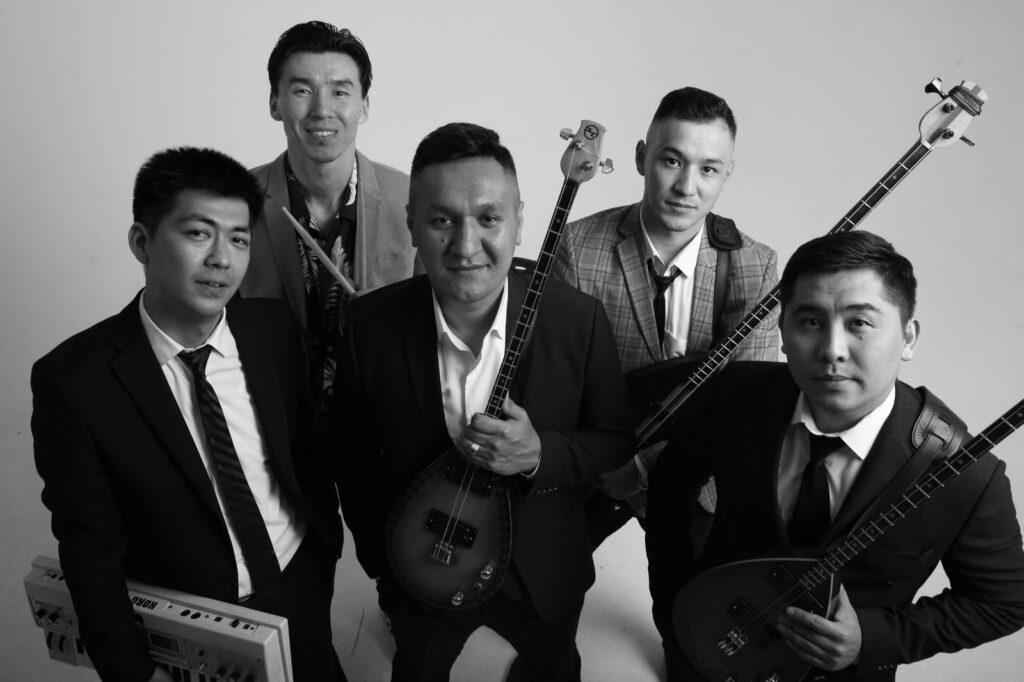
“Kazakhs, through comparison, discovered the beauty of their own instruments and compositions,” he says.
He sees the result as part of a wider cultural revival, accompanied by renewed public interest in Kazakh and Turkic history.
That observation has a visible contemporary context. Traditional instruments now coexist in Kazakhstan with rock, electronic music, world music and other hybrid forms. Almaty’s Spirit of Tengri festival, held since 2013, has developed into a major platform for contemporary ethnic and world music, bringing together performers who combine inherited musical traditions with global genres. Its 2026 edition again presented ethno-fusion and contemporary ethnic music to a large open-air audience.
Aldaspan nevertheless occupies an unusually uncompromising position within this landscape.
Rather than adding a dombra as a marker of local colour to an otherwise familiar rock sound, it asks the instrument itself to do the work normally performed by the guitar.
The resulting music becomes an argument of sorts: modernity does not necessarily require abandoning the traditional instrument.
Warriors, memory and the imagined steppe
History is as important to Aldaspan’s identity as musical technique.
Asked which historical figure most inspires him, Toishy refuses to choose one.
Instead he invokes a collection of personalities and traditions – among them the eighth-century Turkic prince Kül Tegin, Genghis Khan, commanders and warriors – that together form what he describes as a wider Turkic warrior culture.
Some of his broader historical claims go well beyond scholarly consensus, and are best understood as part of his personal interpretation of Eurasian history rather than statements of established fact.
But that worldview helps explain Aldaspan’s artistic universe.
The band is interested not only in how old music can sound through modern equipment, but in whether contemporary Kazakh popular culture can use older histories, heroes and narratives as raw material of its own.
Toishy says the Kazakh language and Kazakh musical traditions remain among the strongest elements shaping the band’s identity.
Actively combining them with contemporary genres, he believes, creates something that cannot simply be replicated elsewhere.
It is a form of cultural confidence that differs from preservation behind glass. The past becomes material to be rearranged, amplified – and distorted.
From an American dream to European festivals
For years, Toishy’s imagined destination for the band lay across the Atlantic.
“As a child I dreamed of stages in the United States,” he says.
He eventually spent six years living there. The experience changed his ambition.
Today, he wants Aldaspan to reach European rock festivals.
Toishy believes European audiences are more receptive to unusual combinations of musical cultures and genres. It is explicitly his own judgement – and one he jokingly acknowledges Americans may dislike – but he now sees Europe rather than the United States as Aldaspan’s most promising international audience.
There is something fitting about that ambition.
Aldaspan is a deeply Kazakh project created partly through encounters with music from elsewhere. Its origin story begins with a teenager in Soviet Kazakhstan hearing an American metal band and unexpectedly recognising the dombra inside it.
Nearly four decades later, Toishy still seems fascinated by the same possibility: that listeners who believe they are hearing two completely separate musical worlds may discover that the boundary between them is less obvious than expected.
For newcomers, he suggests starting with three Aldaspan tracks: Edige from Attila, El Dastan from Uly Kosh, and Turk Kultegin from Balqadisha.
Listen to those, then to an acoustic küi. Then perhaps go back to Motorbreath.
That is the comparison Toishy has been asking people to make since 1988.
And whether or not every listener hears exactly what he hears, Aldaspan has already demonstrated something else: an instrument does not have to remain sonically unchanged to carry a tradition forward.
Sometimes two strings, an amplifier and a distortion pedal are enough to make the steppe sound unexpectedly contemporary.
By Mathieu Lemoine, Editor-in-Chief for Novastan-English, based on an interview with Nurzhan Toishy.