



 In Paris, an Uzbekistani NGO’s fight against human trafficking recognised with the French Republic Human Rights Prize
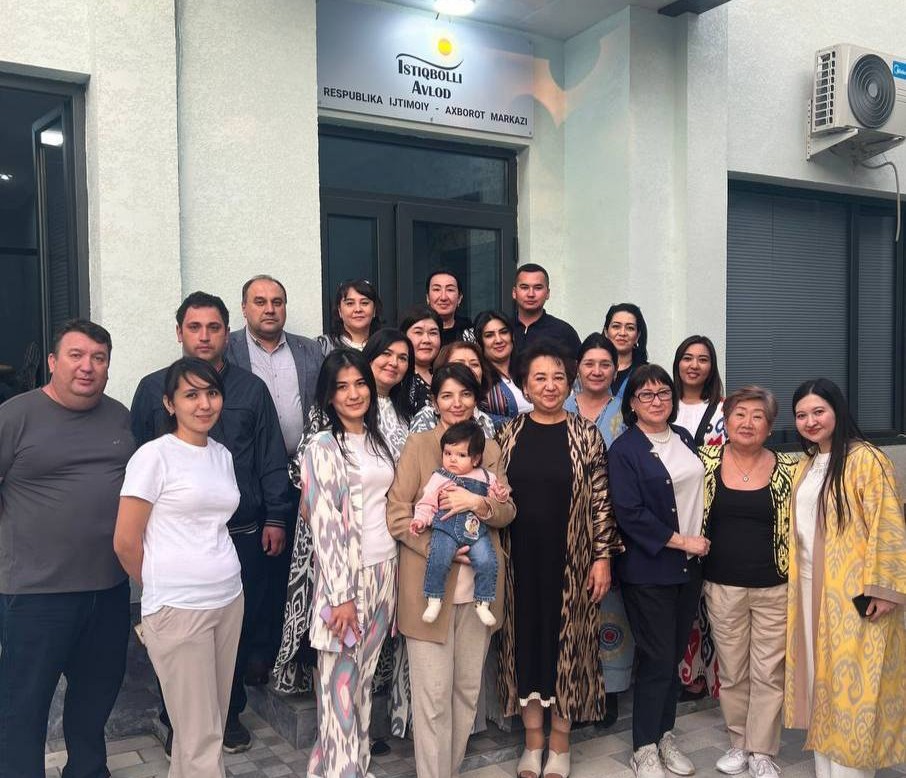
In 2025, the Uzbekistani NGO Istiqbolli Avlod received the Human Rights Prize of the French Republic. For its director, Nodira Karimova, this distinction is both an honour and a heavy responsibility. In an interview with Novastan, she discusses her fight to eradicate human and sexual exploitation affecting the most vulnerable populations, particularly in Uzbekistan.
On 10 December 2025 in Paris, the French National Consultative Commission on Human Rights (CNCDH) awarded the Human Rights Prize of the French Republic “Liberty – Equality – Fraternity” to the Uzbekistani NGO Istiqbolli Avlod. Alongside four other international organisations, the association was recognised for its commitment to fighting the exploitation and trafficking of children, whose number of victims continues to rise according to the latest United Nations data.
Istiqbolli Avlod has been fighting human trafficking since 2001, with a particular focus on children and women. Its founder and director, Nodira Karimova, emphasises that irregular labour migration, especially to Russia, Kazakhstan and Türkiye for Uzbekistani citizens, is a gateway to human trafficking.
Observing that young victims of sexual exploitation are afraid of law enforcement and distrust the justice system, the association launched the project “Child-friendly justice – Do not fear the court” to promote a fair, caring and child-sensitive judicial system.
Interview.
Novastan : In December 2025, you received the Human Rights Prize of the French Republic. What does this mean for you and your work?
Nodira Karimova : This recognition is particularly important for us. First of all, it confirms that our long-standing work in the field of human rights protection, especially children’s rights, is visible and valued not only nationally, but also internationally.
It is also a sign of trust in the principles and values on which our organisation’s work is based: protecting human dignity, access to justice and support for the most vulnerable people. It may also help strengthen the confidence of partners, state institutions and the international community in our organisation. In short, it broadens our opportunities while placing a great responsibility on us.
Does human trafficking remain a serious problem in Central Asia today, particularly in Uzbekistan?
Uzbekistan is one of the most densely populated countries in Central Asia and one of the youngest in terms of demographic composition, with a predominantly young population. While this represents significant potential for the country’s development, it is also a major challenge: according to available estimates, more than 600,000 young people enter Uzbekistan’s labour market every year, and this figure could approach one million in the coming years.
Novastan est le seul média en français et en allemand spécialisé sur l'Asie centrale. Entièrement associatif, il fonctionne grâce à votre participation. Nous sommes indépendants et pour le rester, nous avons besoin de vous ! Vous pouvez nous soutenir à partir de 2 euros par mois (défiscalisé à 66 %), ou en devenant membre actif par ici.
However, employment opportunities within the country do not always make it possible to provide jobs for all young people, especially outside the capital. Under these conditions, labour migration becomes one of the main ways for many people to earn a living. In the current situation, migration is largely unavoidable for Uzbekistan.
Despite the state’s efforts to expand access to employment, some young people without a profession or sufficient information continue to leave for work abroad informally, relying on advice from acquaintances.
Irregular migration often becomes an entry point into human trafficking and directly increases the risks of sexual exploitation for girls and women who are precarious and lack legal status abroad. Under these conditions, girls and women more often trust acquaintances or intermediaries who promise to find them a job, establish the necessary contacts and “solve all problems”, without realising the possible consequences of such offers.
It is also important to note that the risks of sexual exploitation do not exist only abroad. Sexual exploitation within the country, including the involvement and exploitation of underage girls in prostitution, also remains a serious problem and requires particular attention.
How do you interact with the authorities to combat this phenomenon? Do you consider the measures and policies adopted by the state to be effective?
Our organisation has established cooperation with state structures for more than 25 years, which has made it possible to build lasting partnerships and practical interaction. We submitted more than 20 proposals during the drafting process of the law on combating human trafficking, most of which were taken into account and included in the final version of the law.
In cooperation with the Ministries of Internal Affairs and Foreign Affairs, a referral mechanism for victims of human trafficking was created, particularly regarding their return to their country of origin and the legal assistance provided to them. We also often organise joint events, such as roundtables and conferences.
Also read on Novastan : Bilan de 30 ans de défense des droits de l’homme en Asie centrale
This cooperation is based on a series of memoranda of understanding and partnership agreements signed with key public institutions. These include the Ministry of Internal Affairs of the Republic of Uzbekistan, the Migration Agency and the Children’s Ombudsperson.
In addition, our organisation is one of the few non-governmental organisations to have signed a cooperation agreement with the Office of the Prosecutor General of the Republic of Uzbekistan. This makes it possible to establish more systematic and institutional cooperation in the areas of prevention, response and protection of victims’ rights.
It is important to note that the NGO Istiqbolli Avlod is part of the National Commission on Combating Human Trafficking and Decent Work, which enables us to take part in discussions on public policy, make proposals and raise issues based on our field experience. This helps establish dialogue between the state and civil society.
Do you consider the measures and policies adopted by the state to be effective?
The adoption of several legal documents, including the law on combating human trafficking, has been very important because they provide a normative basis. However, adopting laws is only the first step. The main challenge today is to move from regulation to the effective implementation of decisions, especially at the regional and local levels. In other words, the laws exist, but it is essential that they actually work in practice.
To what extent do geopolitical tensions and recent conflicts influence human trafficking?
From our organisation’s perspective, geopolitical tensions and armed conflicts have a direct impact on migration and, consequently, on the dynamics of trafficking. One of the most significant factors in recent years has been the war in Ukraine, which has changed traditional labour migration routes from Central Asia to Russia, including for Uzbek citizens.
Also read on Novastan : En Ouzbékistan, l’origine des transferts de fonds depuis l’étranger se diversifie
We are seeing more and more migrants choosing Türkiye as an alternative destination, for several reasons, including cultural, religious and linguistic proximity, as well as the possibility of visa-free stays for 90 days. However, many arrive without knowing the existing legislation on employment and the legality of their stay, and continue working informally after their permitted stay expires. Under these conditions, migrants often find themselves without legal protection and become vulnerable to exploitation, including sexual exploitation. The risk is particularly high for women.
What are the main profiles of victims?
In cases of sexual exploitation, the victims are often women aged between 25 and 35. Many of them are divorced women with children, who are also responsible for elderly parents. Economic pressure increases their vulnerability.
Their level of education is usually fairly modest. Women with higher education are very rare among the victims.
As for minors, many come from socially vulnerable families. It often happens that their parents are themselves abroad as labour migrants, or that the children have grown up without parental support.
For men who are victims of labour exploitation for economic purposes, they are generally men aged between 19 and 45, often from large families and rural areas, with little vocational training. They go abroad to provide for their families and may find themselves in situations of forced labour, restrictions on their freedom or debt bondage.
Are people in Central Asia more exposed to trafficking within the region or abroad?
Cases within countries also exist, particularly in terms of sexual exploitation involving minors, but they remain difficult to measure because many remain hidden. The phenomenon is both internal and transnational, but the risks linked to international migration are the most frequent.
Has the withdrawal of foreign funding from the United States and support for official development assistance, decided by President Donald Trump in early 2025, affected you?
Yes, these changes have had a significant impact. For many years, the US Department of State and the United States Agency for International Development (USAID) were among the main donors supporting the fight against trafficking in Uzbekistan. These funds were used, for example, to finance the hotline and legal assistance for victims. Today, the reduction in international funding has made it more difficult to maintain these services.
Also read on Novastan :Les conséquences de l’arrêt de l’USAID en Asie centrale
The annual US report on human trafficking also played an important role in encouraging states to improve their policies. Unfortunately, today there are no longer any major active international projects in this field in Uzbekistan, which forces our organisation to seek new sources of funding.
How is regional cooperation evolving in Central Asia?
In recent years, Central Asian countries have shown greater cooperation and regional partnership. However, in practice, migration and human trafficking issues do not yet seem to occupy a central place on the common agenda.
From the point of view of NGOs, concrete cooperation remains limited and has often been linked in the past to projects run by international organisations.
Which achievements are you most proud of?
We are particularly proud to have publicly raised the following issue: a child must not be alone during an investigation or trial. We have shown that legal and psychological support for child victims is not only possible, but necessary.
This practice has become an integral part of our work and can be considered a good practice at the international level.
One of the most memorable moments was when, after a trial, a minor said: “This is the first time I feel that I am being believed”. At that moment, it became clear that our work is not only about legal protection, but also about restoring dignity and a sense of safety.
Why are children afraid to speak out?
This fear often results from a combination of factors: the family’s reaction, social stigmatisation, distrust of the police and threats from exploiters.
In some families, the police are perceived as a threat rather than as protection. Children grow up with this fear, while exploiters also use blackmail and the victims’ sense of shame to maintain control over them.
Also read on Novastan :La souffrance silencieuse des belles-filles en Ouzbékistan
A genuinely child-sensitive pathway begins with the family’s reaction. Adults must respond with support and seek to protect the child. From the first contact with the authorities, the child must be accompanied by a lawyer and a psychologist. Interviews should never take place without these specialists.
How do you identify children at risk when exploitation is hidden?
Identifying children at risk is one of the most difficult aspects of our work, especially when exploitation is concealed, for example through online recruitment, informal networks or cross-border movements.
We regularly organise information activities in neighbourhoods, known as mahallas in Uzbekistan, where we meet parents, teenagers and representatives of local communities. Particular attention is paid to the hotline, and we widely disseminate information about it so that children and families know where to seek help.
Also read on Novastan : En Ouzbékistan, une justice clémentes sur les violences sexuelles
We also distribute information materials in busy places, such as schools, medical facilities and public spaces. We hand out flyers and cards with the organisation’s contact details and organise information meetings and prevention discussions. But given the scale and hidden nature of the problem, we know that these efforts remain insufficient.
We also organise training for law enforcement agencies. However, there is an objective difficulty: high staff turnover. Officers often change and information work has to start again.
In practice, one of the most effective mechanisms remains word of mouth. Often, it is former beneficiaries or their families who pass on the information.
What kind of support is needed beyond the trial?
The trial is only one stage. After it, the child’s life continues, and this is where comprehensive support is essential. The first priority is to ensure the child’s own safety, which means not leaving them in an environment where there remains a risk of violence or pressure. In some cases, temporary accommodation in a safe place is necessary.
The second key element is psychosocial support, with long-term psychological assistance: working on self-esteem, guilt, feelings of shame and rebuilding trust.
Work with the family is also essential. Parents themselves may be in a state of shock or confusion. Then come the return to school, post-trial legal assistance, for example to obtain compensation, protect personal data or avoid further proceedings.
The main difficulty concerns the funding of long-term psychosocial support. A trial has clear timeframes, but rebuilding a child’s life can take years. Yet this type of support is the most difficult to finance and coordinate.
Want more Central Asia in your inbox? Subscribe to our newsletter here.
After this prize, what are your priorities?
It is difficult to identify a single priority, because protecting children requires a comprehensive approach: prevention, legal support, training of professionals and interinstitutional coordination.
In the current context, one of our priorities is to find sustainable sources of funding in order to maintain and develop the mechanisms already in place.
If we had to name one reform we would like to see progress over the next 12 months, it would be the implementation of a mandatory interinstitutional protocol for cases involving child victims, with the guaranteed participation of a lawyer and a psychologist.
At the same time, we believe it is necessary to strengthen public information: to explain clearly that a child must never be alone in court. The mandatory participation of a lawyer and a psychologist must be seen not as an additional measure, but as a fundamental guarantee of children’s rights.
Emma Collet and Mathieu Lemoine,
Contributors for Novastan
Translated from French by Maya Ivanova
Thank you for reading this article! If you have time, we would appreciate your feedback, either through this anonymous form or by email at editorial@novastan.org. Thank you very much!