





 “A public lesson to everybody”: Kazakhstan convicts feminist and LGBTI rights activist Zhanar Sekerbayeva
Support Novastan, the European Central Asia magazine
By supporting Novastan, you are supporting the only English, French and German-language media specialising in Central Asia. We’re independent and we need your help to stay that way!Kazakhstani feminist and LGBTI rights activist Zhanar Sekerbayeva was convicted of battery after a confrontation in Astana in November 2025. She says the prosecution was retaliation for her activism and part of a wider deterioration in the rights of LGBTI people in Kazakhstan.
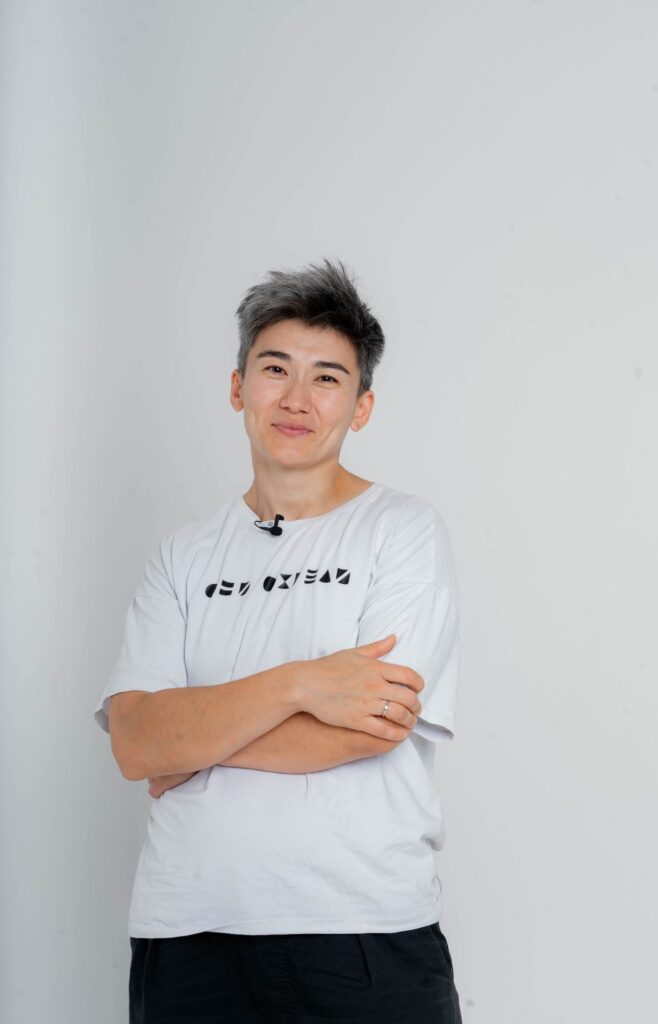
“They said to me, ‘It will be hooliganism. Don’t worry, Zhanar. We just want to get rid of you,’” says Zhanar Sekerbayeva, a Kazakhstani feminist and LGBTI rights activist, and co-founder of the feminist initiative Feminita.
She was describing to Amnesty International what police officers allegedly told her after she and fellow LGBTI rights activists were harassed at a café in Astana in November 2025.
What Sekerbayeva initially understood would be treated as an administrative case instead became a criminal prosecution against her.
“Somebody decided it would not be an administrative offence, but a criminal one, because I think it was some kind of last opportunity for them before the amendments [to the so-called LGBTI propaganda law] came into force,” she says. “They needed a public lesson, a public lesson to everybody.”
On 22 April 2026, a criminal court in Astana found Sekerbayeva guilty under Article 109-1, Part 1 of Kazakhstan’s Criminal Code of “battery or other violent acts causing physical pain but not causing minor injury to health”.
She was fined around 178,000 Kazakhstani tenge, approximately US$380.
From harassment to prosecution
On 22 November 2025, Sekerbayeva and several friends and fellow activists gathered for a private lunch on the second floor of a café in Astana.
For security reasons, the venue’s exact address had been withheld publicly and shared only in private messages with trusted guests.
Yet a woman who had disrupted an expert roundtable on gender issues organised by the Education Community in Astana the previous day found the group there. Accompanied by several unidentified people, she began filming those present without their consent and loudly accused them of spreading “LGBT propaganda”.
When Sekerbayeva and her companions tried to leave, the woman blocked the staircase. After they eventually reached the exit, she obstructed their path again. Witnesses, including diners at nearby tables, later described how the woman physically prevented the group from leaving.
Sekerbayeva had previously survived two violent attacks in Shymkent and Qaragandy in 2021. She says the Astana confrontation left her in severe shock.
But it was Sekerbayeva, rather than the woman who had confronted the group, whom police subsequently pursued.
According to Sekerbayeva, officers followed her from one café to another and then to a shop, where she locked herself in a restroom. She says officers threatened to break down the door.
Sekerbayeva and her colleague Temirlan Baimash were eventually taken to a police station and held for around three hours before being released without formal charges.
Three days later, Sekerbayeva filed a written complaint describing the incident as unlawful stalking.
Police opened a preliminary inquiry but closed it only a few days later, characterising what had happened as no more than a “verbal conflict” that had caused no “substantial harm”.
A second complaint filed by Sekerbayeva on 12 February 2026 was rejected on similar grounds.
By contrast, a complaint against Sekerbayeva’s group was pursued and became the basis of a criminal case for battery.
From witness to sole defendant
By February 2026, Sekerbayeva had gone from being a witness to an accused person and ultimately became the sole defendant in the case.
An indictment approved on 27 March repeatedly described her and her companions as “persons disseminating information prohibited from dissemination on the territory of the Republic of Kazakhstan”.
That language reflected provisions contained in Kazakhstan’s March 2026 law banning so-called “LGBT propaganda”, although the law had not yet entered into force when the café incident took place in November 2025.
The proceedings initially involved three members of Sekerbayeva’s group, but the case eventually narrowed until she was the only person facing prosecution.
At trial, the prosecution relied largely on the complainant’s testimony, which Sekerbayeva says changed in detail over the course of the proceedings, as well as testimony from two witnesses.
According to the case material reviewed for this article, none of the available recordings – including footage from the complainant’s phone and from phones belonging to people accompanying her – show Sekerbayeva striking anyone. Sekerbayeva says the café itself had a surveillance camera, although without audio, and that police relied on only a short segment that did not show the complainant entering or the beginning of the confrontation.
The prosecution’s forensic medical report documented a single bruise on the complainant’s upper arm, which was classified as falling below the threshold of “light harm to health”.
“I should be equal in this case. I should be investigated equally with [her]. No, it was never equal. Never,” Sekerbayeva says.
Her lawyers argued that the prosecution amounted to retaliation for her human rights work and her sexual orientation.
The court rejected this interpretation.
“The defendant’s arguments about alleged persecution on political motives, as well as on the basis of her belonging to LGBT, are a method of defence and are refuted by the case materials,” the judgment stated.
The case materials nevertheless contain explicit references to Sekerbayeva’s LGBTI activism. In statements to police, the complainant repeatedly described her as an activist engaged in “LGBT propaganda”.
A conviction upheld on appeal
On 22 April 2026, the court found Sekerbayeva guilty.
She appealed, but on 2 June the Astana City Court upheld the conviction in full, finding that the original verdict had been “comprehensively, fully and objectively” substantiated.
The decision took effect immediately.
Sekerbayeva had anticipated the outcome.
“We believe the appeal court will likely uphold the lower court’s ruling,” she said before the decision. “We want to exhaust all avenues for defending our rights at the local level before moving to the international stage.”
LGBTI rights under growing pressure in Kazakhstan
The case has unfolded against a broader deterioration in conditions for LGBTI people and human rights defenders in Kazakhstan.
In late 2025, following a 2024 petition signed by 50,000 people demanding restrictions on public LGBTI representation, Kazakhstan’s parliament passed legislation banning the “propaganda of non-traditional sexual orientation and paedophilia” in the media and online.
The law was signed in December 2025 and entered into force in March 2026.
Read more on Novastan: Queer life under pressure in Kyrgyzstan
The legislation has drawn comparisons with Russia’s 2013 anti-LGBTI “propaganda” law, which international human rights bodies have repeatedly found incompatible with fundamental rights.
Amnesty International warned before the Kazakhstani legislation was adopted that such restrictions would further entrench stigma, fear and censorship.
The measure followed earlier discriminatory changes. In 2024, for example, Kazakhstan barred LGBTI people from adopting or mentoring orphans.
Read more on Novastan: When Freedom of Speech Is a Joke: Author of a Satirical News Outlet Detained in Kazakhstan
Further restrictions were incorporated into the new Constitution adopted on 15 March 2026, which defines marriage exclusively as a union between a man and a woman.
Critics also argued that the constitutional process lacked inclusive public consultation and meaningful participation by independent civil society.
The Constitution permits broader restrictions on freedom of expression, association and peaceful assembly on the basis of concepts including “constitutional order” and “public morality” – terms human rights advocates fear could be interpreted expansively.
Feminita under pressure
The case file identifies Sekerbayeva as director of Feminita, the feminist initiative for lesbian, bisexual, queer and trans women that she co-founded with fellow activists.
Feminita is one of the few organised LGBTI groups operating openly in Central Asia.
Kazakhstani authorities have repeatedly refused to register the organisation since it first applied for legal recognition in 2017.
Days before the November 2025 confrontation in Astana, Feminita had organised, funded and hosted a strategic meeting in Almaty bringing together LGBTI activists from across Kazakhstan to discuss how their work could continue under the impending “propaganda” law.
“Feminita was one of the organisers who found money, who rented a hotel and actually found the platform,” Sekerbayeva recalls. “We invited everybody, even the people who are in conflict with us.”
She says the organisation’s visibility has made both her and her colleagues targets for years.
In 2018, Sekerbayeva was arrested and convicted of “petty hooliganism” for taking part in a photoshoot challenging stigma surrounding menstruation.
In 2021, a Feminita event in Shymkent was violently disrupted by a group of men. Sekerbayeva says she was dragged by the hair and punched in the face.
She also served ten days of administrative detention following a 2025 protest against femicide.
Read more on Novastan: Women’s Day in Kazakhstan: hundreds gather for rally in Almaty
During the hearings in her latest case, Sekerbayeva says anonymous and newly created social media accounts repeatedly portrayed her as guilty and deserving of punishment.
Her mother, a paediatrician in Astana, has told her that she is too afraid of possible professional repercussions to attend the hearings.
Adapting activism under the new law
Rather than suspending its activities altogether, Feminita has adapted its public presentation.
We work on the protection of LGBT women’s rights and researchers, mobilisation of community, while also integrating feminist business ideas and eco-feminist activities into our strategic framework.”
“I just want people to see it was a political case”
Asked what justice would mean to her, Sekerbayeva says she is not seeking revenge.
“For now, for me, justice would mean reopening the case and showing that it was not correct to charge me,” she says.
“They should hold to account not only the provocateur, but also the police, the prosecutor’s office, the Committee of National Security and the akimat [local council]. Everybody should be named for how they did this provocation.”
“I don’t need apologies from them. I just want people to see it was a political case, and to see how it was created.”
Her expectations stretch beyond the immediate legal process.
“Even if I will not be alive,” she adds, “I think there will come a time when everything will be reinvestigated again. And I really believe that time will come.”
It would not be the first time Sekerbayeva has turned the label of “hooligan” back on the authorities.
Speaking to Amnesty International in 2019 after an earlier conviction for hooliganism, she said:
“Being a woman human rights defender is much more important – even if that makes me a ‘hooligan’ in the eyes of the authorities.”
By Vahid Aliyev, Global Civic Space Fellow at Amnesty International.