




 From Bukhara to Queens: The Global Journey of the Bukharan Jews
Support Novastan, the European Central Asia magazine
By supporting Novastan, you are supporting the only English, French and German-language media specialising in Central Asia. We’re independent and we need your help to stay that way!In Queens, a few words can contain the history of an entire community. A guest may be welcomed with xush omaded, an expression immediately recognisable to Tajik speakers. At the table may be osh, the regional rice dish better known internationally as plov, while grandparents move between Bukhori and Russian and their grandchildren answer in English.
The scene belongs unmistakably to New York. Its vocabulary, food and social rhythms, however, lead back to Bukhara, Samarkand, Tashkent and Dushanbe.
Read more on Novastan: How Central Asia became home for the Koryo-Saram
Over the final decades of the Soviet Union and the turbulent years that followed its collapse, most Bukharan Jews left Central Asia. Large communities developed abroad, most visibly in the New York neighbourhoods of Forest Hills and Rego Park. Others took root in Vienna, Toronto and a number of smaller centres. The result is an unusual geographical reversal: a culture bearing the name of Bukhara now has some of its most dynamic institutions thousands of kilometres away from the city itself.
Novastan has previously explored the debated origins of the Jewish presence in Central Asia and the historical importance of Bukhara and Khwarezm. The contemporary story begins where those histories leave off. How does a community remain Bukharan after leaving Bukhara? And what links do Bukharan Jews still maintain with the Central Asian societies from which they emerged?
A community whose centre moved
Despite their name, Bukharan Jews did not come exclusively from Bukhara. Communities developed across the territories that today constitute Uzbekistan and Tajikistan, with important centres in Samarkand, Tashkent, Kokand, the Ferghana Valley and Dushanbe. “Bukharan” gradually became a collective designation for a wider Central Asian Jewish civilisation shaped by Persian-speaking urban culture, Jewish religious traditions and long interaction with Uzbek, Tajik and other neighbouring populations.
Migration began well before the Soviet collapse, but accelerated dramatically from the 1970s onwards. By the 1990s, the economic uncertainty accompanying independence, the weakening of Soviet-era professional and social structures, and the opportunity to reunite with relatives abroad encouraged much of the remaining population to depart.
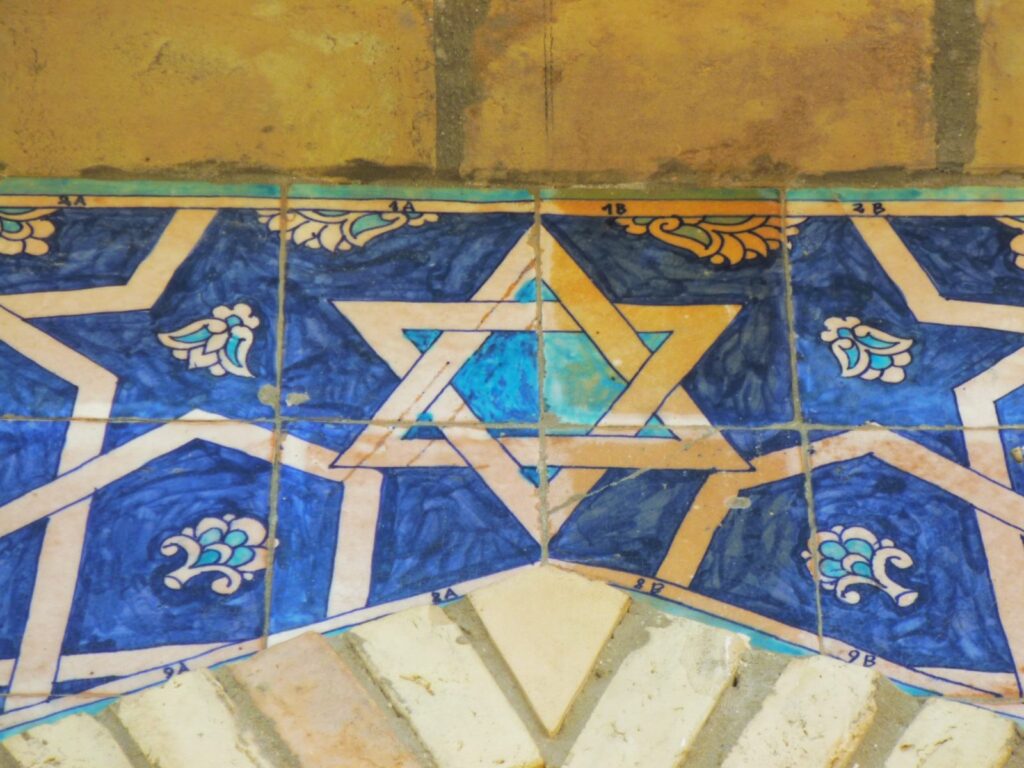
The community did not simply disperse. In several cities, Bukharan Jews recreated dense networks of synagogues, schools, businesses, newspapers, restaurants, cultural organisations and family associations. Queens became the most visible North American example: a place where Central Asian food, music and communal life remained present not only inside private homes, but in streets, shops, banquet halls and religious institutions.
Bukhara had not been reproduced exactly. The new community was increasingly American, urban and outward-looking. Yet it retained practices and relationships that distinguished it from both the surrounding population and other Jewish communities.
Bukhori: a Central Asian language abroad
Perhaps no element expresses this complicated identity better than Bukhori, also called Bukharian or Judeo-Tajik.
Bukhori belongs to the Iranian family of languages. It is closely related to Tajik and, more distantly, to modern Persian. It developed among the Jewish communities of Central Asia, incorporating Hebrew and Aramaic terms associated with religion and communal life, while also absorbing vocabulary and influences from Uzbek and, during the Soviet period, Russian.
To a Tajik speaker, much of Bukhori may sound familiar. Words connected with everyday life, hospitality and family reflect a shared Persian linguistic environment. But religious vocabulary, pronunciation, expressions and the historical experience carried by the language make it distinct.
Read more on Novastan: Les Juifs de Boukhara : comment sont-ils arrivés en Asie centrale ?
Everyday Bukhori contains many words immediately recognisable to Tajik and Persian speakers. A guest may hear xush omaded, “welcome,” while osh evokes both the wider Central Asian rice tradition and specifically Bukharan Jewish dishes such as oshi sabo. Such vocabulary reflects the community’s roots in a Persian-speaking Central Asian environment. Its specifically Jewish dimension is more apparent in religious terminology derived from Hebrew and Aramaic, although the precise vocabulary and pronunciation vary between speakers and communities.
Bukhori’s alphabets tell another story. It was traditionally written in Hebrew characters. Soviet language reforms subsequently introduced Latin and then Cyrillic scripts. Today, the language may appear in Hebrew, Cyrillic or adapted Latin spelling, depending on the speaker, country and intended readership.
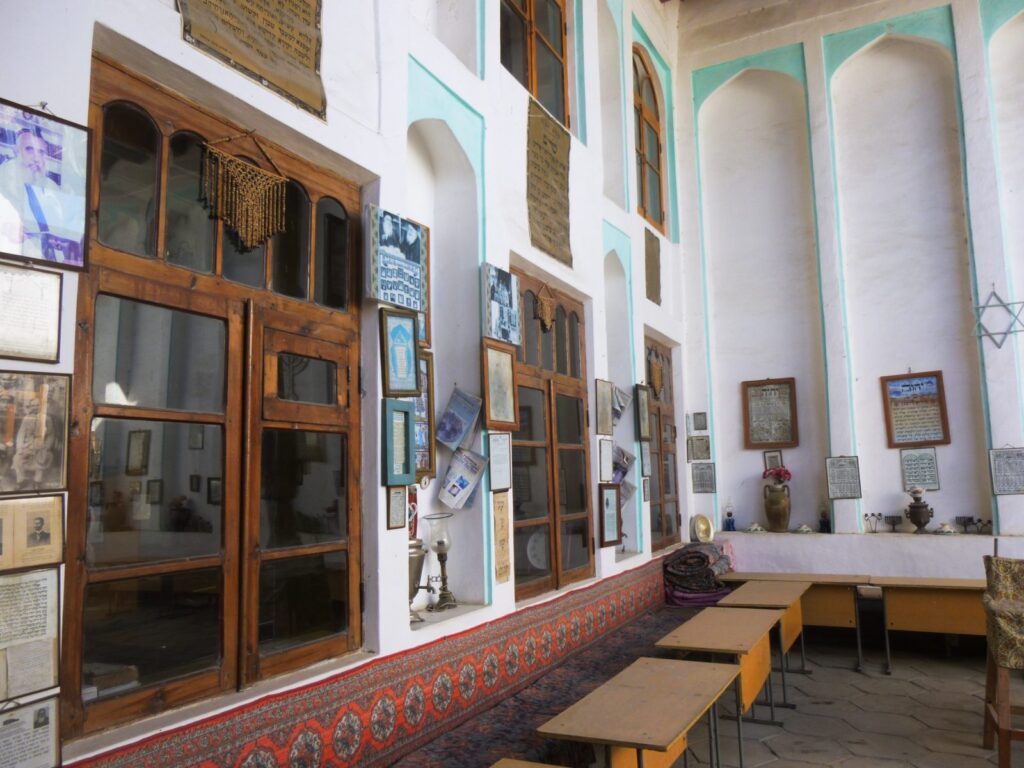
Each script points towards a different cultural horizon: Hebrew towards Jewish religious and literary life, Cyrillic towards the Soviet experience, and Latin increasingly towards younger generations living in English-speaking countries. The lack of a single universally accepted contemporary spelling system also complicates efforts to teach the language.
Bukhori remains spoken, particularly among older and middle-aged members of the community. But it is considered endangered. Migration has strengthened Bukharan communal identity in some respects while weakening the transmission of its traditional language. In Queens, children may grow up surrounded by Bukharan food, weddings, religious institutions and family networks without becoming fluent Bukhori speakers. Russian may remain the language used with parents and grandparents, while English dominates education, work and friendships.
This produces one of the central paradoxes of the modern diaspora: Bukharan identity may be surviving more successfully than Bukhori.
Language loss does not automatically mean the disappearance of the community. A person can identify strongly as Bukharan through family, religion, food, music and social relationships. Yet language carries forms of humour, intimacy and memory that are difficult to reproduce through translation. When grandparents speak Bukhori but grandchildren understand only fragments, more than vocabulary is lost. A particular way of describing Central Asian Jewish life begins to recede.
The question is therefore not simply whether Bukhori will survive. It is also what being Bukharan will mean if it does not.
Queens: a new Bukhara?
Forest Hills and Rego Park are sometimes described as a “new Bukhara.” The expression is evocative, but incomplete.
Queens did not preserve Bukharan culture in a frozen form. It transformed it. Religious practices changed in contact with other Jewish traditions. Businesses adapted to the opportunities and demands of New York. Young people combined family expectations with American education and professional life. Community institutions became more formalised, visible and politically engaged.
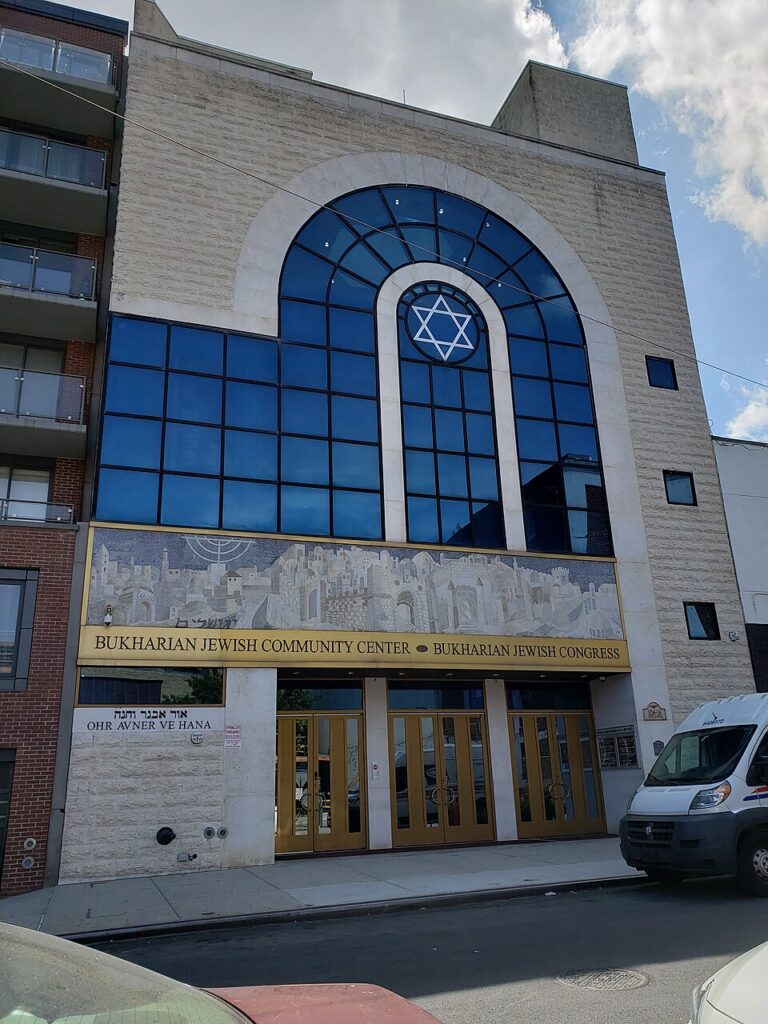
Nevertheless, the density of Bukharan life remains remarkable. Synagogues and schools coexist with restaurants, food shops, newspapers, wedding halls and social organisations. Weddings and religious celebrations bring together extended families and reinforce connections that can also support professional advancement, philanthropy and mutual assistance.
The community’s economic visibility has sometimes encouraged outsiders to describe Bukharan Jews principally through wealth or influence. Such language requires caution. It can reproduce old stereotypes about Jews, money and hidden power while obscuring the ordinary work through which immigrant communities build stability.
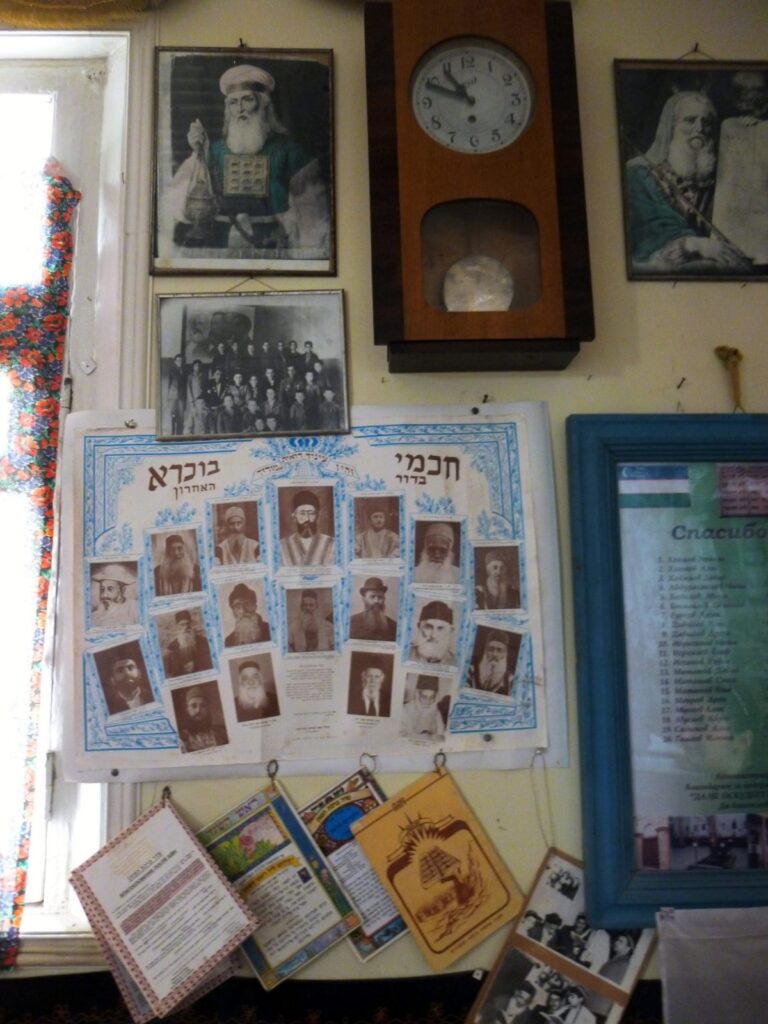
The more interesting story is institutional. Bukharan Jews in Queens developed strong family and community networks, created businesses, funded religious and cultural organisations and became active in local civic life. Their prominence is less a mystery than the result of geographic concentration, entrepreneurship, mutual support and sustained investment in communal institutions.
Elements of Central Asian social organisation also travelled with them. Family reputation, obligations between relatives, elaborate hospitality and neighbourhood-based mutual assistance recall aspects of the mahalla, the local community structure found across Uzbekistan and Tajikistan. These practices have inevitably changed in New York, but they have not disappeared.
Queens is therefore not a replica of Bukhara. It is a new diaspora city in which selected elements of Central Asian life have been reorganised to meet American conditions.
Vienna: a Central Asian Jewish crossroads
Vienna offers a different version of the Bukharan Jewish journey.
The Austrian capital became an important transit point for Jews leaving the Soviet Union during the 1970s. Many continued towards other destinations, but some Bukharan Jewish families remained. Over time, they created one of the most substantial and active Bukharan communities in Europe.
The city now contains Bukharan synagogues, religious and social organisations, businesses and cultural initiatives. Bukhori and Russian continue to be used among parts of the community, while German increasingly dominates among younger generations. Research on Bukharan Jews in Vienna describes a community shaped simultaneously by Central Asian origins, Soviet migration, Jewish religious life and integration into a German-speaking European city.
Vienna’s experience resembles Queens in some respects, but differs in scale and urban setting. Its community is smaller and exists within a European Jewish landscape marked by its own historical sensitivities. It also remains geographically closer to the former Soviet world, potentially facilitating travel and continued personal connections.
Here too, language is an indicator of generational change. Older residents may move between Bukhori and Russian. Their children and grandchildren increasingly use German. The community remains visible, but the balance between religious affiliation, family heritage and specifically Central Asian culture is continually renegotiated.
Toronto: preserving culture through organisation
Toronto represents a third model.
Its Bukharan Jewish population is smaller and less geographically concentrated than that of Queens. The Jewish Bukharian Community of Toronto was formally established in 2003, building on earlier efforts to bring together families dispersed across the Greater Toronto Area. Cultural preservation was explicitly presented as part of its mission.
A smaller community cannot rely on neighbourhood concentration alone. Maintaining cultural life requires deliberate organisation: religious services, family gatherings, youth programmes, celebrations and spaces in which people can meet others with the same background.
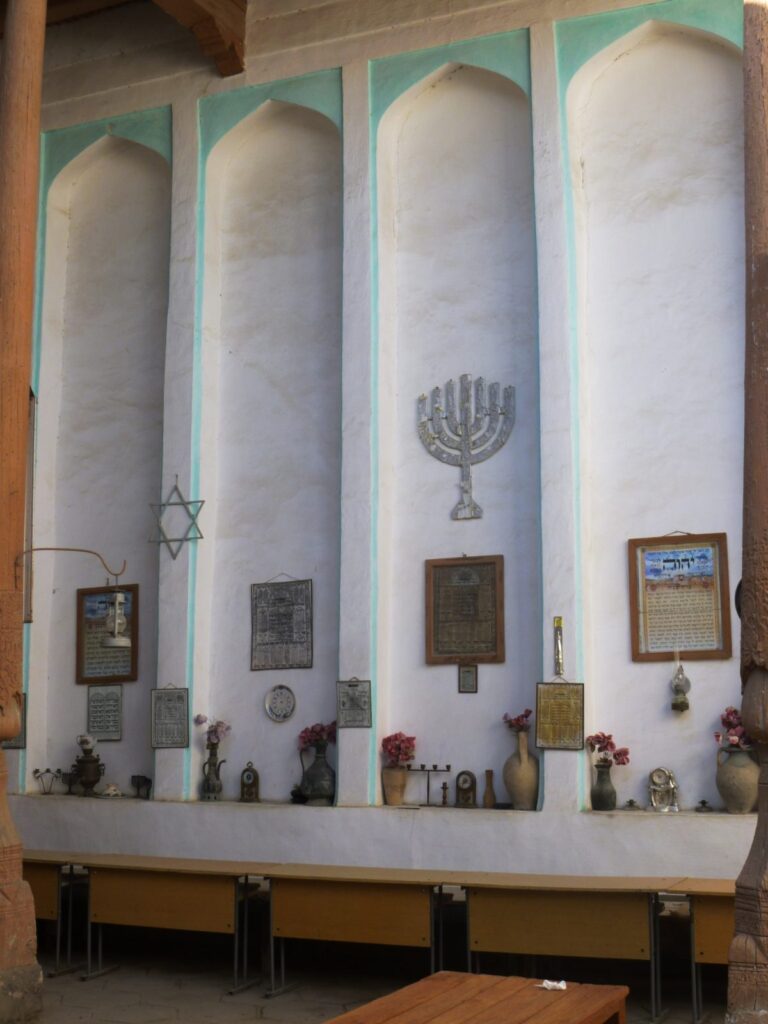
This may make cultural preservation simultaneously more fragile and more conscious. In Queens, Bukharan identity can be reinforced through daily proximity. In Toronto, it may depend more heavily on people choosing to participate.
This is not a contradiction. It is the normal result of a history marked by migration, coercion and adaptation.
Vienna and Toronto therefore broaden the story beyond a simple journey from Uzbekistan to New York. They show that there is no single Bukharan diaspora experience. The survival of language and culture depends on community size, urban geography, religious institutions, migration history and the language of the surrounding society.
Is Central Asia still a homeland?
For the first generation of migrants, Uzbekistan or Tajikistan may remain associated with childhood, education, neighbours and professional life. For their descendants, Central Asia is more likely to be encountered through family stories, food, music, photographs and occasional journeys.
Diaspora visits to Bukhara and Samarkand often include former homes, synagogues, schools and cemeteries. These are not always journeys towards a place of possible return. They are journeys towards evidence: proof that the family history described by parents and grandparents belonged to real streets and neighbourhoods.
Read more on Novastan: Khwarezm et Boukhara, deux foyers anciens des Juifs d’Asie centrale
This raises a subtle distinction. Central Asia can remain emotionally important without functioning as a contemporary homeland. Bukhara may be remembered as a place of coexistence, hospitality and belonging, even when the family’s departure was driven by uncertainty or the conviction that its future lay elsewhere.
The process can also idealise the past. Nostalgic accounts may emphasise close relationships with Muslim neighbours and minimise discrimination, political restrictions or the difficulties of late Soviet and post-Soviet life. Other families may remember exclusion and see departure as liberation rather than loss.
There is no single Bukharan Jewish memory of Central Asia. The diaspora contains different generations, migration routes and political experiences.
A living community or a heritage landscape?
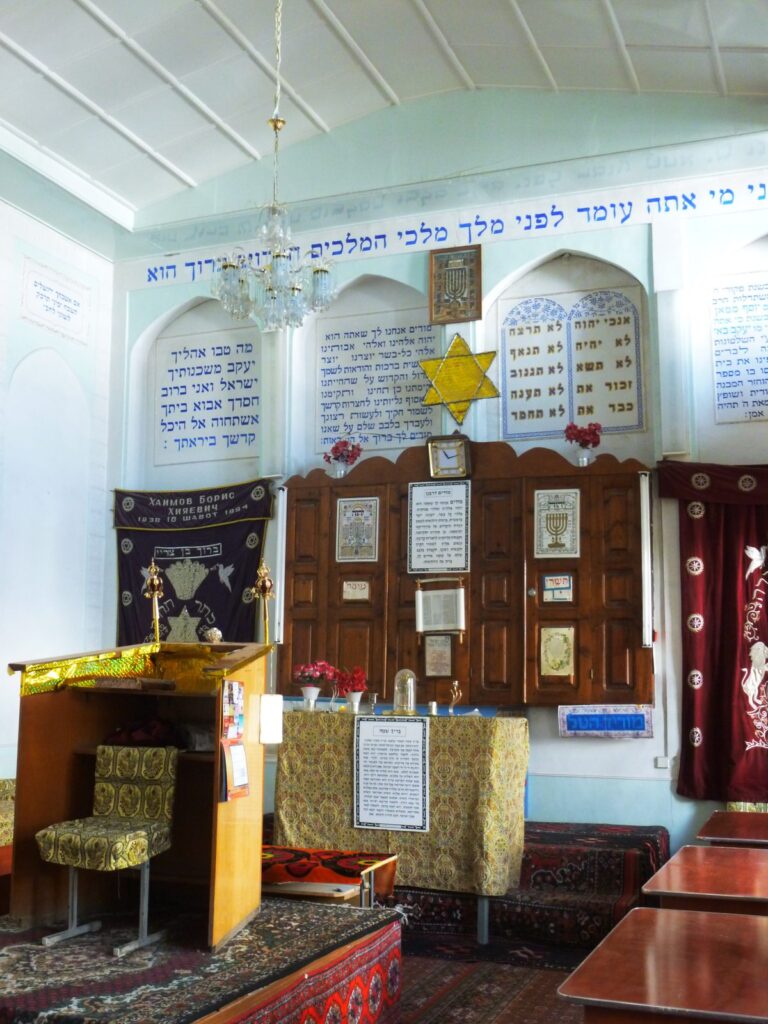
Jewish life has not completely disappeared from Uzbekistan. Synagogues and small communities remain, including in Tashkent, Samarkand and Bukhara. But the demographic contrast is striking: the historic centres now contain only a fraction of the population found in diaspora cities.
This creates a risk that Jewish life in Central Asia becomes treated principally as heritage.
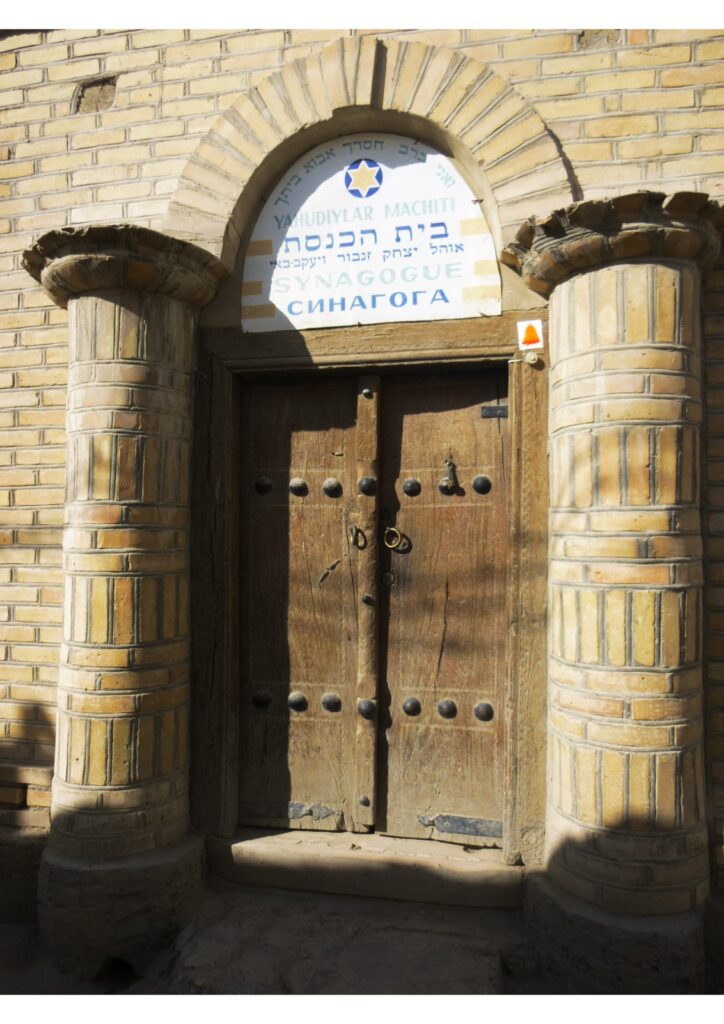
The old Jewish quarter of Bukhara, its synagogues, cemeteries and traditional houses attract visitors and preservation initiatives. The city’s Jewish houses form part of Bukhara’s distinctive architectural landscape, although many have changed ownership or function. Some have become guesthouses, workshops or tourism businesses.
Preservation is necessary, but it raises difficult questions. Who determines how the history of a departed community is presented? Do restored buildings communicate the complexity of Jewish life, or merely provide an attractive setting for tourism? What remains of a neighbourhood when its architecture survives but most of its former inhabitants live abroad?
The remaining Jewish residents should not be reduced to guardians of monuments. Their lives, concerns and choices are part of the contemporary story. Their relationship with the diaspora may include family contacts, religious support, philanthropy and visitors, but it may also contain differences of perspective. Those who stayed did not experience the same transformation as those who rebuilt their lives abroad.
Uzbekistan rediscovers its diaspora
The relationship is not maintained only through private memory. Uzbekistan has increasingly engaged Bukharan Jewish communities abroad as part of its cultural diplomacy.
Official and academic initiatives have highlighted the historical contribution of Jews to Central Asian society. A major conference on Bukharan Jewish heritage was held at Samarkand State University in September 2025. In February 2026, another conference examined the role of Bukharan Jews in the region’s socioeconomic and cultural life, including diaspora investment, tourism and educational exchange.
For Uzbekistan, the diaspora offers several potential advantages. Bukharan Jews can promote the country as a tourist destination, support heritage projects, facilitate business contacts and reinforce an international narrative of religious coexistence.
For the diaspora, official recognition may validate a history that was sometimes marginalised. It may also create opportunities to protect cemeteries, synagogues and family heritage.
But the relationship should not be romanticised. State-sponsored celebration of Jewish history can serve contemporary political objectives. It allows Uzbekistan to present itself internationally as tolerant, open and connected to a successful global diaspora. The decisive question is whether this engagement also supports the remaining local community and permits complex discussion of the past.
Bukharan Jews may be approached as former citizens, cultural ambassadors, investors, tourists or intermediaries. They may see themselves in all of these roles – or reject some of them.
Can Bukhara survive outside Bukhara?
The Bukharan Jews remain a meaningful community. Their institutions are active, their family and religious networks are visible, and their cultural traditions continue to distinguish them across several countries.
But what is being preserved is changing.
Bukhori is weakening even where Bukharan identity remains strong. Central Asia is becoming, for many younger members of the diaspora, an inherited landscape rather than a lived one. Cuisine, weddings and family solidarity may survive more easily than language. Religious identity may grow stronger even as specifically Central Asian knowledge recedes.
The Bukharan Jewish story is therefore not simply one of disappearance or successful preservation. It is a story of selection. Every generation decides, consciously or otherwise, which elements of Bukhara to carry forward.
In Queens, Vienna and Toronto, the answer is still being negotiated – between Bukhori and English, Russian and German, memory and modernity, inherited obligations and individual choices.
Most Bukharan Jews no longer live in Central Asia. Yet they remain one of Central Asia’s most distinctive communities abroad. Their global journey has not ended their relationship with the region. It has transformed Bukhara from a place into a language, a family memory, a social world – and a question passed from one generation to the next.
Mathieu Lemoine, Editor-in-Chief for Novastan-English